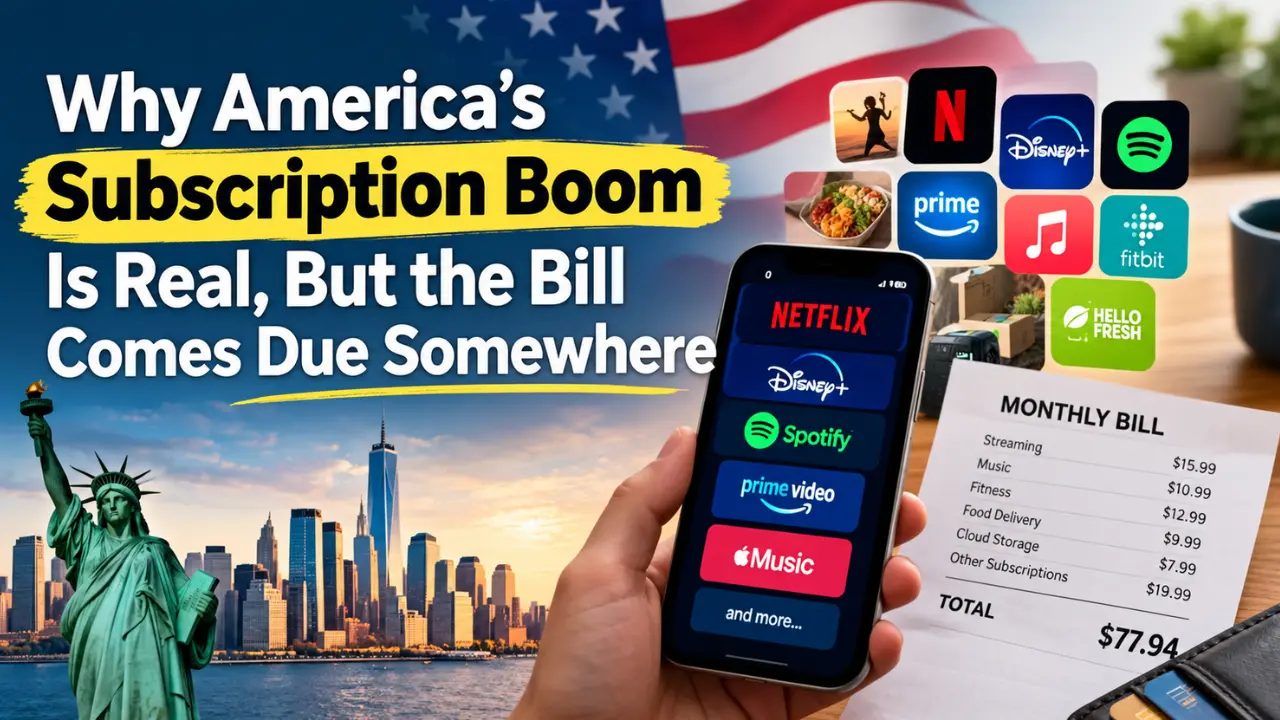
Why America’s Subscription Boom Is Real, But the Bill Comes Due Somewhere
What DoorDash’s DashPass and Duolingo’s Pricing Pivot Reveal About the True Cost of Recurring Revenue
Two American companies show what subscription revenue looks like when it scales, and what it costs along the way. DashPass, DoorDash’s membership program, now anchors a business that just crossed $13.7 billion in annual revenue. Duolingo turned a free language app into a billion-dollar subscription business by layering in a premium tier instead of relying on one flat price. Both are held up as proof that the subscription business model works in the US market. Both also carry costs that founders planning a recurring revenue strategy need to model before they launch.
DashPass: Frequency Over Margin
DashPass exited 2024 with roughly 22 million subscribers, and by the end of 2025 that had grown to about 35 million paid members across DashPass, Wolt+, and Deliveroo Plus. DoorDash’s own numbers show why the company keeps pushing subscriptions so hard: a DashPass member, having already paid a fixed monthly fee, orders three to four times more frequently than a non-member. In its Q2 2026 results, DoorDash said U.S. paid DashPass membership grew more in the trailing twelve months than in the previous two years combined, and full-year 2025 revenue rose nearly 28% to $13.7 billion, with the company crediting subscriber growth as a key driver of its raised profit outlook.
That frequency lift is the entire point of the membership economics. A subscriber who unlocks free delivery is going to use it, which means more commission revenue, more delivery-fee revenue, and more advertising-impression revenue from the same customer, at no extra acquisition cost. DoorDash’s advertising business alone crossed a $1 billion annual run rate in 2025, growing on the back of that same engaged subscriber base.
But the free delivery, reduced service fees, and priority support baked into DashPass all cost the platform money before the $9.99-a-month fee ever gets recovered. This is the same tension Zomato disclosed with Gold in India: subscription tiers built around waived fees tend to carry thinner per-order margins even as they drive volume and order frequency. A founder building a membership program or a loyalty subscription around waived fees needs to model that gap between what the subscription costs to service and what the monthly fee actually recovers, rather than assuming higher order frequency automatically means higher profit.
Duolingo: The Model, Not Just the Price, Changed
Duolingo is the clearer parallel to Pocket FM’s pivot in India, because the lesson isn’t “subscriptions work,” it’s “the format of the subscription matters more than the sign-up itself.” Duolingo didn’t just sell one flat “Duolingo Plus” tier and hope people upgraded. It built a second, higher-priced Duolingo Max tier layered with AI-driven features, effectively tiering the subscription by willingness to pay rather than treating every subscriber as identical.
The results show up directly in the numbers. Paid subscribers grew from 9.5 million at the end of 2024 to 12.2 million by the end of 2025, a 28% year-over-year increase, while full-year 2025 revenue hit $1.04 billion, up 39% from the prior year. Subscription revenue growth has consistently outpaced overall revenue growth in recent quarters, which is exactly the pattern the original India-focused analysis flagged for Pocket FM: subscription revenue rising faster than the base once the pricing structure itself is reworked, not just once the user base grows.
The read-through for any founder: don’t assume the market has “topped out” on a subscription category just because growth has slowed at a flat price point. Tiering, feature-gating, and pricing experiments can reopen growth that a single-price plan has exhausted, and that’s a product and pricing decision, not a marketing one.
How Founders Should Plan a Subscription Business in the US
DoorDash’s disclosure about DashPass margins is the first lesson: model the cost of the benefit, not just the price of the plan. Free shipping, free delivery, ad-free tiers, and priority support all have a real unit cost, and that cost has to be smaller than the subscription fee once usage rises, or the business is subsidizing loyalty rather than monetizing it.
The second lesson is about the plumbing under every subscription business: payment failure, not customer dissatisfaction, is the biggest reason renewals silently disappear. India’s problem is UPI AutoPay mandates failing at renewal due to insufficient balance. The US version of the same failure runs through the card networks instead of a bank-mandate system, but the effect is nearly identical.
Recurring-payment research firm Recurly found that involuntary churn — subscribers lost purely because a card declined, expired, or hit an insufficient-funds hold, not because they chose to cancel — averages about 1.25% of active subscribers every month across industries, and climbs closer to 1.7% in categories like education and digital media. Separate PYMNTS and FlexPay research has found that roughly half of all subscription cancellations trace back to a failed card payment rather than an actual decision to leave, and that the majority of those declines aren’t even the customer’s fault — an expired card or a bank’s overly aggressive fraud filter is often the real cause. For a subscription business, that’s recoverable revenue lost to dunning failures, not genuine churn, and it’s exactly the kind of cost a founder needs a payment-recovery and card-updater strategy for before scaling.
The Regulatory Layer: What Actually Governs Cancellation in the US Right Now
Founders planning a subscription business in the US also need to get the compliance picture right, because it’s shifted recently. The FTC finalized its “click-to-cancel” rule in October 2024, which would have forced every subscription business to make cancelling as easy as signing up. That rule never fully took hold: the Eighth Circuit vacated it in July 2025 on procedural grounds, and as of today it is not in force, even though the FTC reopened rulemaking on the issue in 2026.
That doesn’t mean subscription cancellation is unregulated in the US. What actually binds a subscription business right now is the Restore Online Shoppers’ Confidence Act (ROSCA), Section 5 of the FTC Act on unfair and deceptive practices, and a growing patchwork of state auto-renewal statutes — California, New York, and several other states have their own negative-option and auto-renewal disclosure laws that remain fully enforceable regardless of what happens at the federal level. A founder should design cancellation flows and renewal disclosures around those existing laws now, rather than around a federal rule that could be reinstated, revised, or replaced again.
The Final Word
DoorDash and Duolingo both prove that American consumers will commit to a recurring relationship with a brand, exactly as Zomato Gold and Pocket FM proved in India. But the shape of the win is different in each case. DashPass shows that a subscription can drive volume and frequency even while compressing margin, which only works if the founder has priced the underlying benefit correctly. Duolingo shows that rethinking the subscription’s structure — not just its price — can reopen growth a flat-fee model has already captured. A founder building a US subscription business should design around both realities: benefits priced to survive their own popularity, and a renewal and cancellation process built for the payment-decline and regulatory environment that actually exists today, not the one that was promised in 2024.
Frequently Asked Questions
Is a subscription business model profitable in the US?
It can be, since recurring revenue smooths cash flow and supports long-term planning. But profitability depends entirely on whether the benefits attached to the subscription cost less to deliver than the fee recovers — DoorDash has effectively shown this with DashPass’s thinner per-order margins despite driving significantly higher order volume.
What’s the difference between a flat subscription and a tiered subscription?
A flat subscription charges every subscriber the same price for the same access. A tiered subscription, like Duolingo’s Plus-versus-Max structure, segments subscribers by willingness to pay and unlocks additional growth once a single price point stops converting new users.
How is DashPass’s growth measured?
DoorDash reports total paid memberships across DashPass, Wolt+, and Deliveroo Plus in its quarterly earnings, most recently disclosing around 35 million members for full-year 2025 and record year-over-year subscriber additions through the first half of 2026.
Why do subscription renewals fail in the US if there’s no UPI-style mandate system?
Card declines serve the same function American cards run through issuing banks rather than a UPI mandate, but expired cards, insufficient funds, and fraud-filter false positives cause roughly half of all subscription cancellations, according to PYMNTS and FlexPay research, with involuntary churn averaging over 1% of active subscribers monthly across industries.
Is the FTC’s click-to-cancel rule currently in effect?
No. It was vacated by the Eighth Circuit in July 2025 on procedural grounds. Subscription cancellation in the US is currently governed by ROSCA, Section 5 of the FTC Act, and individual state auto-renewal laws, while the FTC has reopened rulemaking but not issued a replacement.
How much does DashPass cost, and is it worth it for the average user?
DashPass runs $9.99 a month or $96 a year and includes free delivery and reduced service fees on qualifying orders. It tends to pay for itself for households ordering more than two or three times a month, which is exactly why DoorDash designs the benefit around frequency rather than a flat perk.
What is Duolingo Max, and how is it different from regular Duolingo Plus?
Duolingo Max is the higher-priced tier layered on top of the standard ad-free Plus subscription, adding AI-driven features like conversation practice and detailed answer explanations. It’s a pricing-tier strategy rather than a new product, aimed at capturing subscribers willing to pay more without raising the price of the base plan.
What counts as “involuntary churn” in a subscription business?
Involuntary churn is when a subscriber loses access purely because a payment failed — an expired card, an insufficient-funds hold, or a bank’s fraud filter — not because they chose to cancel. Recurly Research puts the average across industries at about 1.25% of active subscribers lost every month, higher in categories like education and digital media, and lower for higher-priced plans.
Can a US subscription business still get sued for making cancellation difficult, even without the click-to-cancel rule?
Yes. ROSCA and Section 5 of the FTC Act both prohibit deceptive or unfair negative-option practices independent of the vacated rule, and several states have their own auto-renewal statutes with active enforcement. A hard-to-cancel flow can still trigger FTC action or a state attorney general investigation.
Does a subscription with free perks always hurt margins, or only sometimes?
It depends on utilization. If the perk is used by only a fraction of subscribers, the fee comfortably covers cost. DoorDash’s disclosure shows the opposite happens with DashPass: because subscribers use the free-delivery benefit heavily, the per-order margin comes in lower even though total revenue and order frequency rise sharply.
What’s the fastest way for a founder to reduce failed-payment churn?
The standard toolkit is automated dunning (retrying failed charges on a schedule), card-updater services that refresh expired card details automatically, smart retry timing around paydays, and offering a backup payment method — together these are reported to recover up to 60% of otherwise-lost renewals at top-performing subscription companies.
Read Also:
- From Magazine Pages to Digital Audiences: How The Success Prime Magazine Extends Every Print Campaign Online
- The Business of Being Unaffordable: How Rising Costs Are Creating New Markets in America
- Top 10 Richest Politicians in America (2026 Net Worth Ranking)
- Start a Franchise for Under $15K: Top Affordable Options
- Microfranchising Explained: A Low-Cost Path to Business Ownership
- Own the Business, Not the Burden: Building a Scalable B2B Asset