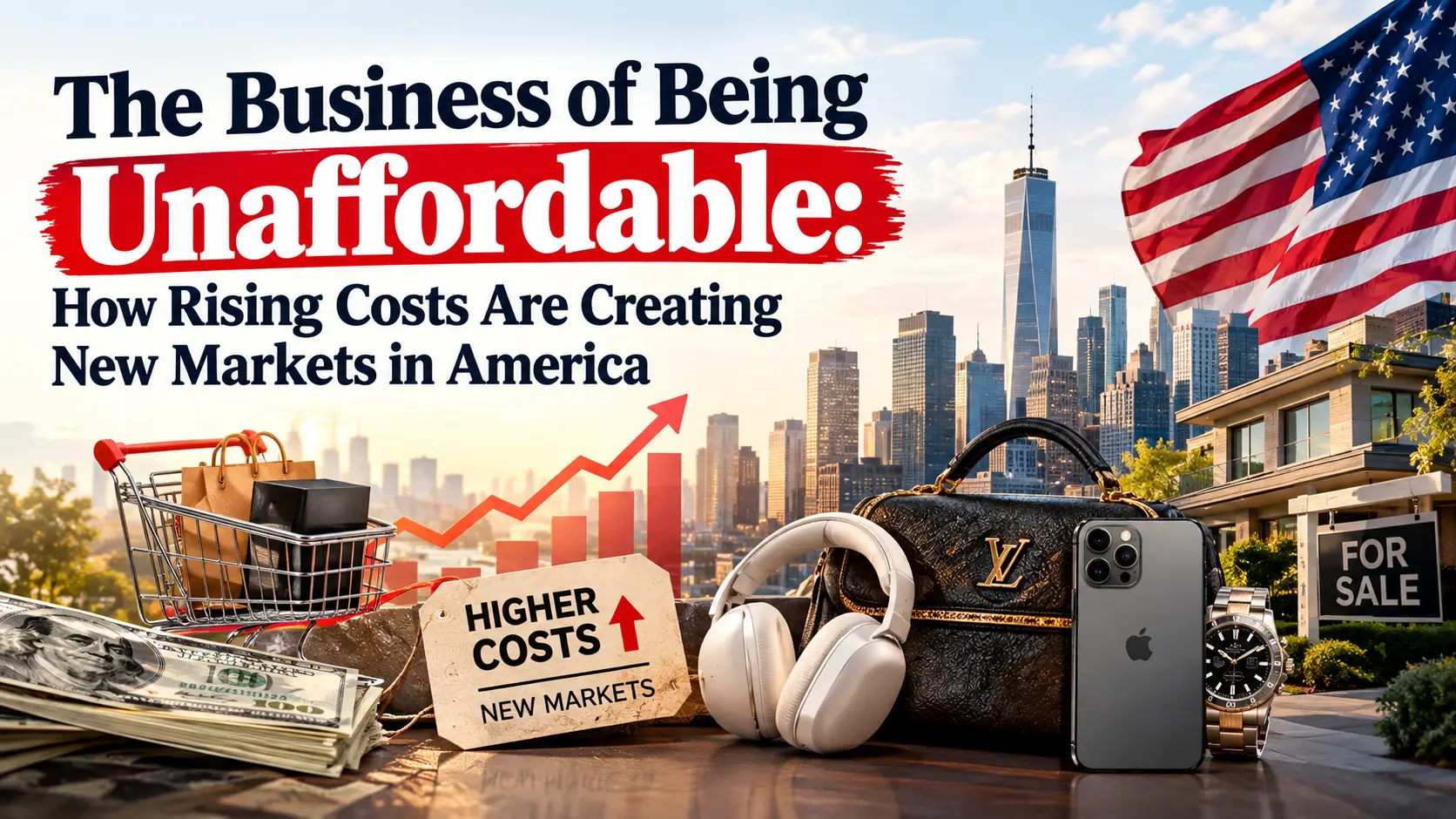
As housing, groceries, healthcare, and utilities have gotten sharply more expensive in the U.S., an entire “affordability economy” has grown up around the strain — Buy Now, Pay Later spending is projected to jump 34.5% in 2026, brand-run resale programs are becoming genuine profit centers rather than marketing gestures, dupe culture has gone mainstream, and nearly half of Americans now say they earn income from a side hustle. Being unaffordable, it turns out, is a genuinely profitable problem for someone else to solve.
There’s a strange asymmetry at the center of the American economy in 2026: by most headline measures, growth has held up reasonably well, yet a majority of consumers report feeling squeezed harder than the topline numbers suggest. Economists have taken to calling the gap between “the data says things are fine” and “people say things are not fine” the vibecession — except by 2026, it’s looking less like a vibe and more like an actual, measurable shift in household finances. And wherever a large enough group of people is under sustained financial pressure, businesses eventually show up to meet them there. This is the story of who’s showing up, and what they’re selling.
The Numbers Behind the Squeeze
Before getting to the businesses capitalizing on the moment, it’s worth being specific about what’s actually gotten more expensive. According to reporting on domestic cost-of-living data, U.S. electricity costs have risen roughly 38–40% since early 2020, notably outpacing the broader 26% rise in the overall cost of living, while rents have climbed 30–40% over the same period. The Federal Reserve Bank of New York separately found that food insecurity has reached levels not seen since the depths of the pandemic, and a widely cited affordability threshold analysis found that a mere $1,000 increase in annual living costs would push roughly 3 million additional households past the point of being able to make ends meet.
What’s notable is that this isn’t purely a story about prices rising — it’s also a story about pay not rising fast enough to keep pace. Economic analysis has pointed to more than four decades of wage growth that has generally failed to keep up with the broader economy’s overall gains, meaning the affordability gap is really the product of two separate trends colliding rather than one runaway variable. Whatever the precise cause in any given category, the practical effect for millions of households is the same: less room in the monthly budget than there used to be, and a market of consumers actively looking for anywhere they can find relief.
The New Markets: Where the Money Is Actually Going
Buy Now, Pay Later: From Niche Tool to Mainstream Habit
Few sectors illustrate the shift as cleanly as installment financing. Buy Now, Pay Later usage in the U.S. jumped 9% year-over-year in a recent November tracked by Adobe, and by Cyber Monday it accounted for roughly 7% of all retail spending that day — versus its usual 1.5% share the rest of the year. Analysts at eMarketer project BNPL usage will grow another 34.5% in 2026, translating into a roughly 19.2% increase in BNPL-driven spending, with the broader global BNPL market now estimated at $560 billion. For retailers, the appeal is straightforward: financing firm Citizens cites Forrester research finding that point-of-sale financing can lift overall merchant sales by as much as 32%, and roughly a third of millennials say the availability of an installment option directly influences whether they make a purchase at all. It’s worth noting the other side of that coin too: research shows 34–41% of BNPL users report making at least one late payment, even as outright default rates remain a comparatively low 1.8–2% — a reminder that “affordable” financing still carries real risk for a meaningful share of the people using it.
Resale Goes From Side Hustle to Boardroom Strategy
Secondhand goods have quietly become one of retail’s more serious growth stories. Major brands — Lululemon, Canada Goose, and Ikea among them in the broader North American market — have launched formal buy-back and resale programs rather than leaving the secondhand market to third-party platforms. The shift in thinking is notable: resale was historically viewed internally as a threat that would cannibalize new sales or dilute brand positioning, particularly in fashion. Industry analysis now increasingly frames it the opposite way — as a customer acquisition channel (with roughly half of shoppers who first discover a brand through resale later buying it new), a loyalty mechanism through trade-in credit, and a legitimate revenue line rather than a marketing cost, aided by improved AI-powered intake and logistics that have finally made resale operations profitable at scale rather than merely popular.
Dupe Culture Goes Fully Mainstream
What used to carry a faint stigma — buying the deliberately cheaper version of a viral product — has become a dominant shopping behavior in its own right, driven heavily by short-form video platforms surfacing side-by-side comparisons between name-brand items and lower-cost alternatives. The trend sits squarely inside a broader consumer shift researchers have described as “muted desire” — not simply an inability to afford full-price goods, but a values shift where consciously choosing the more affordable option has become something people actively signal rather than quietly settle for.
Discount and Value Retail Outgrow the Middle
As household budgets tighten, spending has increasingly polarized rather than simply shrinking uniformly. Mid-tier retailers have generally lost share, while both value-focused chains and, at the other end, premium options that clearly justify their price have held up better. Business analysis of the sector has framed the winning formula precisely: the retailers succeeding right now aren’t simply the cheapest — they’re the ones offering genuinely higher value per dollar, with warehouse clubs and large-format value retailers frequently cited as the clearest beneficiaries of that shift as shoppers consolidate spending toward fewer, more trusted destinations.
The Side Hustle Economy Becomes a Financial Necessity, Not a Hobby
Perhaps the most direct evidence of household financial strain is what people are doing with their own time. A 2026 Intuit QuickBooks entrepreneurship survey found that 47% of Americans — nearly one in two — reported earning income from a side hustle that year, with the top stated reason being simply to save money or make ends meet rather than to pursue a passion project. Separate research puts the figure even higher among people who consider side income essential rather than optional, with one survey finding 73% of Americans now view a side hustle as a financial necessity. The nature of that work is shifting too: alongside traditional gig work like rideshare and delivery driving, 2026 has seen the rise of what some researchers call “micro-side hustles” — smaller, on-demand tasks done in short bursts rather than a second part-time job — and “side stacking,” where people deliberately build multiple smaller income streams rather than relying on one primary job, treating income diversification the way an investor might treat a portfolio.
A Snapshot: The Affordability Economy by the Numbers
| Market | Key 2026 Data Point | Source |
|---|---|---|
| Buy Now, Pay Later | 34.5% projected growth in usage; $560B global market | eMarketer, industry BNPL research |
| Resale / secondhand | Major brands (Lululemon, Canada Goose, Ikea) now run formal resale programs | Industry reporting |
| Side hustles | 47% of Americans report side-hustle income | Intuit QuickBooks 2026 Entrepreneurship Study |
| Electricity costs | Up 38–40% since early 2020 | Domestic cost-of-living reporting |
| Rent | Up 30–40% since 2020 | Domestic cost-of-living reporting |
| Food insecurity | Highest levels since 2020 | Federal Reserve Bank of New York survey |
What This Actually Means for Businesses
The throughline across every one of these markets isn’t really “cheap wins.” It’s that consumers under financial pressure are getting sharply more discerning about where their money goes, and rewarding businesses that either genuinely lower the cost of something they need or help them extract more value from what they already have. BNPL succeeds because it doesn’t ask people to want less — it lets them spread a purchase they’ve already decided to make across a schedule that fits their cash flow. Resale succeeds because it turns “I can’t afford new” into “I’m being smart,” reframing a budget constraint as a values statement. Side hustles succeed because, when wages alone don’t keep pace with costs, the most direct lever left for a household is generating a second income stream rather than waiting for a raise.
For businesses, the practical lesson emerging from 2026 isn’t simply “lower your prices” — companies that tried that playbook without rethinking the underlying value proposition have generally struggled. The more durable strategy, visible across resale, BNPL, and value retail alike, has been building genuinely new ways for financially stretched consumers to get something they want without the traditional full upfront cost — whether that’s spreading a payment, buying secondhand with a brand’s own backing, or discovering a lower-cost alternative that still feels like a smart choice rather than a compromise.
This article synthesizes publicly available economic and industry data from sources including the Federal Reserve Bank of New York, Stanford’s Institute for Economic Policy Research, eMarketer, Adobe, and Intuit QuickBooks, current as of September 2026. It is intended as business and economic analysis, not financial or investment advice.
Frequently Asked Questions
What is the “affordability economy”?
It refers to the growing cluster of business models — Buy Now, Pay Later financing, brand-run resale programs, discount and value retail, and side-hustle/gig platforms — that have expanded specifically to help consumers manage rising living costs without simply spending less overall.
How much is Buy Now, Pay Later usage growing in 2026?
eMarketer projects BNPL usage will grow 34.5% in 2026, driving a roughly 19.2% increase in BNPL-related spending, within a global BNPL market estimated at $560 billion.
Why are brands like Lululemon and Ikea getting into resale?
Formal brand-run resale programs are increasingly viewed as a customer acquisition tool (many resale shoppers later buy new), a loyalty mechanism through trade-in credit, and a legitimate profit center — a shift from resale’s earlier reputation as something that only cannibalized new sales.
How many Americans have a side hustle in 2026?
According to Intuit QuickBooks’ 2026 Entrepreneurship Study, 47% of Americans reported earning income from a side hustle, with saving money cited as the top motivation.
What’s driving the rise of “dupe culture”?
Short-form video platforms have made it easy to compare name-brand products against lower-cost alternatives side by side, combined with a broader consumer shift toward treating cost-consciousness as a deliberate, positive choice rather than a compromise.
Are discount retailers actually winning more business in 2026?
Yes, generally. As spending has polarized, mid-tier retailers have lost share while value-focused chains and retailers offering clearly higher value per dollar — not simply the lowest price — have gained ground.
Read Also:
- iPhone 18 Pro Max: Complete 2026 Guide to Price, Colors, Cases, Carriers and the iPhone Duo
- Top 10 Richest Politicians in America (2026 Net Worth Ranking)
- The World’s Youngest Billionaires of 2026: Meet the 8 Under Age 23