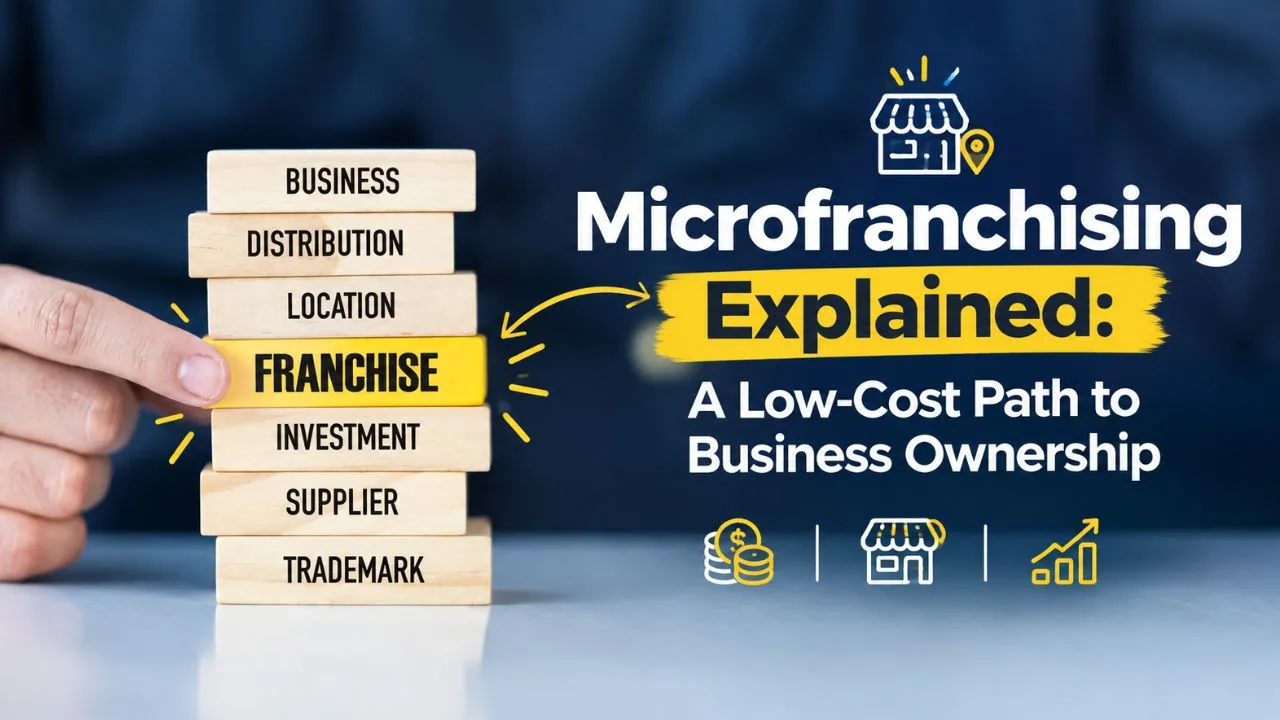
Microfranchising is a stripped-down version of traditional franchising built for low-capital, low-overhead business ownership. Instead of a commercial lease, expensive equipment, and a large hourly staff, a microfranchise typically runs from a home office or digitally, requires a fraction of the investment traditional franchises demand, and is designed to be operated profitably by a single owner or a very small team. It keeps the proven operating system that makes franchising valuable — brand recognition, training, and a tested playbook — while removing most of the physical infrastructure that makes traditional franchising expensive and risky for first-time owners.
For decades, the traditional franchise model followed a predictable, expensive blueprint: buy into a recognized brand, sign a substantial commercial lease, purchase equipment, and manage a team of hourly employees. That path has built real wealth for a lot of people, but the financial barrier to entry has also kept thousands of capable, motivated entrepreneurs on the sidelines simply because they couldn’t access six figures of startup capital. Microfranchising exists specifically to close that gap.
What Actually Makes a Business a “Microfranchise”
A microfranchise takes the foundational value of traditional franchising — a proven, repeatable operating system — and removes the operational weight that usually comes with it. Rather than centering on physical infrastructure, a microfranchise focuses on lean, specialized, often relationship-driven services that don’t require a storefront to deliver value.
To genuinely qualify as a microfranchise, a business opportunity generally has three defining characteristics:
- Minimal initial capital. Startup costs sit well below traditional franchise benchmarks, and many microfranchise categories can be entered without anywhere near the capital a conventional franchise requires.
- Low-asset operations. No commercial storefront, no vehicle fleet, no heavy equipment leases. Most microfranchises run entirely home-based or digitally.
- Simplified scale. The business model is built to be genuinely profitable with a single owner-operator or a very small, agile team — not a business that requires a management hierarchy to function.
By removing site costs and inventory logistics from the equation, microfranchising lets an independent owner put essentially all of their time and energy into market growth and revenue generation, rather than splitting attention between sales and physical operations.
Microfranchise vs. Traditional Franchise: A Direct Comparison
| Factor | Traditional Franchise | Microfranchise |
|---|---|---|
| Typical investment level | Often six figures | A small fraction of that, frequently under $20,000 |
| Physical footprint | Commercial lease, storefront, equipment | Home-based or fully digital |
| Staffing model | Team of hourly employees | Single owner-operator or very small team |
| Revenue driver | High-volume consumer transactions | Often relationship-driven or B2B services |
| Financial risk profile | Higher — tied to lease, payroll, inventory | Lower — minimal fixed overhead |
| Time to launch | Longer — site build-out, hiring, licensing | Shorter — fewer physical dependencies |
This isn’t an argument that traditional franchising is a bad model — plenty of owners build substantial wealth through storefront and equipment-heavy franchises, and some business categories genuinely require that kind of physical presence to operate at all. The point of microfranchising is narrower: it opens business ownership to people who want the structure and support of a franchise system without the capital and risk profile that traditional franchising demands.
Why the Microfranchise Structure Reduces Risk for First-Time Owners
Launching an independent business from scratch means building your own operational playbooks, marketing materials, and vendor relationships through costly trial and error — mistakes that, in a fully independent startup, come directly out of your own pocket and your own runway. A microfranchise gives a new owner the agility of a small, lean startup while backing them with the tested infrastructure of an established brand system.
That combination — speed to market with a built-in operational safety net — is really the core value proposition of the model. A new owner isn’t left wondering whether their billing system works, how to design marketing materials, or whether their fulfillment process can actually scale. The operating system is handed over on day one, which lets a first-time entrepreneur focus on execution and local relationship-building rather than infrastructure-building.
What a B2B Media Microfranchise Looks Like in Practice
One category that illustrates the microfranchise model particularly well is B2B hyperlocal media — businesses built around connecting local advertisers with their communities through premium, locally-focused publications, rather than through mass-market retail or manual labor. Brands operating in this space, such as The Success Prime, structure the opportunity around a clear division of labor between the franchise owner and the corporate backend:
What the franchise owner typically focuses on:
- Building B2B relationships with local business owners
- Local community networking and event participation
- Advertising partner acquisition and account management
What the corporate/franchisor side typically handles:
- Design and production of the publication or media product
- Printing, distribution, or digital publishing logistics
- Client billing and payment collection
- Ongoing training and mentorship support
Because the corporate backend manages the technical and administrative workload — editorial layout, production, and billing — the individual owner can run a genuinely scalable local media business from a home office with minimal overhead. The owner builds equity in a tangible advertising and relationship asset over time, leveraging a proven national framework to drive results in their specific local market, rather than reinventing the entire operating model from scratch.
Is Microfranchising Actually Profitable?
The short answer is that microfranchising’s low overhead structure is precisely what makes it an attractive profitability model for independent owners. Because the format eliminates major fixed costs — commercial rent, physical inventory, and a large payroll — a higher percentage of gross revenue has a realistic path to the bottom line compared to more capital-intensive business models. That said, “low overhead” doesn’t automatically mean “low effort” — profitability in a relationship-driven microfranchise still depends heavily on an owner’s ability to consistently build and retain client relationships, which is a genuine sales and networking skill, not a passive income stream.
What to Ask Before Choosing a Microfranchise
Before committing to any microfranchise opportunity, a few questions are worth asking directly of the franchisor rather than relying solely on marketing materials:
- What exactly does the corporate side handle, versus what remains the owner’s responsibility? Get specifics in writing through the Franchise Disclosure Document (FDD), not just a verbal pitch.
- What kind of training and ongoing support is actually provided — a one-time onboarding, or continued mentorship as the business grows?
- How is revenue actually generated and sustained — is it a genuinely recurring relationship model, or does it require constant new client acquisition to maintain?
- What do current franchise owners’ real day-to-day operations look like? Ask to speak directly with existing owners rather than relying only on promotional content.
- What territory protections or exclusivity terms apply, and how are they defined and enforced?
Who Microfranchising Is (and Isn’t) a Good Fit For
Microfranchising tends to suit people who are genuinely comfortable with relationship-building and local networking, prefer a home-based or remote operating style over managing a physical location, and are willing to build a client base steadily rather than expecting immediate high-volume transactional revenue. It’s less suited to people who prefer highly structured, hands-on operational work, or who need a business model with faster initial cash flow than a relationship-driven sales cycle typically provides in its early months.
The appeal of microfranchising isn’t that it’s an easier path to business ownership than a traditional franchise — building genuine local relationships and a client base still takes real, sustained work. The appeal is that it removes the massive capital barrier and physical-operations risk that keeps so many capable people from ever starting in the first place, replacing it with a leaner, more accessible route into real business ownership.
This article is intended as general business education and does not constitute financial, legal, or franchise investment advice. Always review a franchise’s official Franchise Disclosure Document (FDD) and consult an independent attorney or accountant before committing to any franchise or business opportunity.
Frequently Asked Questions
What is the main difference between a franchise and a microfranchise?
The primary differences are cost and scale. Traditional franchises typically require substantial upfront capital, commercial real estate, and physical assets. Microfranchises operate with dramatically lower startup investment, run primarily from a home office or digitally, and rely on lean, service-based or B2B structures rather than brick-and-mortar storefronts.
Are microfranchises profitable business opportunities?
Yes, generally. By eliminating major fixed expenses like commercial rent, physical inventory, and large payrolls, microfranchises maintain low operational overhead, which allows a higher share of gross revenue to reach the bottom line — though actual profitability still depends on the owner’s ability to build and sustain client relationships.
What kind of support do microfranchise owners typically receive?
Most microfranchise systems provide a structured onboarding process, sales and networking training, marketing materials, and ongoing mentorship, while the corporate side typically handles production, design, distribution, and billing — allowing the owner to focus primarily on relationship-building and local growth.
How much does it typically cost to start a microfranchise?
Costs vary by category, but the defining feature of microfranchising is a dramatically lower investment threshold than traditional franchising — the model is specifically designed around minimal capital and low fixed overhead rather than the six-figure investments common in brick-and-mortar franchise systems.
Is microfranchising a good option for first-time business owners?
It can be, particularly for people who want the structure and support of a proven system without taking on the capital risk and physical operations of a traditional franchise. It suits people comfortable with relationship-driven, home-based work more than those looking for a highly structured, hands-on operational role.
Read Also:
- From Magazine Pages to Digital Audiences: How The Success Prime Magazine Extends Every Print Campaign Online
- The Business of Being Unaffordable: How Rising Costs Are Creating New Markets in America
- Top 10 Richest Politicians in America (2026 Net Worth Ranking)
- Start a Franchise for Under $15K: Top Affordable Options