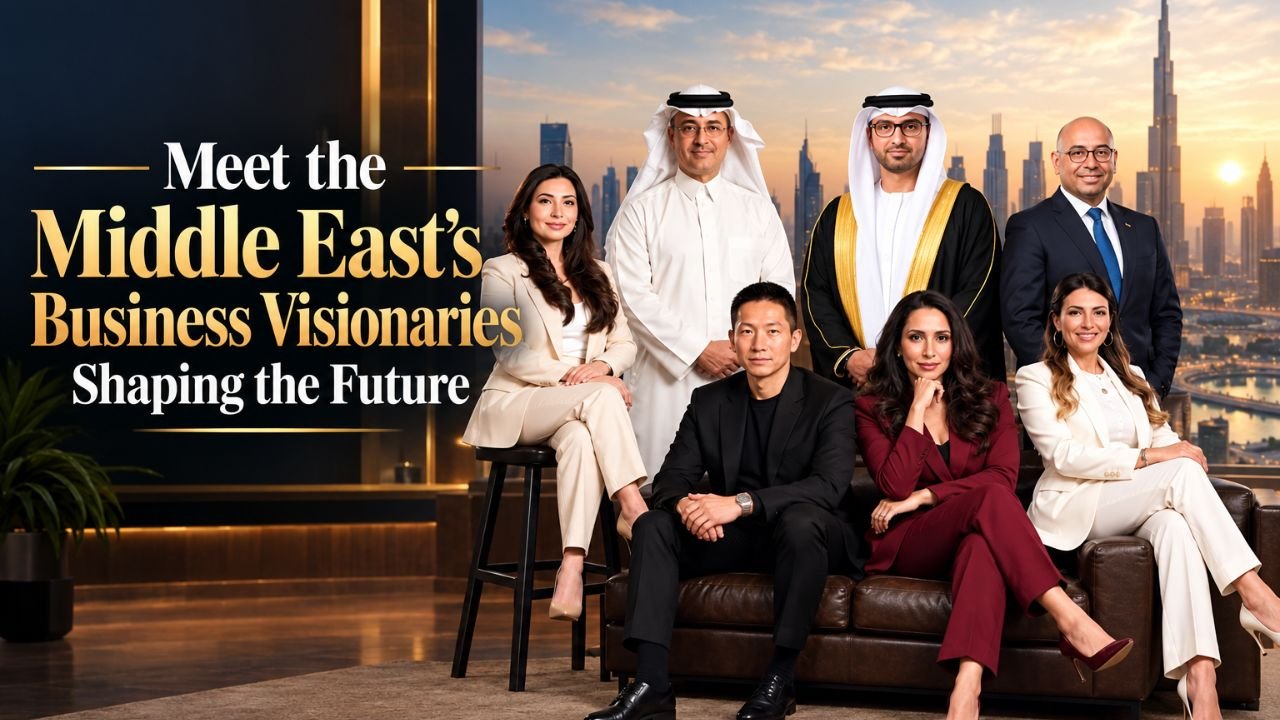
Meet the Middle East’s Business Visionaries Shaping the Future
The People Redefining Leadership Across Energy, Tech, Finance and Healthcare
Walk through any major business district in Dubai, Riyadh, or Abu Dhabi today, and you’ll notice something: the people running the region’s biggest companies look nothing like they did a decade ago. Energy executives are now talking about AI infrastructure. Bankers are building fintech platforms. Healthcare leaders are scaling across borders instead of staying local. The Middle East’s business landscape is shifting fast, and a specific group of visionary leaders in the Middle East is driving that shift — across technology, sustainability, global markets, and economic growth all at once.
This isn’t a ranking, and it’s not a popularity contest. It’s a closer look at who these leaders actually are, what they’re building, and why their approach matters for anyone trying to understand where the region’s economy is headed next.
What Actually Makes a Leader “Visionary” in the Middle East?
Here’s the thing about vision — it’s easy to talk about and genuinely hard to execute. Anyone can have a big idea. Building something that still matters five or ten years later is a completely different skill.
A truly visionary business leader in this region tends to share a few traits:
- Expanding deliberately into new markets, rather than staying comfortable in one
- Investing early in emerging technology, especially AI and digital infrastructure
- Developing talent pipelines, not just hiring for today’s needs
- Supporting economic diversification, a theme that runs through nearly every major Gulf growth strategy
- Thinking in decades, not quarters
- Connecting private growth to broader national development goals
That’s also why you’ll find these leaders coming from wildly different backgrounds — career CEOs, first-time founders, technology executives, and a growing number of women business leaders stepping into roles that didn’t exist for them in this industry a generation ago. Forbes Middle East’s 2026 rankings alone cover 102 individuals across 100 entries, spanning 21 nationalities and 29 different sectors — a clear signal that regional leadership is no longer concentrated in one industry or one demographic.
8 Visionary CEOs and Leaders Worth Knowing in the Middle East
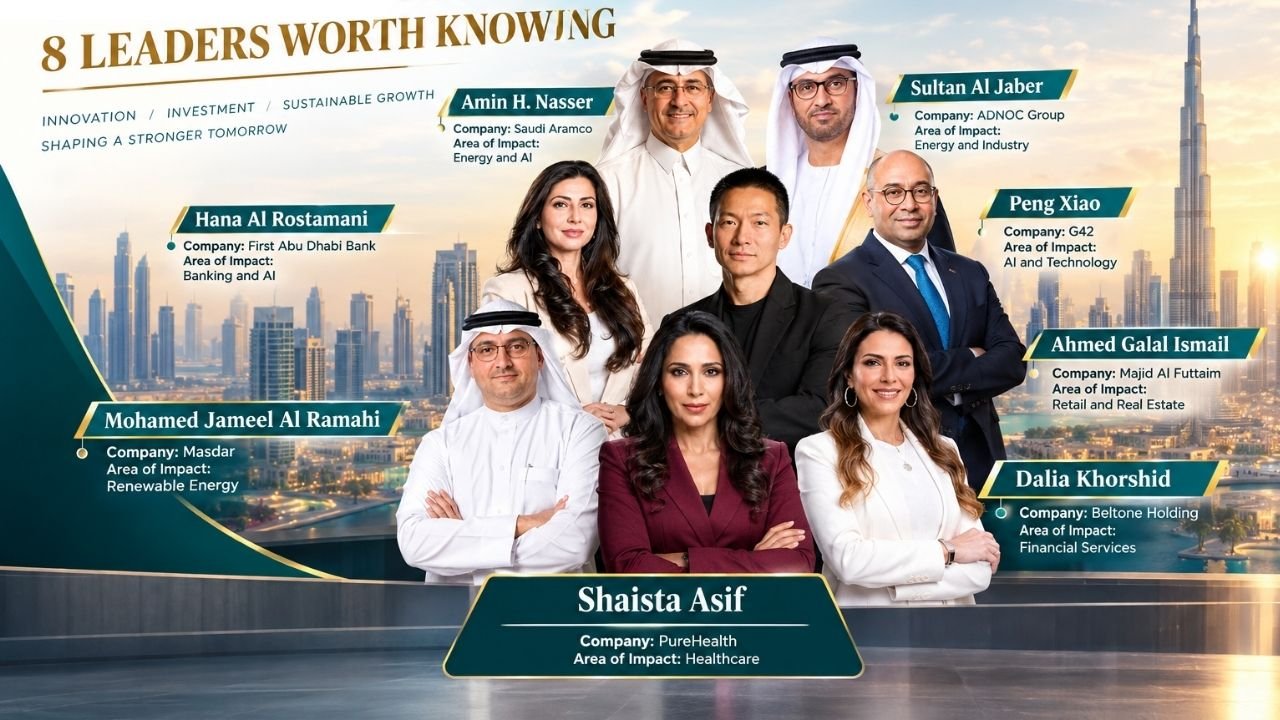
Think about how much is changing simultaneously right now — energy transition, artificial intelligence, digital banking, regional healthcare expansion, clean technology. The leaders below aren’t all solving the same problem, which is exactly the point. Here are eight names pulled from Forbes Middle East’s 2026 CEO list, chosen specifically to show that range:
| Leader | Company | Area of Impact |
|---|---|---|
| Amin H. Nasser | Saudi Aramco | Energy and AI |
| Sultan Al Jaber | ADNOC Group | Energy and industry |
| Hana Al Rostamani | First Abu Dhabi Bank | Banking and AI |
| Peng Xiao | G42 | AI and technology |
| Ahmed Galal Ismail | Majid Al Futtaim | Retail and real estate |
| Mohamed Jameel Al Ramahi | Masdar | Renewable energy |
| Shaista Asif | PureHealth | Healthcare |
| Dalia Khorshid | Beltone Holding | Financial services |
Forbes’ methodology weighs regional impact, company scale, recent performance, experience, and innovation — which is really a long way of asking: what is this person actually building, changing, or scaling right now, rather than what they’ve already accomplished in the past?
What Other Businesses Can Actually Learn From Them
Strip away the titles and company names, and a handful of practical lessons keep showing up across nearly every one of these leadership stories:
Think past your current market before growth slows down. Waiting until a market plateaus to look for the next one almost always costs you time you didn’t need to lose.
Use technology to solve real operational problems, not as a buzzword. AI and digital tools only matter when they genuinely improve how a business functions day to day.
Build relationships outside your own industry. Investors, policymakers, founders in unrelated sectors — these relationships surface perspectives you’ll never find by staying inside your own professional bubble.
Adapt before change becomes unavoidable. By the time disruption is obvious to everyone, your options for responding to it have already shrunk.
For companies exploring how to scale a business in the UAE or across the wider Gulf region, these aren’t abstract leadership platitudes — they’re the actual playbook being used right now by the people running the region’s fastest-growing companies.
Influence Isn’t Always About the Biggest Title
When people talk about the most influential Arab business leaders, there’s a tendency to default to whoever runs the largest company. But influence in this region increasingly shows up in different forms:
| Type of Influence | What It Looks Like in Practice |
|---|---|
| Business | Scaling major companies across new markets |
| Technology | Building digital platforms used at national scale |
| Investment | Funding entirely new industries from the ground up |
| Innovation | Turning early-stage ideas into real, operating businesses |
| Regional impact | Expanding operations across multiple Gulf and MENA markets |
The more useful question isn’t “who holds the biggest title” — it’s “what has this person actually built or changed.” That framing explains why visionary leadership in the Middle East comes from such different fields in the first place, and why influence here often extends well beyond the walls of a single organization.
Where Vision Meets Technology: The Region’s Top Tech Entrepreneurs
Technology leadership in the Middle East has outgrown the idea of “tech” meaning just software companies. AI, fintech, cloud infrastructure, digital health platforms, and smart-city development are now core parts of how the region’s economy is being rebuilt.
There’s real urgency behind this shift. PwC’s 2025 Middle East CEO Survey found that 60% of Middle East CEOs believed their businesses would not remain viable within 10 years without meaningful adaptation — a statistic that should make clear why “innovation” isn’t a marketing word here, it’s closer to a survival requirement.
That urgency is shaping where the region’s tech ecosystem is actually putting its energy:
- AI and data are being embedded directly into how businesses operate, not bolted on afterward
- Fintech is reshaping how financial services get delivered, especially to underbanked populations
- Health technology is opening entirely new models for care delivery across borders
- Smart cities are connecting physical infrastructure with everyday digital life
Dubai’s growing cluster of emerging startups reflects this same pattern — founders testing new business models and technologies in a market that’s actively rewarding experimentation rather than punishing it.
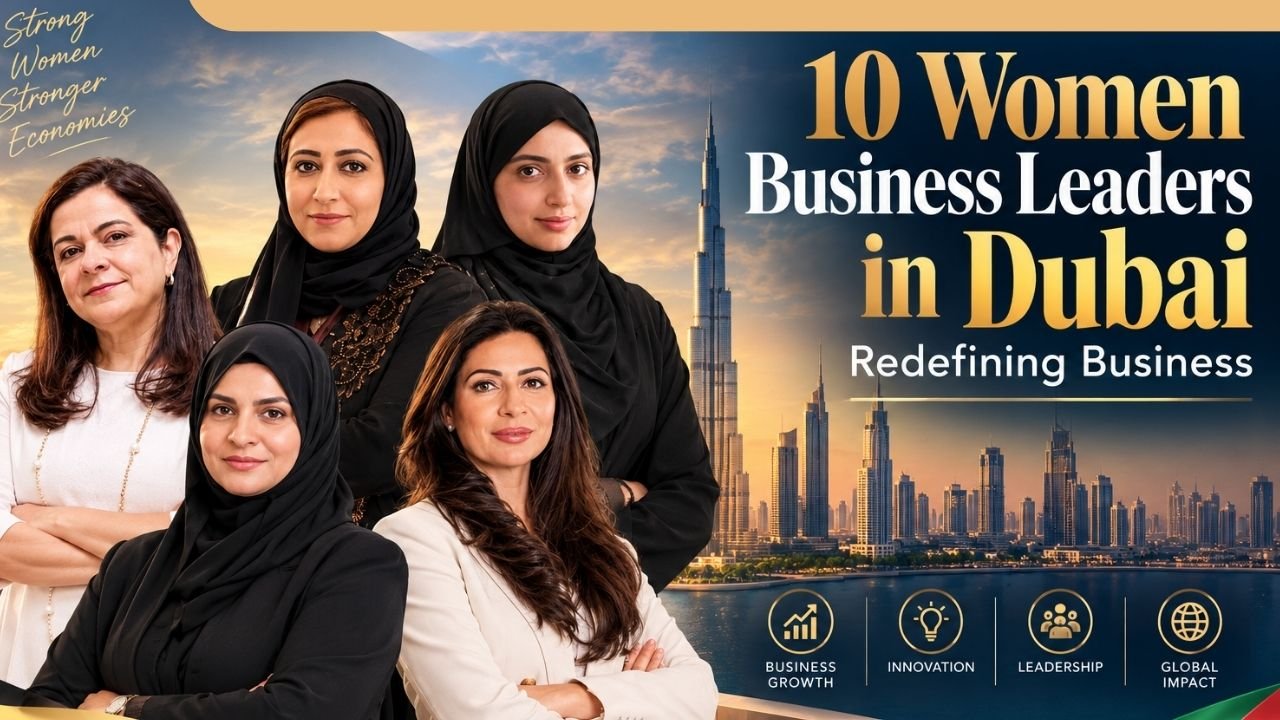
Women Leaders in Business: How Dubai’s Boardrooms Are Changing
Sit in on enough boardroom meetings in Dubai today, and you’ll notice women leading far more than one type of business — banking, healthcare, aviation, technology, investment, and consulting all show up in the mix now, not just the sectors traditionally associated with women in leadership.
Forbes Middle East’s 2025 list of top businesswomen covers 100 leaders across 32 sectors and 29 nationalities, with 46 of those based in the UAE alone. A few examples show just how broad that leadership actually is:
- Hana Al Rostamani, Group CEO of First Abu Dhabi Bank, leads one of the region’s most significant financial institutions
- Shaista Asif, Co-founder and Group CEO of PureHealth, runs a major healthcare platform with operations spanning multiple markets
- Alisha Moopen, Managing Director and Group CEO of Aster DM Healthcare GCC, is driving regional expansion across healthcare
- Suzanne Al Anani, CEO of Dubai Aviation Engineering Projects, operates at the intersection of aviation and large-scale infrastructure
This broader mix is exactly why women’s leadership in Dubai’s business community doesn’t fit neatly into one category anymore. And for emerging leaders trying to build similar influence, professional networks and industry communities remain one of the fastest ways to exchange ideas and build the relationships that eventually turn into real opportunities.
Why Even Experienced Leaders Still Show Up to Business Events
It’s a fair question — if you already know your industry inside and out, why bother attending another conference or summit? The honest answer: even seasoned executives get stuck inside the same professional circles without realizing it.
Business events put leaders in the room with new markets, different industries, investors, technology companies, and ideas they wouldn’t otherwise run into during a normal work week. For visionary leaders across the Middle East, that kind of cross-industry exposure is often where unexpected opportunities actually start. The broader regional business ecosystem has leaned into this approach deliberately, creating spaces specifically designed to connect leaders beyond their usual sector boundaries — because the real value, as most experienced executives will tell you, isn’t the event itself. It’s what happens in the follow-up conversation afterward.
The Bottom Line
Visionary leadership in the Middle East was never really about who holds the biggest title in the room. It’s about what someone builds, what they’re willing to change, and what they enable other people to achieve around them. Across the region, this new generation of CEOs, tech entrepreneurs, and women business leaders is actively reshaping entire industries, opening markets that didn’t exist a decade ago, and creating opportunities in sectors still being defined. And somewhere right now, tomorrow’s most influential Middle Eastern business leader is probably already building their first company, leading a small growing team, or testing an idea that hasn’t made headlines yet.
Frequently Asked Questions
1. Who counts as a “visionary leader” in the Middle East?
Leaders recognized for documented innovation, measurable business growth, industry-wide change, and influence that extends beyond their own company into the broader regional economy.
2. Who are some well-known business leaders currently shaping the Middle East?
Examples include Amin H. Nasser of Saudi Aramco, Sultan Al Jaber of ADNOC Group, Hana Al Rostamani of First Abu Dhabi Bank, and Shaista Asif of PureHealth, among others featured on Forbes Middle East’s 2026 Top CEOs list.
3. Why is Middle Eastern business leadership gaining global attention right now?
Economic diversification, rapid technology adoption, international investment, and large-scale expansion strategies are reshaping how the region’s economy operates, drawing global business interest in the process.
4. What industries are Middle Eastern leaders most actively shaping?
Energy, technology, financial services, healthcare, retail, real estate, aviation, and renewable energy are among the sectors seeing the most visible leadership-driven transformation.
5. What makes Middle Eastern leadership different today compared to a decade ago?
Today’s regional leaders are increasingly balancing traditional, established industries with technology adoption, economic diversification, global market expansion, and long-term national development goals, rather than focusing on a single sector alone.
6. How many women are currently represented in Middle East business leadership?
Forbes Middle East’s 2025 list of top businesswomen features 100 leaders spanning 32 sectors and 29 nationalities, with nearly half based in the UAE.
7. Why does technology play such a central role in the region’s leadership story?
A 2025 PwC survey found that 60% of Middle East CEOs believe their businesses wouldn’t remain viable within a decade without significant adaptation, making technology investment a core part of nearly every major leadership strategy in the region.
Read Also:
- From Magazine Pages to Digital Audiences: How The Success Prime Magazine Extends Every Print Campaign Online
- The Business of Being Unaffordable: How Rising Costs Are Creating New Markets in America
- Top 10 Richest Politicians in America (2026 Net Worth Ranking)
- Start a Franchise for Under $15K: Top Affordable Options
- Why America’s Subscription Boom Is Real, But the Bill Comes Due Somewhere