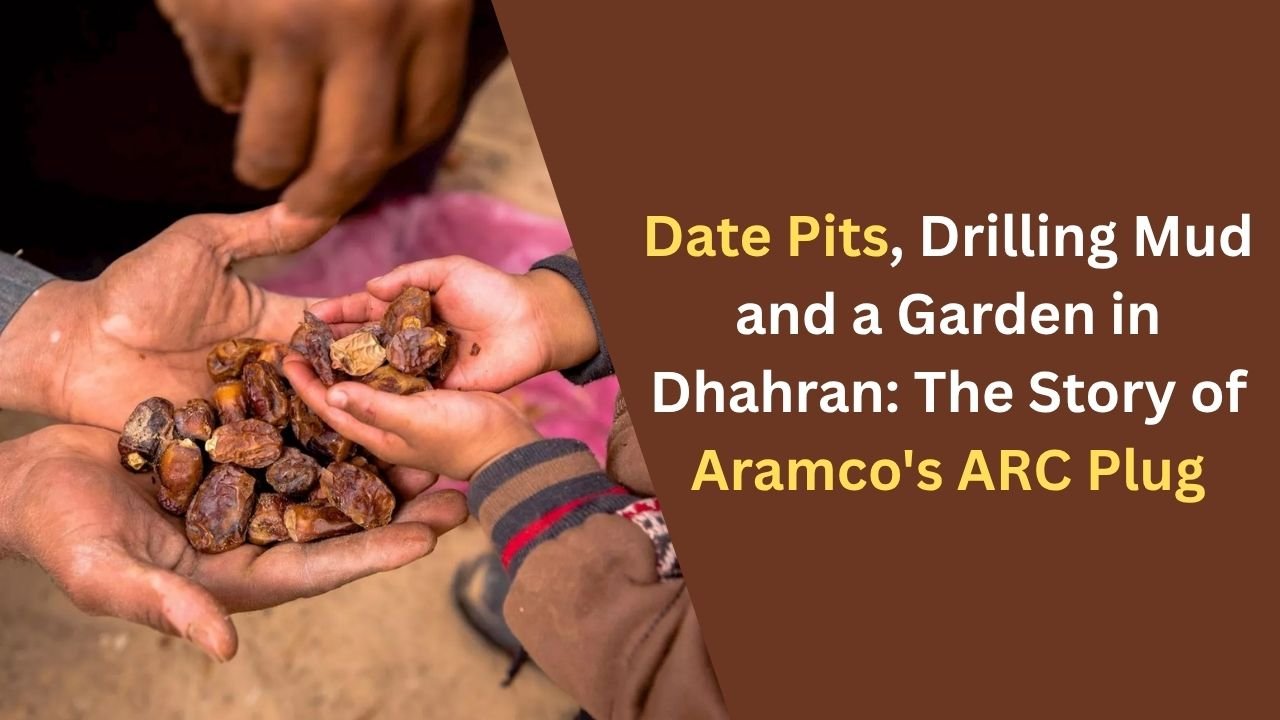
Date Pits, Drilling Mud and a Garden in Dhahran: The Story of Aramco’s ARC Plug
I have written about energy for years, and I have learned that the most interesting stories rarely start in a boardroom. This one starts in a backyard.
The reporting I reviewed suggests that around 2015, a senior Aramco researcher was pruning his date palm in Dhahran after the harvest. He looked at the pile of leftover seeds and wondered whether they were really just waste. That small question turned into a patented drilling product, ARC Plug, which has now replaced an imported material in Aramco’s field operations.
A note on “latest data”: I found no new 2026 announcement about ARC Plug. The most recent public details come from Aramco’s own publications and technical papers, and the story remains relevant because the numbers behind it still hold.
The Problem Nobody Sees: Drilling Fluid That Disappears
Drilling a well relies on a fluid called drilling mud. It is pumped down the pipe, out through the bit and back up, carrying rock chips with it and keeping pressure stable. In Saudi Arabia, the porous rock that makes such good reservoirs can also swallow the fluid. These “loss zones” slow drilling or halt it entirely, and a long stoppage can cost millions of dollars in lost production and wasted labour.
The industry’s fix is lost-circulation material (LCM), particles added to the mud to seal the gaps. Calcium carbonate is cheap but can damage the surrounding rock if overused. Polymers can work better but cost more. Aramco had relied on an imported walnut-shell product from the US.
Why Date Seeds Make Sense
Saudi Arabia is the world’s second-largest commercial date producer. According to Oil & Gas Middle East, the country generates around 150,000 tons of date seeds every year. Most of that waste was burned or buried on farms, which brings pollution and pest problems.
The research team, led by Dr. Mohammad Amanullah at Aramco’s EXPEC Advanced Research Center, tested seed-based particles against the walnut product. Their findings:
- The seed-based LCM performed as well as the walnut shell, and in some conditions better.
- Laboratory tests ran at 250°F and 1,500 psi using a 2 mm slotted disc, and showed effective sealing, with results better than commercial particulate LCMs.
- Work with the Date Palm Research Center in Al-Hasa found that every variety tested had very similar mechanical properties, so the material is consistent whichever tree it comes from.
From Idea to Award
The timeline is short for oilfield technology:
- 2015: Patent filed on using date seeds as LCM.
- 2016: Field trials on three wells with different drilling conditions. ARC Plug reduced fluid loss in each.
- 2017: The product won Technical Innovation of the Year at the Oil & Gas Middle East Awards.
The team also developed a companion product, ARC Eco-Fiber, made from date tree waste, which broadens the use of the palm.
Why It Matters Beyond the Rig
I think the real value of this story is how many problems one idea touches:
- Supply chain localization. A product that used to be shipped from the US is now sourced and processed locally, a few hundred kilometres from where it is used.
- Lower emissions. Shorter transport means a smaller carbon footprint.
- Less farm waste. Fewer seeds are burned or buried. According to Oil & Gas Middle East, Aramco collects more than half of the country’s discarded date seeds, turning a disposal cost into a revenue source for the first time.
- Biodegradability. The material is natural, unlike some synthetic alternatives.
The Bigger Picture
Aramco’s scale puts this in context. The company manages hydrocarbon reserves of 247.2 billion barrels of oil equivalent as of the end of 2025 and employs more than 76,000 people. A few thousand tons of date seeds will never change that. But at that scale, small efficiencies repeated across many wells add up.
My Takeaway
I find this story satisfying because it avoids the usual grand claims. It is a practical fix to a real engineering headache, found by someone paying attention to what was in front of him. Innovation does not always need a new lab. Sometimes it needs a garden and a curious engineer.
Sources: Aramco publications, Oil & Gas Middle East and SPE technical papers on ARC Plug. Figures are as published by those sources.
Frequently Asked Questions
What is ARC Plug?
A lost-circulation material made from date seeds, developed by Aramco‘s EXPEC Advanced Research Center to stop drilling fluid escaping into porous rock.
Who invented it?
A team led by Dr. Mohammad Amanullah. A colleague, Mohammad Arfaj, led the testing phase.
What did it replace?
An imported walnut-shell product known as nut-plug.
How many date seeds does Saudi Arabia produce?
Around 150,000 tons a year, according to Oil & Gas Middle East.
When was it patented and tested in the field?
The patent was filed in 2015, and field trials began in 2016.
Did it win any awards?
Yes. Technical Innovation of the Year at the Oil & Gas Middle East Awards in 2017.
Is there any new 2026 update on ARC Plug?
I did not find one. The latest details come from earlier Aramco publications and technical papers.
Read Also:
- From Magazine Pages to Digital Audiences: How The Success Prime Magazine Extends Every Print Campaign Online
- The Business of Being Unaffordable: How Rising Costs Are Creating New Markets in America
- Top 10 Richest Politicians in America (2026 Net Worth Ranking)
- Start a Franchise for Under $15K: Top Affordable Options
- Why America’s Subscription Boom Is Real, But the Bill Comes Due Somewhere