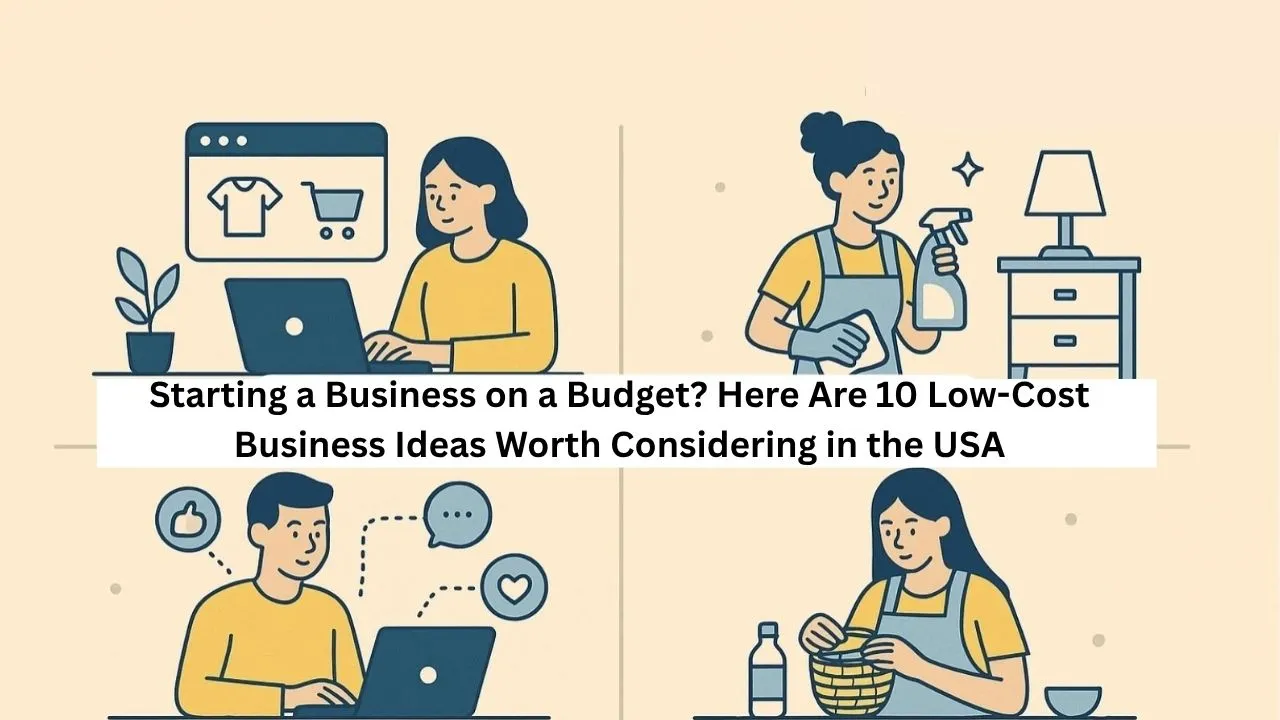
You Don’t Need a Fat Bank Account to Become Your Own Boss The myth that starting a business requires tens of thousands of dollars in savings has quietly fallen apart over the past few years. Between cloud-based tools, no-code platforms, and gig-economy marketplaces, launching a low-cost business in the USA has never been more realistic — many of the ideas below can get off the ground for a few hundred dollars, sometimes less. Here are 10 budget-friendly business ideas worth serious consideration if you’re ready to start small and scale smart.
Here Are 10 Low-Cost Business Ideas Worth Considering in the USA
1. Freelance Services (Writing, Design, Virtual Assistance)
If you have a marketable skill — writing, graphic design, bookkeeping, social media management, or admin support — freelancing remains one of the lowest-cost ways to start earning independently. All you really need is a laptop, an internet connection, and a profile on platforms like Upwork, Fiverr, or Contra. There’s no inventory, no storefront, and virtually no upfront investment beyond your time.
Startup cost: Under $100
Best for: Skilled professionals wanting flexible, remote income
2. Print-on-Demand or Dropshipping E-commerce
Print-on-demand and dropshipping businesses let you sell custom apparel, mugs, phone cases, or other products without ever holding inventory. Platforms like Printful, Printify, and Shopify handle production and fulfillment, so you only pay when a customer orders. This removes the biggest traditional retail cost — warehousing stock you might never sell.
Startup cost: $100–$500 (mostly store setup and marketing)
Best for: Creative entrepreneurs interested in e-commerce without inventory risk
3. Handmade Goods on Etsy
For crafters, jewelry makers, and artisans, Etsy remains one of the most accessible marketplaces to launch a product business. Listing fees are typically just $0.20 per item, and the platform already brings built-in buyer traffic, which dramatically cuts your marketing costs compared to building a standalone store from scratch.
Startup cost: $50–$300 (materials and initial listings)
Best for: Makers of handmade or vintage goods
4. Pet Sitting and Dog Walking
With over 66% of U.S. households owning a pet, demand for reliable, local pet care has only grown. Apps like Rover and Wag let you list your services, get matched with clients, and get paid — without needing a storefront, license (in most states), or major equipment investment.
Startup cost: Under $100 (insurance and basic supplies)
Best for: Animal lovers in suburban or urban areas with active pet communities
5. Cleaning Services (Residential or Commercial)
A cleaning business is one of the most consistently in-demand, low-overhead service businesses you can start. Initial costs are limited to basic supplies and transportation, and many cleaners start by taking on a handful of local residential clients before expanding to small offices or Airbnb turnover cleaning, which tends to pay a premium.
Startup cost: $200–$500 (supplies and basic marketing)
Best for: Hands-on entrepreneurs who want fast, local cash flow
6. Social Media Management for Small Businesses
Many local businesses know they need a social media presence but don’t have the time or skill to manage it. If you understand content creation, scheduling tools, and basic analytics, you can offer social media management as a service — often starting with just one or two retainer clients to build a steady income stream.
Startup cost: Under $100 (scheduling software, portfolio samples)
Best for: Digitally savvy entrepreneurs who enjoy content and marketing
7. Mobile Car Detailing
Unlike a traditional car wash, mobile detailing lets you bring the service directly to the customer’s driveway or office parking lot, eliminating the need to rent a physical location. With a basic set of supplies and a reliable vehicle, this is a business that can realistically launch on a few hundred dollars and scale through repeat bookings and referrals.
Startup cost: $300–$800 (equipment and supplies)
Best for: Entrepreneurs who prefer hands-on, mobile service work
8. Tutoring or Online Course Creation
If you have expertise in a subject — academic, technical, or creative — tutoring (in person or via platforms like Wyzant and Varsity Tutors) or building a self-paced course on platforms like Teachable or Udemy can generate income with minimal upfront investment. Course creation in particular has strong long-term potential, since a single course can be sold repeatedly with no added production cost per sale.
Startup cost: $0–$200
Best for: Subject-matter experts and educators
9. Event or Party Planning (Starting Small)
Event planning doesn’t require an office or staff to begin — many successful planners start by organizing small local events (birthdays, baby showers, corporate mixers) using vendor relationships and strong organizational skills rather than owned equipment. Word-of-mouth and social proof from early, smaller events are often what fuel growth into larger, higher-paying bookings.
Startup cost: $200–$500 (marketing materials, sample décor)
Best for: Organized, detail-oriented entrepreneurs who enjoy people-facing work
10. Personal Fitness Training or Wellness Coaching
With certifications available online for a few hundred dollars, personal training and wellness coaching businesses can launch without renting gym space — many trainers start by offering outdoor sessions, home visits, or virtual coaching, keeping overhead minimal while building a client base.
Startup cost: $300–$1,000 (certification and liability insurance)
Best for: Fitness enthusiasts who want flexible, client-facing work
How to Fund a Low-Budget Business If You Need a Little Extra Capital
Even the leanest business idea sometimes needs a small cash cushion for supplies, licensing, or marketing. A few realistic funding paths for U.S.-based entrepreneurs include:
- SBA Microloans — The U.S. Small Business Administration’s Microloan Program offers loans up to $50,000, though the average microloan issued is only around $13,000–$16,000, making it specifically designed for small, early-stage funding needs rather than large expansions.
- Local CDFIs and nonprofit lenders — Community Development Financial Institutions often provide small loans to entrepreneurs who may not qualify for traditional bank financing.
- Personal savings or a side-hustle runway — Many of the ideas above are explicitly designed to be started while still working a full-time job, letting you fund growth from early revenue rather than debt.
The Bottom Line
Starting a business on a tight budget in the U.S. is no longer a limitation — it’s practically a built-in advantage, since lean startups are forced to validate demand before overcommitting financially. Whether you lean into a service-based idea like cleaning or pet sitting, a digital skill like freelancing or course creation, or a low-inventory e-commerce model like print-on-demand, the key is starting small, proving the concept with real customers, and reinvesting profits to grow — rather than waiting until you’ve saved up for a “perfect” launch that may never come.
Frequently Asked Questions
1. What is the cheapest business to start in the USA?
Service-based businesses like freelancing, virtual assistance, or social media management are among the cheapest to start, often requiring under $100 since they rely on existing skills rather than equipment or inventory.
2. Do I need an LLC to start a small business on a budget?
Not necessarily right away. Many entrepreneurs start as a sole proprietor to keep costs low, then form an LLC once the business generates consistent revenue, since LLC filing fees vary by state and add an upfront cost.
3. Can I get funding for a business with no credit history?
Yes. SBA microloans and CDFI lenders are specifically designed for entrepreneurs who may have limited credit history or difficulty qualifying for traditional bank loans.
4. How much does it typically cost to start a dropshipping or print-on-demand business?
Most entrepreneurs can launch for $100–$500, covering store setup fees, a custom domain, and initial marketing, since there’s no inventory to purchase upfront.
5. Is it realistic to start a business while still working a full-time job?
Yes, and it’s actually a common strategy. Many of the businesses listed here — freelancing, Etsy shops, course creation, tutoring — can be started part-time and scaled gradually before transitioning to full-time.
6. What’s the maximum amount I can borrow through an SBA Microloan?
SBA Microloans max out at $50,000, though the average microloan issued is closer to $13,000–$16,000, reflecting their design for small, early-stage funding needs.
7. Which low-budget business idea has the best long-term scalability?
Online course creation and e-commerce (print-on-demand or dropshipping) tend to scale best long-term, since both allow revenue to grow without a proportional increase in time or labor per sale.
8. Do service-based businesses like cleaning or pet sitting require a business license?
Licensing requirements vary by city and state. Many service businesses can start with minimal licensing, but it’s worth checking local regulations and whether liability insurance is recommended or required.
9. What ongoing costs should I expect beyond the initial startup cost?
Common ongoing costs include platform or marketplace fees (Etsy, Upwork, Rover), marketing, supplies restocking, insurance, and any software subscriptions used to run the business.
10. How do I decide which low-budget business idea is right for me?
Consider your existing skills, how much hands-on time you can commit, whether you prefer client-facing or remote work, and how much capital you’re realistically able to invest before choosing a direction.
Read Also:
- From Magazine Pages to Digital Audiences: How The Success Prime Magazine Extends Every Print Campaign Online
- The Business of Being Unaffordable: How Rising Costs Are Creating New Markets in America
- Top 10 Richest Politicians in America (2026 Net Worth Ranking)
- Start a Franchise for Under $15K: Top Affordable Options
- Why America’s Subscription Boom Is Real, But the Bill Comes Due Somewhere