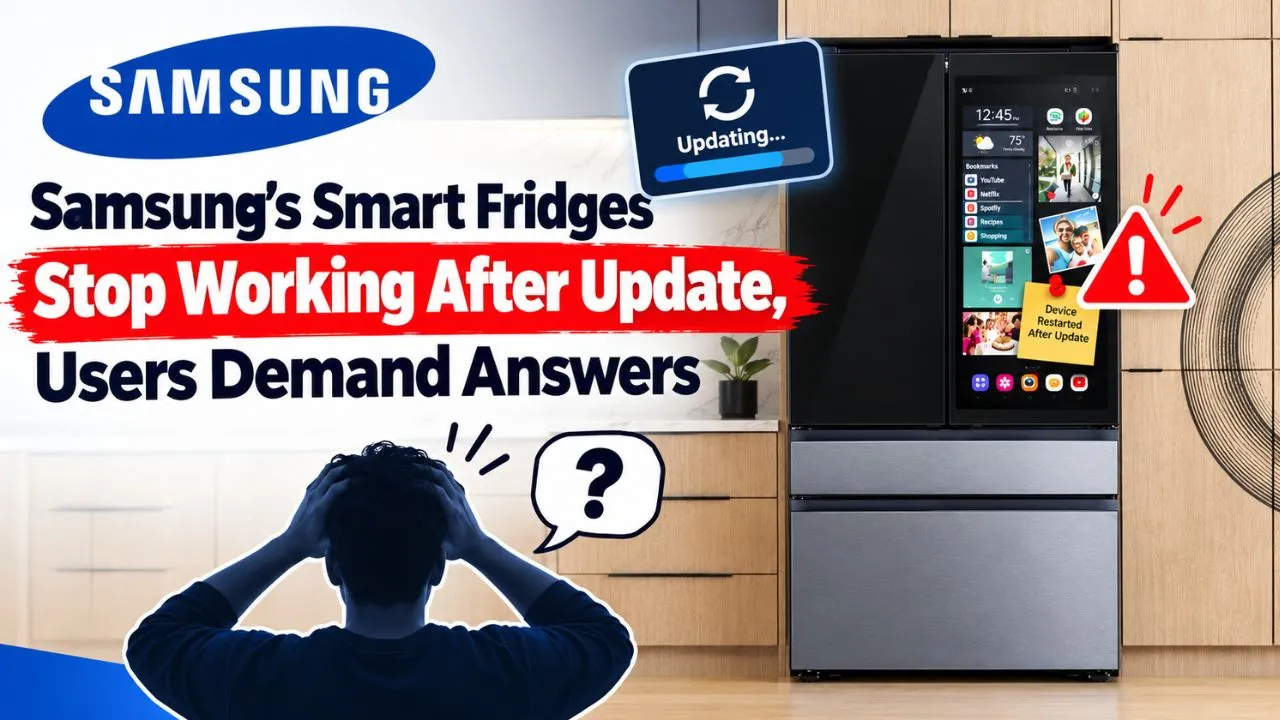
When “Smart” Goes Dark: Samsung’s AI Fridge Update Bricks Refrigerators Days Before Chuseok
A Software Push Meant to Improve Smart Fridges Instead Shut Them Down
For a growing number of Samsung refrigerator owners in South Korea, a routine software notification turned into a holiday nightmare. On the afternoon of September 22, Samsung began rolling out a SmartThings update to its connected refrigerator lineup — and instead of adding features, the update knocked units out entirely, just as households were preparing for Chuseok, one of the biggest food-centric holidays of the year.
What Went Wrong
According to reports from Star News Korea and SBS News, owners who tapped the update notification in the SmartThings app found their refrigerators unresponsive minutes later. Descriptions from affected users painted a consistent picture: the interior light off, the touch panel dead, and cooling stopped completely. Some units froze mid-update, stuck on an “updating” screen that never cleared, and wouldn’t reset even after owners cut the power and plugged the unit back in.
The timing made it worse. Chuseok is a holiday built around home-cooked meals and stocked kitchens, and several owners said in posts on Samsung’s own community forum, Samsung Members, that days of prepared holiday food would now have to be thrown out.
The Cause: A Test Build Sent to Real Customers
The most-affected units belong to Samsung’s Bespoke AI 4-Door series, part of the smart refrigerator lineup the company has been expanding since 2024. Per ZDNet Korea, the root cause wasn’t a bug in a finished update — it was a deployment error that pushed internal test software to production units. In other words, code meant for Samsung’s own engineers to evaluate ended up on customers’ kitchen appliances.
Samsung told ZDNet Korea it identified the mistake and halted the rollout immediately, but for households whose fridges had already pulled the update, the damage was already done.
Samsung’s Response, and Its Limits
Samsung has publicly apologized for the disruption and is asking affected owners to book an in-person engineer visit, since the fix reportedly can’t be done remotely — a technician has to physically inspect the unit. In the meantime, the company’s advice has been low-tech: move perishables into ice boxes.
That guidance ran straight into a second problem. Multiple users reported that Samsung’s booking system itself buckled under the sudden spike in service requests, making it hard to even schedule the repair Samsung was recommending.
Samsung Electronics Service says it will keep engineers and call-center staff working through the holiday period for urgent cooling failures, with SBS citing September 26 and 27 as available service dates. But at least one customer said a local service center told them no visit would be possible until after Chuseok — leaving a gap of several days with a dead refrigerator and no clear timeline.
The Open Questions
As of now, Samsung hasn’t disclosed how many refrigerators were affected by the faulty push, and it hasn’t announced any compensation for the food owners have lost. With official channels overwhelmed, some households have improvised their own fix, packing fridges with dry ice to keep food from spoiling while they wait for a technician.
The Bigger Lesson: What Happens When a Fridge Needs Wi-Fi to Work
This incident is a sharp reminder of a trade-off that gets little attention when smart appliances are marketed: a refrigerator that can receive AI-powered software updates is also a refrigerator that can be broken by one. A traditional fridge fails mechanically, over years, and usually gives some warning. A connected fridge can fail instantly, for every affected unit at once, because of a mistake in a deployment pipeline hundreds of miles from anyone’s kitchen.
For Samsung, the immediate priority is clearing the repair backlog before more food spoils and trust erodes further. For consumers, the episode raises a question worth sitting with: as more home appliances ship with constant connectivity and over-the-air updates, how much of daily life — a full fridge, a cool home, a working stove — should depend on a company’s software pipeline staying error-free?
1. What exactly happened to Samsung’s smart refrigerators?
A SmartThings software update pushed to Samsung’s connected refrigerators on September 22 caused some units to shut down entirely — cooling stopped, the touch panel went unresponsive, and the interior light turned off, right after owners applied the update.
2. Which Samsung refrigerator models were affected?
Most reported failures involve the Bespoke AI 4-Door series, part of Samsung’s smart refrigerator lineup launched from 2024 onwards.
3. What caused the update to break the refrigerators?
According to ZDNet Korea, the failure traces back to a deployment error that pushed internal test software — meant only for Samsung’s own engineers — out to customer units instead of a finished, verified update.
4. Did Samsung stop the update rollout?
Yes. Samsung told ZDNet Korea it identified the deployment error and halted distribution immediately, though units that had already received the update were still affected.
5. Can owners fix a bricked fridge themselves?
No. Samsung says the affected units need an in-person engineer visit to diagnose and repair, since the failure can’t be resolved remotely by restarting or power-cycling the unit — several owners confirmed that pulling the power and plugging it back in did nothing.
6. What should owners do while waiting for repair?
Samsung has advised moving perishable food into ice boxes in the meantime. Some owners have resorted to packing their fridges with dry ice as a stopgap to slow spoilage further.
7. Is Samsung offering emergency repair service during the Chuseok holiday?
Samsung Electronics Service says it will keep engineers and call-center staff on duty through the holiday for urgent cooling failures, with SBS News citing September 26 and 27 as available service dates — though some customers report being told a visit isn’t possible until after the holiday.
8. Is Samsung compensating customers for spoiled food?
As of the latest reports, Samsung has not announced any compensation plan for food lost due to the outage, nor has it disclosed how many units were affected.
9. Is this problem limited to South Korea, or could it affect other regions?
All current reporting on this incident is specific to South Korea, where the update rollout and failures were first observed. There’s no confirmation yet on whether the same faulty update reached Bespoke AI 4-Door units sold in other markets.
10. What does this incident say about smart, connected appliances in general?
It highlights a trade-off often overlooked in smart-appliance marketing: a refrigerator that can receive AI-powered software updates over Wi-Fi can also fail instantly and at scale if something goes wrong in that update pipeline — a risk traditional, non-connected refrigerators don’t carry.
Read Also:
- From Magazine Pages to Digital Audiences: How The Success Prime Magazine Extends Every Print Campaign Online
- The Business of Being Unaffordable: How Rising Costs Are Creating New Markets in America
- Top 10 Richest Politicians in America (2026 Net Worth Ranking)
- Start a Franchise for Under $15K: Top Affordable Options
- Why America’s Subscription Boom Is Real, But the Bill Comes Due Somewhere