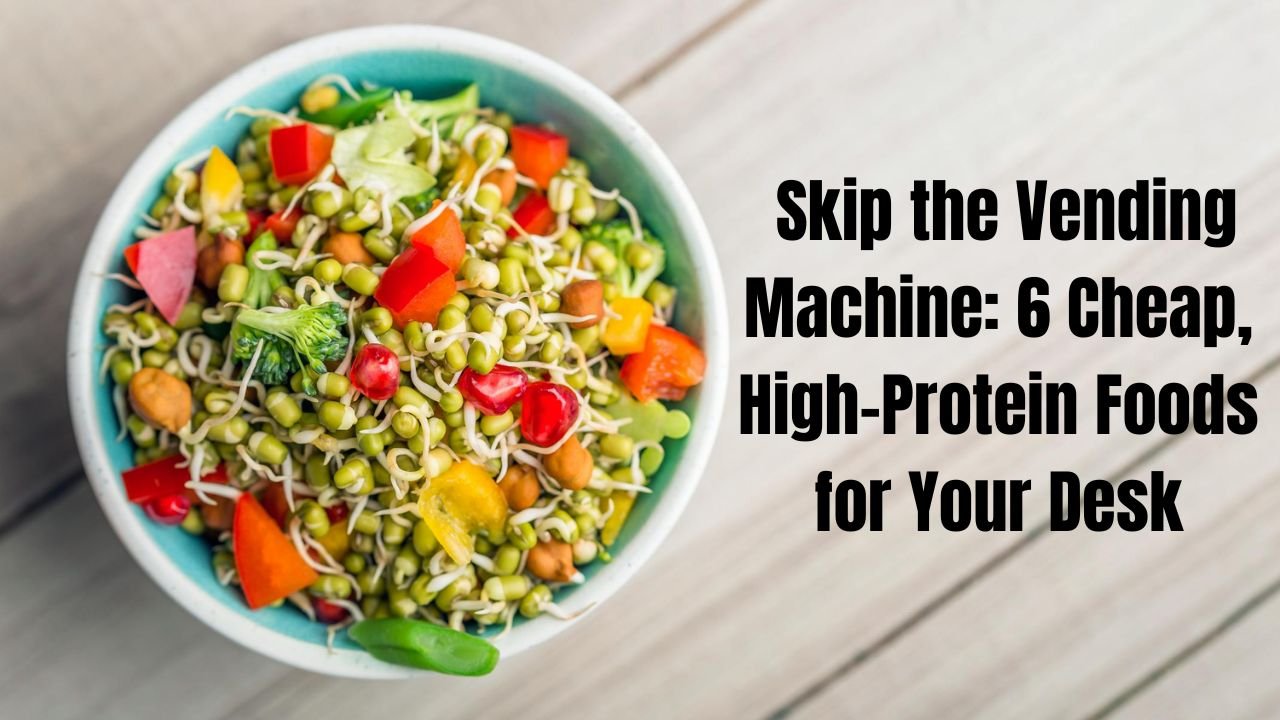
Skip the vending machine and the expensive protein bars. These six pantry-friendly foods keep you full, fit in a tiffin, and cost far less than you’d expect.
It’s 4 p.m. at your desk. Lunch was hours ago, a deadline is looming, and the office snack trolley is rolling by with biscuits, chips and namkeen. You grab something quick, feel a short burst of energy, and then crash within the hour.
It’s a familiar story, and a big reason is what’s missing from those snacks: protein. Protein digests more slowly than refined carbohydrates, which helps you feel full for longer and keeps you from hunting for your next snack every ninety minutes. The good news is that you don’t need expensive supplements, imported protein bars or a gym-influencer meal plan to get more of it.
Here are six budget-friendly, office-friendly foods that can do the job, with how much protein each one gives, how to carry it, and how to make it taste good.
A quick note on numbers: protein figures vary a little between sources and brands, and prices change by city and season. Treat the values below as ballpark guides, and check the label on whatever you buy.
1. Roasted chana: the desk-drawer classic
If there is one food that deserves a permanent place in your office drawer, it’s roasted chana. It’s cheap, it needs no fridge, and it’s ready to eat the moment you open the packet.
Protein: Roasted chana provides about 20 to 22 grams of protein per 100 grams. In snack-sized terms, 50 grams of roasted chana has about 12 grams of protein, although other sources put a 50-gram portion nearer 10 grams, depending on the product. Either way, that is a solid mid-afternoon top-up.
Why it works at the office:
- It’s shelf-stable, so you can keep a packet at your desk for weeks.
- Chickpeas have a high protein-to-calorie ratio, around 22% of calories from protein for cooked white chana, which is higher than rice or wheat roti.
- It’s also rich in fibre, which helps with fullness.
- Roasted chana is named among the cheapest vegetarian protein sources, along with lentils and soya chunks.
How to eat it: Straight from the packet, or mixed with chopped onion, tomato, green chilli and a squeeze of lemon for a quick chaat. Add a pinch of chaat masala and it feels like a treat.
Watch out for: Flavoured or heavily salted packets. Plain roasted chana is the better pick, and you can add your own spices.
2. Boiled eggs: portable, filling and fast
For people who eat eggs, a boiled egg is hard to beat. It arrives in its own packaging and needs no cutlery.
Protein: One large egg typically provides about 6.3 grams of protein. Two eggs give you around 12 to 13 grams, about the same as a good handful of roasted chana, in a lighter and softer snack.
Why it works at the office:
- Boil a batch on Sunday and carry two or three a day. (Keep them chilled and eat them within a few days.)
- Eggs are also a source of other useful nutrients. Egg yolks are one of the best food sources of choline, and eggs provide B vitamins and vitamin D.
- Few foods deliver this much for so little money.
How to eat it: Peel, sprinkle with salt, pepper and chilli flakes, or slice into a sandwich or salad.
Watch out for: Your own health situation. If you have diabetes, high cholesterol or heart disease, ask your doctor how many eggs suit you. For most healthy adults, the American Heart Association says up to one whole egg a day fits a heart-healthy pattern, and the boiled egg should be fully cooked, not runny, for safety. Also remember that office fridges aren’t always reliable, so don’t leave boiled eggs sitting at room temperature for hours.
3. Peanuts and peanut butter: tiny, cheap, powerful
Peanuts are technically legumes, not nuts, and they are one of the best protein-per-rupee foods you can buy.
Protein: Peanuts have roughly 25 to 26 grams of protein per 100 grams, and a 50-gram handful delivers about 13 grams of protein at a cost of roughly ₹5 to ₹10. Prices will vary, but peanuts typically sell for about ₹120 to ₹180 per kilo.
Why it works at the office:
- No refrigeration, no cooking and no mess.
- A small jar of peanut butter lasts for weeks. Spread it on whole-wheat bread, a banana or even a roti.
- A handful keeps you full for a surprisingly long time.
How to eat it: Roasted peanuts with a little onion and tomato for a quick sundal-style snack, or peanut butter on toast for breakfast at your desk.
Watch out for: Portions. Peanuts are protein-rich but also energy-dense. They contain about 567 calories per 100 grams, and as one guide puts it, don’t eat too many, as peanuts are also high in fat and calories. A small handful, not the whole packet, is the right amount. Check peanut butter labels too, since some brands add lots of sugar and oil. And of course, skip peanuts entirely if you or a colleague has a peanut allergy.
4. Curd and hung curd: the cooling protein
Plain curd (dahi) is a staple in many Indian lunchboxes, and with a small tweak it becomes a stronger source of protein.
Protein: Ordinary curd is modest. It provides about 3.5 grams of protein per 100 grams, compared with about 10 grams for Greek yoghurt. The difference comes from straining away the whey. At home, you can get a similar effect by hanging curd in a muslin cloth for a few hours, and 100 grams of hung curd with berries gives roughly 10 to 12 grams of protein as an evening snack.
Why it works at the office:
- It’s cooling and easy on the stomach, which is welcome in a hot, stuffy office.
- It pairs with almost anything: fruit, roasted seeds, chopped cucumber or a pinch of roasted cumin.
- Curd and hung-curd dips can be part of a protein-rich snack, and many families already have it in the fridge.
How to eat it: A small tiffin of thick curd with cucumber and mint, or hung curd mixed with chopped vegetables as a dip for roasted chana or whole-wheat crackers.
Watch out for: Refrigeration. Curd needs to stay cool, so carry it in an insulated bag with an ice pack, or keep it in the office fridge in a clearly labelled box. Choose plain, unsweetened curd, since flavoured yoghurts can pack in a lot of sugar.
5. Paneer: the vegetarian’s protein block
Paneer is the most versatile vegetarian protein in Indian kitchens, and a small cube goes a long way.
Protein: Paneer has roughly 18 to 20 grams of protein per 100 grams. Some sources list a lower figure, so the exact amount depends on the type, since low-fat versions differ. An evening snack of 100 grams of paneer cubes gives about 18 grams of protein.
Why it works at the office:
- It is easy to turn into different dishes: bhurji, tikka, sandwiches, wraps or salad.
- It’s filling and pairs well with vegetables.
- A paneer bhurji sandwich or roti roll travels well and tastes good even cold.
How to eat it: Crumble it into a quick bhurji with onion, tomato and spices, or cube it with cucumber, capsicum and chaat masala for a salad.
Watch out for: The cost and calories. Paneer has about 258 calories per 100 grams, and it tends to be one of the pricier items on this list. Buy fresh paneer from a trusted shop and use it within a few days, or make it at home. A small portion mixed with vegetables stretches both budget and calories.
6. Soya chunks: the cheapest protein bomb
Soya chunks (nutri nuggets) are the secret weapon of budget protein, and many people overlook them.
Protein: Soya chunks provide about 52 grams of protein per 100 grams of dry weight, the highest on the list. Once soaked and cooked, the number drops because they absorb water. Soaked chunks have about 16 to 17 grams of protein per 100 grams. That is still a lot for something so cheap: they are described as the highest-protein vegetarian source and extremely economical.
Why it works at the office:
- A small packet makes many servings.
- They soak up spices, so a simple soya chunks masala or pulao is filling and cheap.
- They are easy to cook in bulk and pack for lunch.
How to eat it: Soak in hot water for ten minutes, squeeze out the water, and cook in a tomato-onion gravy, add to a veg pulao, or toss with spices and a little oil in a pan for a crunchy snack.
Watch out for: Variety. Soya is a good food, but it is best to rotate it with other protein sources rather than rely on it every day. If you have a soya allergy, a thyroid condition or other medical concern, check with your doctor first.
A bonus: sprouts and sattu
If you want a seventh option, consider these two.
- Sprouted moong chaat: Sprouted moong provides about 3 to 4 grams of protein per 100 grams, which is lower than the others, but it is light, cheap and a good way to add volume and fibre to your lunch.
- Sattu: Roasted gram flour is sometimes called India’s original protein drink, and stirring 30 grams into water with cumin and lemon gives roughly 6 to 8 grams of protein. It is simple and takes seconds to prepare at your desk.
A sample office day
To see how these foods fit together, here’s one way to build a day. Quantities are examples, not a prescription.
- Morning (at your desk): Peanut butter on whole-wheat toast with a banana.
- Mid-morning: A small handful of roasted chana.
- Lunch: Dal, roti, sabzi and a katori of curd, or a soya chunks pulao with raita.
- Evening snack: Two boiled eggs, or 100 grams of paneer cubes with cucumber.
- Optional: A glass of sattu water in the late afternoon.
One of the sources in my research showed a similar plan: roasted chana mid-morning, paneer sabzi with curd at lunch and a handful of peanuts in the evening adding up to roughly 49 grams of protein in the day, though your own needs depend on your body, activity level and health.
Quick cheat sheet
| Food | Rough protein | Needs fridge? | Best for |
|---|---|---|---|
| Roasted chana | 20–22 g per 100 g | No | Desk-drawer snack |
| Boiled egg | About 6 g each | Yes | Quick, filling snack |
| Peanuts / peanut butter | 25–26 g per 100 g | No | Energy, breakfast toast |
| Hung curd | About 10 g per 100 g | Yes | Cooling, light snack |
| Paneer | 18–20 g per 100 g | Yes | Lunch and evening snack |
| Soya chunks | 16–17 g per 100 g soaked | After cooking | Cheap protein-rich meals |
Approximate values, as discussed above. Brands and preparations differ.
Smart habits for an office protein routine
- Prep on Sunday. Boil eggs, soak and cook soya chunks, and hang a batch of curd. A little prep saves money and temptation all week.
- Pair protein with fibre. Chana, vegetables and fruit help you stay full for longer.
- Mind the portions. Peanuts and paneer are healthy, but they are also dense in calories.
- Store food safely. Eggs, paneer and curd need to stay cold. Use an insulated bag or the office fridge.
- Check labels. Pre-packed snacks are often loaded with salt, sugar or oil.
- Drink water. Fibre-rich foods work best with enough fluids.
Who should be careful?
Protein is good for most people, but it isn’t one-size-fits-all. If you have kidney disease, diabetes, high cholesterol, a food allergy, or a medical condition that needs a special diet, speak to your doctor or a registered dietitian before changing what you eat. The same goes if you’re pregnant or managing a long-term health issue. A single general guide, including this one, can’t replace personal advice.
The bottom line
Eating more protein at the office doesn’t need to be expensive, complicated or fancy. A packet of roasted chana, a couple of boiled eggs, a small jar of peanut butter, a tub of thick curd, a handful of paneer cubes and a bag of soya chunks can cover a full working week for a few hundred rupees.
Start small: swap one biscuit break this week for roasted chana or a boiled egg. See how you feel by the end of the afternoon. Chances are the 4 p.m. crash will be a little gentler, and your wallet will thank you too.
Disclaimer: This article is for general information and is not medical or dietary advice. Nutrition values and prices are approximate and vary by brand, region and season. Please consult a doctor or registered dietitian for advice that fits your health needs.