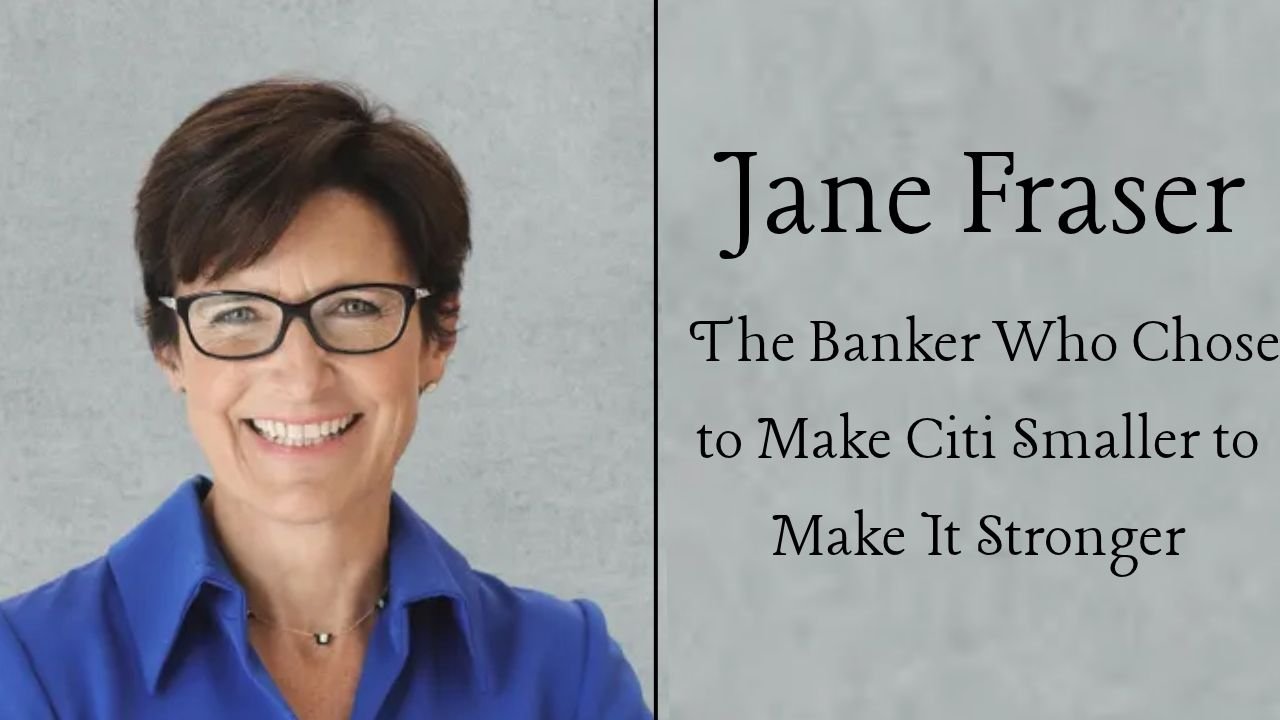
Jane Fraser became CEO of Citigroup in 2021 as the first woman to lead a major U.S. bank. Here is how she is simplifying Citi, what the latest results show, and what leaders can learn.
Most CEOs are rewarded for growth. Jane Fraser’s defining move at Citigroup was the opposite: she decided that a global bank with too many businesses was a weaker bank, and she began cutting. Years in, the experiment is producing numbers that are hard to ignore, along with some questions that aren’t.
What stands out to me is that the boldest move in this story isn’t an acquisition, it’s a decision to sell.
This article walks through who Fraser is, how she is reshaping Citi, what the latest quarter says, and what founders and executives can borrow from her playbook.
Who Is Jane Fraser?
Jane Fraser is the Chair and Chief Executive Officer of Citigroup. She became CEO in March 2021 and added the Chair role in October 2025. She is widely known as the first woman to lead a major U.S. bank, but her career is about more than that milestone. It’s a story of strategy, patience and an unusual willingness to shrink a giant.
Jane Fraser’s early career and education
Fraser didn’t start in a bank. She earned an M.A. in economics from the University of Cambridge and an MBA from Harvard Business School, then worked as a partner at McKinsey & Company, where she specialised in strategy and business transformation.
That consulting background shows in how she runs Citi. Instead of seeing a sprawling institution as a pile of departments, she looks for priorities, structure, discipline and measurable outcomes. It is a useful reminder that skills from outside banking can be exactly what a bank needs.
Her rise within Citi
Fraser joined Citi in 2004 and spent more than two decades in the building. Her roles included Global Head of Strategy and M&A, CEO of Citi Private Bank, CEO of Citi Latin America, and President and CEO of the Global Consumer Bank. So when she took the top job, she was an insider who already knew the clients, the international footprint and the internal problems.
Jane Fraser’s Leadership at Citi
Becoming the first woman to lead a major U.S. bank
When Fraser became CEO in March 2021, it was a historic moment, and also a hard one. Citi needed a clearer operating model, stronger controls, a simpler portfolio and better returns. Her leadership has therefore been judged on two levels: the symbolic one of breaking a barrier, and the practical one of building a stronger, more profitable bank.
A strategy built around simplification
Simplification is the thread running through her tenure. Citi has exited or sold several international consumer businesses that management saw as a poor fit with its long-term plan, so that capital and attention can go to businesses where it has real advantages.
Citi now describes itself through five connected businesses: Services, Markets, Banking, Wealth and U.S. Consumer Cards. Fraser’s argument is that a focused organisation decides faster, has clearer accountability and allocates resources better.
There is a lesson here that travels well beyond banking: growth doesn’t always mean adding more. Sometimes it starts with deciding what to stop doing.
How Jane Fraser Is Transforming Citi
Strengthening risk management and controls
For a global bank, risk management isn’t paperwork. It is the foundation of customer trust and regulatory credibility. Fraser has made strengthening Citi’s risk and control environment a central pillar of the transformation, investing in automation, modernisation and operational resilience while simplifying the structure.
Why this matters now: cybersecurity, AI, geopolitical shocks, data governance and financial crime can hit a bank all at once. Her approach treats technology and risk as partners that must evolve together, not as separate to-do lists.
Building a more technology-driven bank
Technology is the other major pillar. For modern banks, it’s no longer about launching a nicer app. It’s about scalable infrastructure, clean data, automated controls and digital experiences that work across borders.
AI is a growing part of the story. Reuters reported in May 2026 that Citi was exploring AI opportunities, including an initiative called “Sky” in wealth management. And after the latest results, Fraser said Citi is preparing for what has been described as an “AI-driven future.”
Jane Fraser’s Results and Citi’s Performance
A stronger financial picture
Citi reported $85.2 billion in revenue for 2025, its highest in more than a decade, despite selling several businesses. It also reported a 7.7% return on tangible common equity (8.8% excluding two notable items) and returned $17.6 billion to common shareholders, according to the bank.
The latest numbers: Q3 2026
The most recent quarter adds a fresh data point, and it comes with a footnote worth understanding.
- Citigroup reported third-quarter 2026 net income of $5.2 billion, or $2.85 per share, on revenue of $23.8 billion. Revenue rose 8% year over year, which Fraser described as the best third-quarter revenue in a decade, with growth in four of its five businesses.
- Return on tangible common equity (RoTCE) was 11.5%, up 180 basis points from a year earlier. For the first nine months of 2026, RoTCE was 12.6%. Citi now expects full-year RoTCE above 11%, up from the 10% to 11% target it had carried since January.
- Services, the strongest performer, saw revenue up 15% to $6.61 billion. Wealth net income rose 93% to $585 million, with RoTCE of 14.3% versus 7.8% a year earlier.
- Expenses were $14 billion, down 2%, and management expects a full-year efficiency ratio below 60%.
Why you’ll see two different growth numbers. Some outlets say net income rose 40%, others say 17%. Both can be right. The prior-year quarter included a goodwill impairment of $726 million. Against the reported base, profit jumped about 40%, but excluding that notable item, last year’s net income was $4.5 billion, so the underlying growth is nearer to 17%. When reading bank results, always check whether a one-off item is distorting the comparison.
The soft spots
Not everything improved. U.S. Consumer Cards revenue was broadly flat at $4.66 billion, and net income fell 8% as higher partner payments and rewards expenses offset higher net interest income. In Markets, net income grew only 2% and fell 27% from the previous quarter. And provisions for credit losses rose 6% to $2.59 billion. citigroup q3 profit jumps beating wall street estimates .
Earlier in the year, the market also reacted coolly to the second quarter, when Citi shares fell as investors focused on rising expenses and the second-half outlook, even though revenue hit a decade high. That tension is the heart of any turnaround: strong results today, and proof that they’re durable tomorrow.
What Leaders Can Learn From Jane Fraser
1. Simplification creates strength. Complexity is expensive, and a company can have many businesses without a clear strategy. Review every product line, market and process regularly, and ask whether it still earns its place.
2. Transformation takes patience and accountability. Citi’s overhaul involved divestitures, restructuring, technology investment, tighter controls and cultural change. Fraser tied it to measurable targets, including return metrics. Citi has said it aims for an 11–13% near-term return goal, and Fraser said Citi expects to exceed this year’s target even while pulling forward investments.
3. Leadership means making hard choices. Exiting businesses can cut revenue in the short run, but frees capital and focus. Size isn’t strength.
4. Read results critically. A good leader (and a good reader) looks past headline growth to one-offs, expenses and credit quality.
5. Pair efficiency with investment. Cutting costs while still funding technology, AI and controls is harder than doing either alone, and it’s where many turnarounds stall.
Jane Fraser’s Broader Influence on Financial Leadership
Fraser’s influence reaches beyond Citi. In 2026, she was appointed to the Federal Reserve Board’s Federal Advisory Council for a one-year term, representing the Second Federal Reserve District. She also holds roles at the Financial Services Forum, Business Roundtable, Council on Foreign Relations and Partnership for New York City, and has been awarded a damehood by King Charles III for services to the financial sector.
Today’s bank CEOs take part in conversations about trade, technology, regulation, economic policy and geopolitical risk, so these roles show how far the job now extends.
What Comes Next for Jane Fraser and Citi?
The next phase of the transformation
The second half of the job is harder than the first. Simplifying Citi was one challenge; proving the simpler Citi can keep beating expectations is another. Expect the focus to shift toward growth: expanding Services and Wealth, building institutional franchises, and using AI more effectively, all without letting costs and complexity creep back.
A long-term leadership test
The numbers so far are encouraging, but investors will keep watching expenses, credit costs and the weaker corners of the portfolio, such as consumer cards. For Fraser, the goal isn’t one strong year. It is a Citi that is simpler, more resilient, technologically capable and consistently profitable.
Frequently Asked Questions About Jane Fraser
Who is Jane Fraser?
She is the Chair and CEO of Citigroup. She became CEO in March 2021 and Chair in October 2025. She previously led Citi’s Global Consumer Bank, Private Bank and Latin America business, and worked at McKinsey. She holds an MBA from Harvard Business School and an M.A. in economics from Cambridge.
When did Jane Fraser become Citi CEO?
In March 2021, making her the first woman to lead a major U.S. bank.
What is Jane Fraser’s leadership strategy?
Simplification, stronger risk and controls, technology modernisation, disciplined capital allocation, and growth in the businesses where Citi has a competitive edge.
What has Jane Fraser achieved at Citi?
Citi exited several international consumer businesses, reorganised around five core businesses and reported its highest annual revenue in more than a decade in 2025. Its latest quarter delivered the best third-quarter revenue in ten years.
Is Jane Fraser still the CEO of Citi?
Yes. As of the third-quarter 2026 results announced on 13 October 2026, she remains Citi’s Chair and CEO.
What can entrepreneurs learn from Jane Fraser?
Focus, hard choices, measurable goals and long-term execution. Sometimes the strongest growth strategy is removing distractions.
What is RoTCE, and why does it matter?
Return on tangible common equity measures how much profit a bank earns on its shareholders’ tangible equity. It’s a key yardstick for judging whether a bank’s turnaround is really paying off.
Conclusion: The Leadership Legacy of Jane Fraser
Jane Fraser’s story is a story about transformation. She inherited a complex global bank with a pressing need for stronger execution, and she responded by simplifying, strengthening controls, modernising technology and concentrating on businesses with the most potential. The 2025 and 2026 results suggest the plan is gaining traction, though the long-term test remains whether those gains last.
For the wider business world, Fraser offers a clear lesson: meaningful change takes more than a big vision. It takes difficult choices, accountability and the discipline to keep executing when results take time. As banking enters an era shaped by AI, geopolitics and shifting customer expectations, her next chapter may prove as significant as the milestone that put her in the corner office.
For smaller businesses, the question is the same: what is one product or client you keep only out of habit?