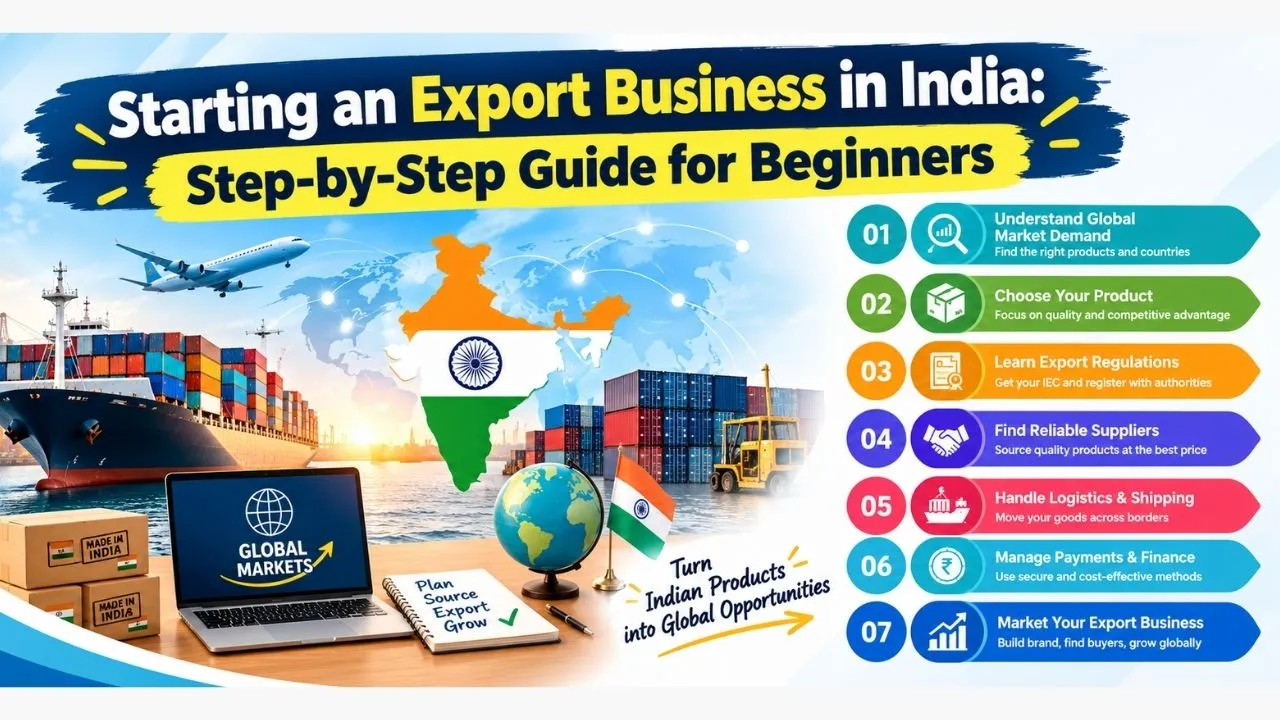
The narrative has settled, it is also wrong. Starting an export business in India is routinely treated as a paperwork exercise, it is not. By mid-2026, the gap between acquiring an Import Export Code and actually shipping profitable cargo has widened into a structural divide. Founders treating global trade as a simple arbitrage play are quietly watching margins evaporate. In customs holds freight surcharges. Operators who treat it as a compliance architecture, a logistics calibration, a payment-risk mitigation engine; those are the ones quietly widening net margins. The market is not waiting for more products, it is pricing in operational discipline. On paper, the DGFT portal looks like a gateway. In practice—well, practice is a negotiation with customs brokers, freight forwarders. The quiet calculus of whether a Letter of Credit will actually clear. Friction, left unmanaged, turns a global ambition into a stranded inventory ledger,quietly,without warning.
Starting an Export Business in India: Essential Steps and Requirements
Product Selection and Finding Profitable Export Markets
Product selection operates as the first constraint, always product selection. The reflexive push toward “what we can manufacture” has hardened into a margin-eroding default. Global buyers do not care about domestic production surpluses, or government incentives, they care about specification compliance, consistent yield, landed cost predictability. A buyer in Hamburg does not care about your PLI scheme, they care if the moisture content matches the contract. Historical trade data,HS code tariff structures, real-time buyer inquiry velocity inform the architecture. Spreadsheets that ignore non-tariff barriers become exercises in optimism. Optimism does not clear the port, it never has. Export deployments routinely fracture, not because of weak product quality, but because the wrong HS codes were staged for the wrong destination market. Triggering anti-dumping duties, erasing years of margin. The friction lives in the handoff, between domestic manufacturing and international compliance. That handoff is where value leaks. When selection treats global demand as a static variable rather than a dynamic regulatory equation, operators guarantee container rejections. At the destination port while carrying dead stock the warehouse, calibration is not complexity, it is risk pricing. Simple in theory, messy in execution.
Export Compliance, Licences and Regulatory Requirements in India
Regulatory architecture operates on a different frequency. The compliance pipeline that flooded trade forums between 2020 and 2023 has contracted under stricter quality control mandates and evolving geopolitical sanctions. Capital and time have rotated toward proactive certification and RCMC alignment and real-time duty drawback optimization. The friction lies in documentation latency, customs clearance delays. Operators who secured advanced quality certifications and locked in export promotion council memberships before the compliance crackdown accelerated are sitting on compounding trust. Those who relied on basic IEC registration are watching shipment velocity compress under physical inspections and documentary discrepancies. Audits of trade dashboards consistently highlight a pattern: the difference between a profitable quarter and a demurrage drain is not product superiority. It is documentation precision, post-shipment routing. The market is no longer rewarding volume, it is rewarding regulatory precision. Precision, properly engineered, is the only trade vector that compounds. Everything else is speculation dressed up as strategy. Shipments that appear flawless in the factory routinely collapse. Because the certificate of origin lacked a minor consular stamp or because the packing list leaked a discrepancy, at the bill of lading stage. That is the friction, that is the reality.
Export Logistics, Incoterms and Shipping Risk Management
Logistics and Incoterms expose the physical vulnerability of the trade. The narrative of FOB supremacy has largely given way, to structured CIF and DAP workflows. Risk calibration, the promise of handing over goods at the nearest port is tightening. But not as a limitation, they function as margin filters. The difference between a freight forwarder and a logistics partner is the difference between a vendor and a strategic ally. One moves boxes, the other solves problems before they reach the port. The operators who maintain healthy trade margins are not the ones with the highest shipment volume. They are the ones with the clearest Incoterm selection, the most disciplined freight forwarding partnerships, the highest conversion from ex-works to delivered acceptance. Generic freight booking has stopped functioning as a cost center,it now functions as a margin anchor. Predictability, properly engineered, is the only logistics lever that compounds through shipping cycles. Freight forwarders at mature ports routinely reject blanket space commitments. Because the documentation lift does not align with vessel schedule capacity. That is not caution, that is clarity. Fragmented logistics strategy is not merely a shipping challenge, it is a behavioural signal. Ignoring it is a strategic failure, structuring it is margin defense.
International Export Payments and Foreign Exchange Risk Management
Payment architecture exposes the core financial vulnerability. The old model of open account terms and handshake agreements has given way to hybrid routing architectures: Irrevocable Letters of Credit. ECGC insurance, real-time credit rating tracking across buyer portfolios. Currency hedging is no longer a luxury for large conglomerates. It is a mandatory operational line item for mid-tier exporters. The exchange rate between the Indian rupee and the US dollar keeps changing and if any business is not considering these changes while making any plans then they are making a serious mistake in planning. The revenue forecast of any companies should be seen only as a rough guidance about the future and it should not be considered as a promise of actual earnings.
The operators who succeed do not promise fastest market penetration. They design transparency into their payment architecture. Align credit terms with actual buyer solvency probability. Mid-tier exporters routinely abandon rigid open account strategies in favor of adaptive LC modules that adapts to geopolitical risk shifts, currency fluctuation constraints. It is messier to negotiate, it is also far more resilient. The risk lies in over-optimistic buyer trust modelling and underestimating the operational overhead of documentary compliance. Flexibility is not a free option, it is a priced-in trade-off. Trade-offs, properly structured, are solvency defense. The entities that treat ECGC coverage as a regulatory checkbox are the ones carrying bad debt, erasing export margins. Those that treat it as a structural lever are the ones converting payment security into aggressive market expansion.
Export Quality Control, Packaging and Safe Transit Management
Quality control and packaging function as the silent deal breaker. The export packaging narrative has evolved from “protect the product”, to “survive the supply chain”. The maritime logistics reality between 2022 and 2024 has forced a recalibration of material science. The domestic packaging model that ignored humidity, salt air, rough handling is now facing claim rejections, that erase freight margins.
Operators who secured ISPM-15 compliant wood packaging and vacuum-sealed moisture barriers before the claim acceleration are sitting on compounding buyer retention. Those who relied on standard domestic corrugation are watching profit margins compress, under demurrage claims, cargo damage disputes.
Audits of claim dashboards consistently highlight a pattern: the difference between a repeat buyer and a terminated contract is not product quality. It is packaging resilience, transit durability. The market is no longer rewarding cheap packaging,it is rewarding transit survival. Precision, properly engineered, is the only retention vector that compounds. Everything else is speculation dressed up as cost-saving. Containers that appear flawless at the factory gate routinely collapse. Because the palletization failed to account for container stacking weight. Or because the moisture barrier leaked at the transhipment stage.
What ties these operational threads together is not the allure of foreign exchange. It is structural realism. The export window in mid-2026 is not a market waiting for a government subsidy to restore growth. It is a market pricing in a new baseline- Compliance constraints, logistics friction and capital discipline. The operators who adapt treat every shipment as a live balance sheet, monitoring documentation accuracy and stress-testing freight capacity, aligning payment terms with buyer predictability rather than speculative volume generation.
The broader lesson is straightforward: global trade has stopped being a manufacturing extension exercise, become an active compliance and logistics discipline. The gap between exporters that recognize this and those that do not is no longer measured in container counts. It is measured in net realized margin. The market will not reward domestic scale,it will reward international precision and in the current cycle, precision is the only margin left. The only one worth defending,the only one that compounds through trade cycles.
Read Also: