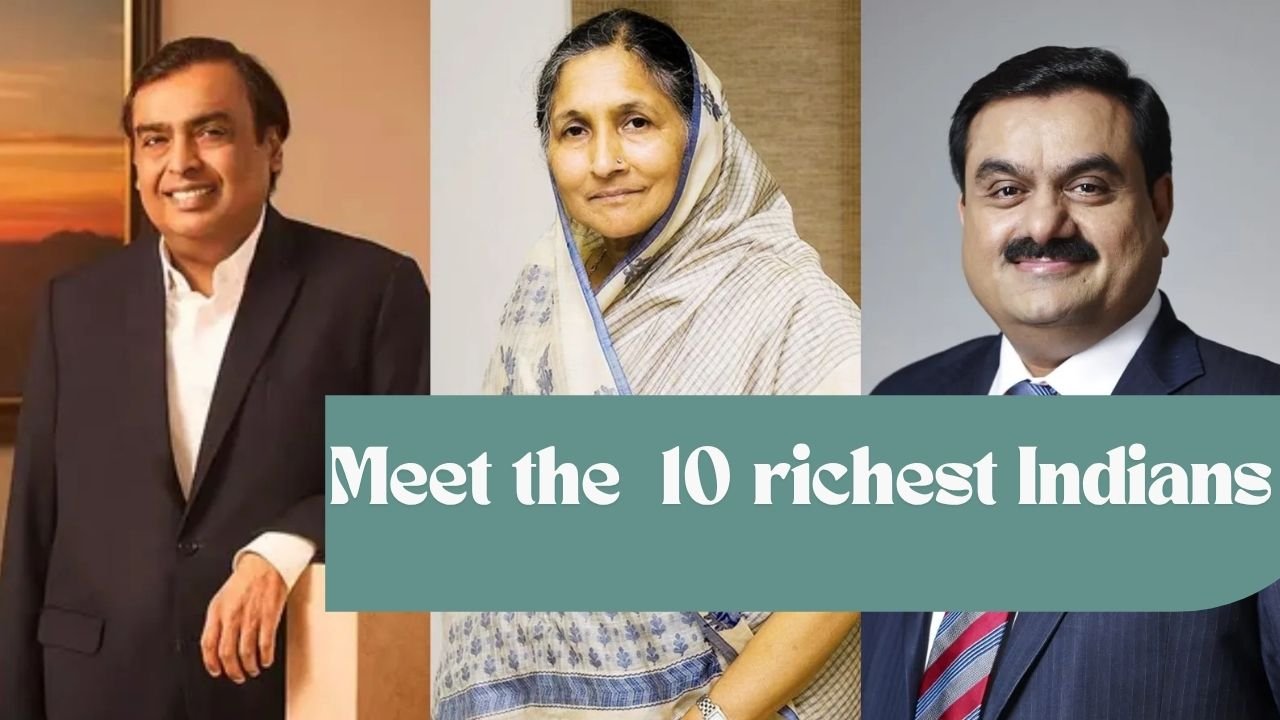
I’ll be honest — I’ve read more “richest person” lists than I probably should admit to as someone who writes about business for a living. Most of them blur together after a while: the same five or six names shuffling around a few positions, the same predictable headlines. But every year, when Forbes drops its fresh India rich list, I still find myself genuinely curious. Not just about the numbers, which are almost too large to emotionally process, but about what they actually represent — decades of risk, reinvention, and in a few cases, sheer stubbornness that paid off spectacularly.
So here’s my personal walkthrough of the Top 10 Richest Indians in 2026, according to Forbes, compiled via The Success Prime’s latest rankings. Some of these names will be obvious before you even click. A couple might surprise you.
India’s Billionaire List 2026: Net Worth and Business Empires
1. Gautam Adani & Family — $112.7 Billion
There’s no soft way to open this list: Gautam Adani’s net worth sits at a staggering $112.7 billion, putting him comfortably at No. 1 on India’s 2026 rich list. What strikes me most about Adani isn’t just the number — it’s the breadth of what sits underneath it. Ports, energy, airports, cement, data centers. It’s less “one big bet” and more “own a piece of everything India needs to keep running.” Love it or question it, that’s a genuinely different wealth-building philosophy than most billionaires take.
2. Mukesh Ambani — $86.3 Billion
I don’t think I’ve ever written an India business article that didn’t eventually circle back to Mukesh Ambani. At $86.3 billion, Reliance Industries’ chairman remains the most consistently dominant name in Indian business — telecom, retail, energy, all under one roof. What’s genuinely interesting watching his trajectory over the years is how deliberately he’s repositioned Reliance from an oil-and-gas legacy business into a consumer-facing digital and retail empire. That’s not luck. That’s long-game thinking.
3. Savitri Jindal — $39.8 Billion
This is the one that always makes me pause. Savitri Jindal, at $39.8 billion, is the highest-ranked woman on this list, having taken the reins of the Jindal Group conglomerate after her husband’s passing. There’s something genuinely striking about a woman who wasn’t raised to run a steel and energy empire ending up as one of its most successful stewards — not just holding the fort, but actively growing it.
4. Lakshmi Mittal — $34.7 Billion
Ask most people outside India to name an Indian billionaire, and Lakshmi Mittal often comes up before anyone else — which makes sense, given he built ArcelorMittal into the world’s largest steelmaker through an aggressive, decades-long series of acquisitions across continents. At $34.7 billion, Mittal remains proof that Indian wealth isn’t confined to India’s borders.
5. Sunil Mittal & Family — $32.9 Billion
No relation to Lakshmi, but equally formidable in his own lane — Sunil Mittal’s Bharti Airtel helped define how an entire country adopted mobile connectivity. At $32.9 billion, his wealth reflects one of the clearest “right place, right infrastructure bet, right time” stories in modern Indian business.
6. Cyrus Poonawalla — $28.4 Billion
Here’s a name that deserves more mainstream recognition than it usually gets. Cyrus Poonawalla, at $28.4 billion, runs the Serum Institute of India — the world’s largest vaccine manufacturer by volume. If you’ve ever been vaccinated anywhere in the world, there’s a real chance a Poonawalla-made dose was involved. That’s a quieter kind of global influence than flashy headlines usually capture.
7. Shiv Nadar — $27.4 Billion
Shiv Nadar’s HCL Technologies helped put India on the global IT-services map decades before “Indian tech” became an industry buzzphrase. At $27.4 billion, Nadar represents something I find genuinely admirable: he’s also become one of India’s most committed philanthropists, pouring enormous resources into education through the Shiv Nadar Foundation.
8. Dilip Shanghvi — $26.3 Billion
Dilip Shanghvi built Sun Pharmaceutical from essentially nothing into India’s largest pharmaceutical company and a genuine global player in generic medicine. At $26.3 billion, his story is one of the more understated founder journeys on this list — less media spotlight, more relentless execution.
9. Kumar Mangalam Birla — $23.2 Billion
The Aditya Birla Group spans cement, telecom, financial services, and fashion retail, and Kumar Mangalam Birla, at $23.2 billion, has spent his career expanding a century-old family conglomerate into genuinely modern sectors rather than just preserving legacy businesses. That balancing act — tradition plus reinvention — isn’t easy to pull off.
10. Hinduja Family — $21.2 Billion
Closing out the list is the Hinduja Family, worth a combined $21.2 billion, whose business empire spans banking, automotive, media, and healthcare across multiple countries. Few Indian business families have built as genuinely global a footprint while still staying closely tied to their Indian roots.
What This List Actually Tells Us
Writing this out, what strikes me most isn’t just the size of these fortunes — it’s how differently each of these ten people built them. Infrastructure bets, inherited legacies turned into something bigger, global manufacturing dominance, quiet pharmaceutical empires, a vaccine business most people never think about until they need it. India’s richest in 2026 aren’t one archetype. They’re ten completely different answers to the same question: what does it actually take to build something this big, in a country this complex, over a timeline this long?
That’s the part of these lists I keep coming back for — not the numbers themselves, but the decades of decisions sitting quietly behind them.
Data and rankings sourced from Forbes’ 2026 list, as compiled by The Success Prime.
1. Why does Gautam Adani’s net worth fluctuate so sharply compared to others on this list?
A large share of Adani’s wealth is tied to the market value of his publicly listed companies (ports, energy, cement), so stock price swings move his net worth far more dramatically day-to-day than someone like Cyrus Poonawalla, whose wealth sits in a largely private company.
2. How is Savitri Jindal’s wealth different from a typical “self-made” billionaire?
Jindal inherited leadership of the Jindal Group after her husband O.P. Jindal’s death in 2005, making her one of the few people on this list whose fortune reflects successful stewardship and expansion of an existing empire rather than building one from scratch.
3. Which industry shows up most often across this top 10?
Diversified conglomerates (spanning energy, metals, telecom, and infrastructure together) appear more than any single-sector business, reflecting how Indian billionaire wealth tends to be built across multiple industries rather than one specialty.
4. Is Lakshmi Mittal’s wealth actually generated in India?
Not primarily. ArcelorMittal’s operations are spread across Europe, the Americas, and Asia, making Mittal one of the clearest examples on this list of Indian-origin wealth built largely outside India itself.
5. How did Cyrus Poonawalla’s vaccine business become a multi-billion-dollar fortune?
Serum Institute of India produces vaccines at massive global scale and low cost, supplying a significant share of the world’s vaccine doses — a business model built on volume and global public health demand rather than luxury or high-margin products.
6. What’s the age range of the people on this list, and does it matter?
The list spans founders and heirs across different generations, from long-established leaders like the Hinduja family patriarchs to relatively newer-generation stewards, showing that neither age nor founding-era is a prerequisite for top-tier wealth in India.
7. How many of these fortunes are inherited versus self-built?
It’s a mix — Savitri Jindal and the Hinduja family represent inherited and multi-generational wealth, while figures like Dilip Shanghvi and Shiv Nadar built their companies largely from the ground up, showing both paths remain viable routes to the top 10.
8. Does this list include wealth held outside India?
Yes. Forbes’ net worth calculations account for global assets and holdings, not just India-based business value, which is part of why figures like Lakshmi Mittal and the Hinduja family rank where they do despite significant operations abroad.
9. How often does Forbes update this ranking, and why do the numbers change?
Forbes typically refreshes real-time billionaire rankings continuously based on stock prices and periodically publishes full “rich list” snapshots, meaning the exact figures in this list reflect a specific point in time and can shift with market movements.
10. What’s the biggest gap between any two consecutive spots on this list?
The largest jump is between Gautam Adani at #1 ($112.7bn) and Mukesh Ambani at #2 ($86.3bn) — a $26.4 billion gap — while the differences between ranks 6 through 10 are far tighter, often within a few billion dollars of each other.
Read Also: