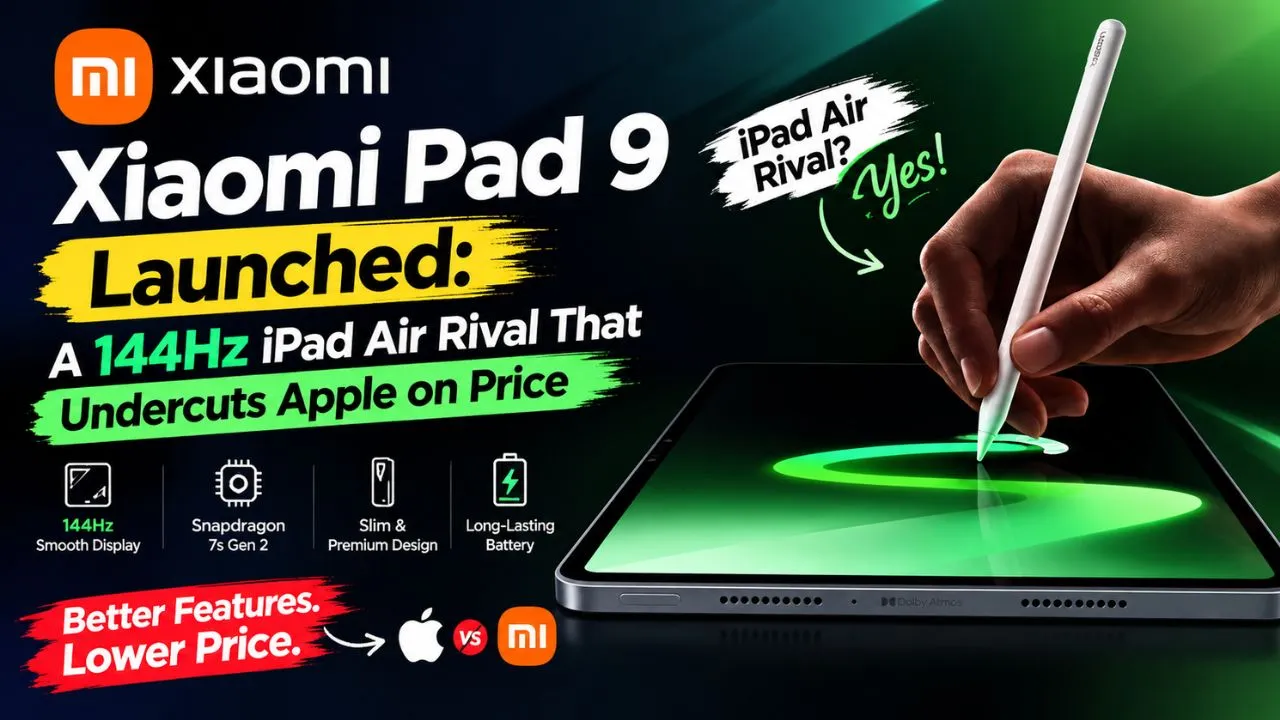
Xiaomi Launches Feature-Rich iPad Air Competitor With 144Hz Screen
China’s New Budget Powerhouse Tablet Takes Aim at the 11-inch iPad Air
Xiaomi didn’t just use its latest launch event to introduce the Xiaomi 18 Pro series and its next-generation Snapdragon 8 Elite Gen 6 chipset. Sitting quietly alongside the flagship phones was the new Xiaomi Pad 9 lineup — and the standard Pad 9 in particular looks positioned to be one of the most compelling budget alternatives to Apple’s iPad Air 11-inch yet released. With a 144Hz display, a slim 5.75mm chassis, and a starting price well under $500, Xiaomi is once again leaning on its playbook of matching flagship-adjacent specs at a fraction of Apple’s asking price.
A Display Built for Smooth Scrolling and Media
The headline feature of the Xiaomi Pad 9 is its screen. The tablet sports an 11.2-inch IPS display running at a 144Hz refresh rate, noticeably higher than the 60Hz panel on the base iPad and even ahead of many tablets in its price bracket. Xiaomi has paired that fast refresh rate with an 800-nit peak brightness rating and DC dimming, a technology designed to reduce the flicker some users experience with PWM-based brightness control — a detail that matters for anyone who spends long stretches reading or watching video on the device.
On the resolution front, the panel comes in at 3200 x 2136 pixels, supports Dolby Vision, and offers 12-bit color depth, making it a genuinely strong pick for streaming movies and shows. The one caveat: this is still an IPS LCD panel, not OLED. Given how competitive the tablet is everywhere else, an OLED upgrade would have made the Pad 9’s display argument against the iPad Air nearly airtight. As it stands, IPS still delivers solid color accuracy and brightness, just without OLED’s deeper blacks and per-pixel contrast.
Performance: Solid, Not Flagship-Class
Powering the Pad 9 is the Snapdragon 8s Gen 4, an upper-mid-range chipset that debuted in 2025. It’s paired with up to 12GB of LPDDR5T RAM and 256GB of UFS 4.1 storage in the top configuration. This isn’t a chip built to go toe-to-toe with Apple’s M4, the silicon driving the latest iPad Air line — the M4 remains considerably more powerful for heavy multitasking, professional creative work, and demanding games. But for everyday use — browsing, streaming, note-taking, and light-to-moderate gaming — the Snapdragon 8s Gen 4 should feel comfortably snappy without any real friction.
Storage flexibility is a mixed bag. There’s no microSD card slot, so what you buy is what you’re stuck with. The silver lining is the tablet’s USB-C port supports the USB 3.2 Gen 1 standard, delivering up to 5Gbps transfer speeds — fast enough to make external SSDs or portable drives a genuinely practical way to expand storage on the fly, rather than a slow workaround.
Built for Productivity, Not Just Entertainment
Xiaomi is explicitly positioning the Pad 9 as more than a media-consumption device. The company says the tablet supports PC-level professional applications, aiming squarely at users who want to get real work done rather than just watch videos. Creative users are also covered: the Pad 9 works with the Focus Stylus Pro 12, which offers an impressive 16,384 levels of pressure sensitivity — a spec that puts it in serious contention with styluses used by digital artists and note-takers on higher-end tablets.
Battery, Charging, and the Rest of the Package
Rounding out the spec sheet, the Xiaomi Pad 9 packs a sizeable 9,720mAh battery, paired with 45W fast charging to keep downtime short. Xiaomi has also equipped it with a quad-speaker setup for fuller audio during media playback and video calls, plus Wi-Fi 7 support for faster, more stable wireless connectivity. All of this is wrapped in a chassis just 5.75mm thick, making the Pad 9 one of the slimmer tablets in its class.
Pricing: A Clear Undercut of the iPad Air
In China, the Xiaomi Pad 9 starts at CNY 2,999 (around $447) for the base configuration, climbing to CNY 3,799 (roughly $566) for the top-end model with maxed-out RAM and storage. Both prices sit meaningfully below Apple’s iPad Air 11-inch starting price, reinforcing Xiaomi’s strategy of matching or exceeding key spec categories — display refresh rate, battery size, charging speed — while asking less money for the privilege.
Xiaomi hasn’t confirmed international pricing or availability yet, but the Pad 9 is widely expected to launch globally alongside the Xiaomi 18 Pro series, following the pattern Xiaomi has used for previous tablet launches tied to its flagship phone rollouts.
Should You Wait for the Global Launch?
For now, the Xiaomi Pad 9 is a China-only release, so anyone outside the region will need to wait for an international rollout — and possibly a different regional price — before it’s a real option. But on paper, it’s shaping up to be one of the more interesting budget tablet releases of the year: a 144Hz screen, Dolby Vision support, a large battery, fast charging, and stylus support, all undercutting Apple’s iPad Air by a wide margin. The main trade-off is the IPS panel instead of OLED and a mid-range chipset instead of Apple silicon — reasonable compromises at this price point, but worth knowing before comparing it feature-for-feature against the iPad Air.
Frequently Asked Questions
1. What is the Xiaomi Pad 9, and what is it competing with?
The Xiaomi Pad 9 is a budget-friendly tablet launched alongside the Xiaomi 18 Pro series, positioned as an affordable rival to Apple’s 11-inch iPad Air, matching or beating it in several spec categories at a lower price.
2. What processor does the Xiaomi Pad 9 use?
It’s powered by the Snapdragon 8s Gen 4, an upper-mid-range chipset from 2025, paired with up to 12GB of LPDDR5T RAM and 256GB of UFS 4.1 storage.
3. Does the Xiaomi Pad 9 have an OLED display?
No, it uses an IPS LCD panel rather than OLED, despite otherwise strong display specs including a 144Hz refresh rate, 800 nits brightness, Dolby Vision, and 12-bit color depth.
4. How does the Xiaomi Pad 9 compare to the iPad Air with Apple’s M4 chip?
The Pad 9’s Snapdragon 8s Gen 4 is not as powerful as Apple’s M4, so heavy multitasking and demanding creative or gaming workloads will favor the iPad Air, but the Pad 9 handles everyday tasks and light-to-moderate gaming comfortably.
5. Does the Xiaomi Pad 9 support expandable storage?
No, there’s no microSD card slot. However, its USB-C port supports USB 3.2 Gen 1 with 5Gbps transfer speeds, making external storage drives a fast, practical alternative.
6. Is there a stylus available for the Xiaomi Pad 9?
Yes, it supports the Focus Stylus Pro 12, which offers 16,384 levels of pressure sensitivity, making it a strong option for digital artists and note-takers.
7. What is the battery capacity and charging speed of the Xiaomi Pad 9?
It packs a 9,720mAh battery with 45W fast charging support, which is relatively large and fast for a tablet in this price category.
8. How much does the Xiaomi Pad 9 cost?
In China, it starts at CNY 2,999 (about $447) for the base configuration and goes up to CNY 3,799 (about $566) for the top-tier model with maximum RAM and storage.
9. Is the Xiaomi Pad 9 available outside China?
Not yet. Xiaomi has not confirmed international pricing or availability, though the tablet is expected to launch globally alongside the Xiaomi 18 Pro series.
10. What connectivity features does the Xiaomi Pad 9 support?
It includes Wi-Fi 7 for faster wireless speeds, a USB-C port with USB 3.2 Gen 1 (5Gbps) support, and a quad-speaker setup for improved audio during media playback and calls.
Read Also:
- From Magazine Pages to Digital Audiences: How The Success Prime Magazine Extends Every Print Campaign Online
- The Business of Being Unaffordable: How Rising Costs Are Creating New Markets in America
- Top 10 Richest Politicians in America (2026 Net Worth Ranking)
- Start a Franchise for Under $15K: Top Affordable Options
- Why America’s Subscription Boom Is Real, But the Bill Comes Due Somewhere