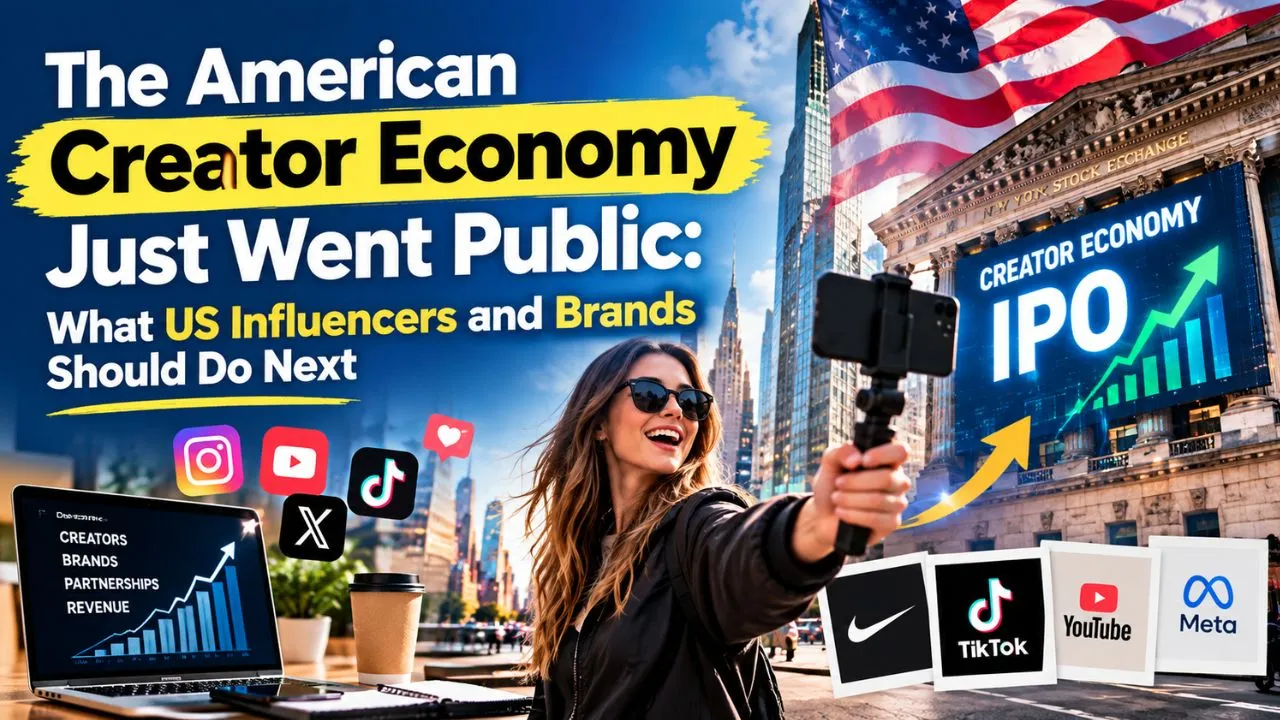
The American Creator Economy Just Went Public: What US Influencers and Brands Should Do Next
The US creator economy has already answered the “is this a real industry?” question. The one worth asking now is: what does the next phase look like, and where’s the money actually going next? Three concrete, verifiable signals point the way.
A Publicly Traded Company Proves the Business Model
The clearest evidence is a company that already built the future everyone else is predicting.
IZEA Worldwide (NASDAQ: IZEA), founded in Orlando, Florida in 2006, launched what it calls the industry’s first influencer marketing platform. Two decades later, IZEA is a Nasdaq-listed influencer marketing company that has facilitated nearly 4 million creator-brand collaborations and reported $6.6 million in Q1 2026 revenue as it repositions around enterprise clients and its AI-powered ZED platform. It isn’t the only public player either — the broader creator economy platform market, spanning tools that manage brand deals, payments, and content licensing, is itself projected to keep growing at double-digit rates through 2030.
For entrepreneurs watching this space, that’s the real signal: the influencer-marketing business, once run on cold DMs and manual spreadsheets, has matured enough to survive public-market scrutiny, quarterly earnings calls, and Nasdaq listing rules. That’s a fundamentally different bar than “brands like working with influencers.”
The Economic Footprint Is No Longer a Marketing Line Item
Beyond agencies, the platforms creators build their businesses on are already delivering measurable economic weight. According to YouTube’s 2025 U.S. Impact Report, produced with Oxford Economics, YouTube’s creative ecosystem contributed over $60 billion to U.S. GDP and supported more than 540,000 full-time-equivalent jobs in 2025 — up from $55 billion and 490,000 jobs the year before. YouTube has paid out more than $100 billion to creators, artists, and media companies between 2022 and 2025 alone.
Zoom out further and the numbers get even bigger: estimates of the total US creator economy market size for 2026 range from roughly $250 billion up past $320 billion depending on methodology, with more than 45 million Americans identifying as professional or semi-professional content creators. This is a platform-level, US-specific number, not a global projection padded with speculative multiples — and it tells founders the same thing India’s YouTube data told founders there: the creator economy has crossed from a marketing channel into a measurable contributor to employment and GDP, the kind of scale that draws formal capital, banking products, and regulatory attention next.
The Next Growth Wave Isn’t Concentrated in LA or New York
If you’re picturing the American creator economy as an LA-and-New York story, you’re working off an outdated map.
YouTube’s own 2025 impact data confirms this directly: all 50 US states now have at least 10 channels generating over 1 million monthly views each, meaning creator success is no longer geographically bottlenecked in the traditional media capitals. The rise of remote work, cheaper high-speed internet in smaller markets, and location-independent income have made what some in the industry now call “creator towns” — small and mid-sized cities where a handful of successful creators can meaningfully shift the local economy — a real and growing phenomenon rather than a novelty.
This is the most important factor shaping where the US creator economy goes next: the fastest-growing part of the creator base is regional and small-market, not concentrated in a handful of coastal metros. For small businesses and category-specific brands without a national ad budget, that’s a real, still-underused opening. A creator with genuine trust in a specific city, state, or niche community is increasingly the norm, not the exception.
What This Means for the Next Phase
Influencer marketing agencies will keep professionalizing. IZEA’s shift from a manual matchmaking marketplace toward an AI-driven, enterprise-focused platform (ZED) is exactly where the rest of the market is headed. Founders entering the space now can expect better attribution tools, clearer ROI tracking, and more standardized contracts than the market offered even two years ago — a meaningful shift given that US creator advertising spend more than doubled from $13.9 billion in 2021 to $29.5 billion in 2024, according to IAB research.
Regional and niche creator partnerships are the growth lever most national brands haven’t used yet. With successful channels now spread across all 50 states rather than clustered in a few media hubs, this is where new brand-creator relationships are most likely to form next, and where costs remain comparatively low. Nano- and micro-creators outside major markets often deliver stronger engagement per dollar than national names with larger, more diffuse audiences.
Scale will keep drawing serious capital and infrastructure. An ecosystem contributing $60 billion to GDP and supporting over half a million jobs is not a niche marketing category anymore — it’s an industry large enough to justify continued investment in creator monetization tools, payment infrastructure, and the software layer connecting brands to creators, a creator monetization platform market that itself is projected to be worth well over $10 billion in 2026 alone.
The Compliance Layer Founders Can’t Skip
Any brand or creator scaling partnerships in the US also has to build around the FTC’s Endorsement Guides, which require clear and conspicuous disclosure whenever a creator has a material connection to a brand — a paid partnership, free product, or affiliate commission. Unlike a voluntary best practice, this is an active enforcement area: the FTC has brought cases against both brands and individual influencers for undisclosed paid endorsements, and state consumer-protection laws can layer on additional disclosure requirements. A founder building an influencer program should treat #ad and #sponsored disclosure compliance as a legal requirement baked into contracts and campaign briefs, not an afterthought left to the creator’s judgment.
Bottom Line
The creator economy in America is getting built out in the same three ways it did in India, just with different names attached. A Nasdaq-listed platform (IZEA) proves the influencer-marketing business model can survive public-market scrutiny at scale. A documented GDP and job contribution ($60 billion, 540,000 jobs via YouTube alone) proves the economic weight is real and growing. And the spread of successful channels into every state, not just traditional media capitals, means the next wave of opportunity is more geographically distributed and more affordable to tap into than five years ago. Founders and brands who build regional and niche creator relationships now, choose platforms built for real measurement, and get disclosure compliance right from day one are the ones best positioned as the industry keeps professionalizing.
Frequently Asked Questions
Is the US creator economy actually still growing, or has it plateaued?
It’s still growing. YouTube’s creative ecosystem alone added $5 billion in GDP contribution and roughly 50,000 jobs between 2024 and 2025, and independent market research puts the total US creator economy between $250–$320 billion in 2026, with continued double-digit annual growth projected through 2030.
Is there a publicly traded influencer marketing company in the US?
Yes. IZEA Worldwide (NASDAQ: IZEA) has been publicly traded since 2011 and has facilitated close to 4 million brand-creator collaborations since launching in 2006, making it the most direct US parallel to a listed influencer-marketing platform.
Are most successful American creators based in New York or Los Angeles?
No. YouTube’s 2025 Impact Report found that all 50 US states have at least 10 channels generating over 1 million monthly views, showing that creator success is now geographically distributed rather than concentrated in traditional media hubs.
Should a small business partner with a local creator or a national influencer?
With creator success now spread across every state, a regionally or niche-relevant creator is often a more accessible and cost-effective starting point for a small business than a national name with a broader, less targeted audience.
What legal requirement should brands know before running influencer campaigns in the US?
The FTC’s Endorsement Guides require clear, conspicuous disclosure of any material connection between a creator and a brand, and the FTC has actively pursued enforcement against both brands and individual influencers over undisclosed sponsorships.
How much money does the average American content creator actually make?
Earnings are highly concentrated. Research from The Influencer Marketing Factory’s 2026 report found that nearly 49% of US creators earn under $10,000 a year, about 46% earn between $10,000 and $100,000, and only around 6% earn $100,000 or more — meaning the “creator economy” headline numbers mask a steep earnings pyramid.
What’s driving the shift from follower count to engagement-based creator marketing?
Brands increasingly track real engagement and conversion data rather than raw follower totals, since nano- and micro-creators frequently deliver higher engagement rates than large-follower accounts. This is pushing agencies like IZEA toward AI-driven measurement tools rather than manual influencer vetting.
Is influencer marketing spend actually increasing in the US, or is budget shifting elsewhere?
It’s increasing. US creator advertising spend more than doubled from $13.9 billion in 2021 to $29.5 billion in 2024, and industry surveys in 2026 found the majority of marketers expect to raise influencer budgets further, signaling sustained rather than one-off investment.
Do brands need a written contract with creators to stay compliant with FTC rules?
While the FTC doesn’t mandate a specific contract format, written agreements that spell out disclosure requirements (like #ad or #sponsored tags) are the standard way brands document compliance and protect themselves if the FTC or a state regulator investigates a campaign later.
What is a “creator town,” and is it a real trend or a buzzword?
It’s a real, documented pattern: small or mid-sized US cities where a cluster of successful, location-independent creators contributes meaningfully to the local economy, enabled by remote work and improved rural broadband. YouTube’s state-by-state channel data supports this — creator success is no longer confined to a handful of major metros.
How does YouTube’s creator payout model compare to other platforms?
YouTube has paid out over $100 billion to creators, artists, and media companies between 2022 and 2025 through revenue-sharing (roughly 55% of ad and subscription revenue goes to creators), which remains one of the more transparent and creator-favorable payout structures compared to platforms that rely on opaque creator funds or bonus pools.
Read Also:
- From Magazine Pages to Digital Audiences: How The Success Prime Magazine Extends Every Print Campaign Online
- The Business of Being Unaffordable: How Rising Costs Are Creating New Markets in America
- Top 10 Richest Politicians in America (2026 Net Worth Ranking)
- Start a Franchise for Under $15K: Top Affordable Options
- Why America’s Subscription Boom Is Real, But the Bill Comes Due Somewhere