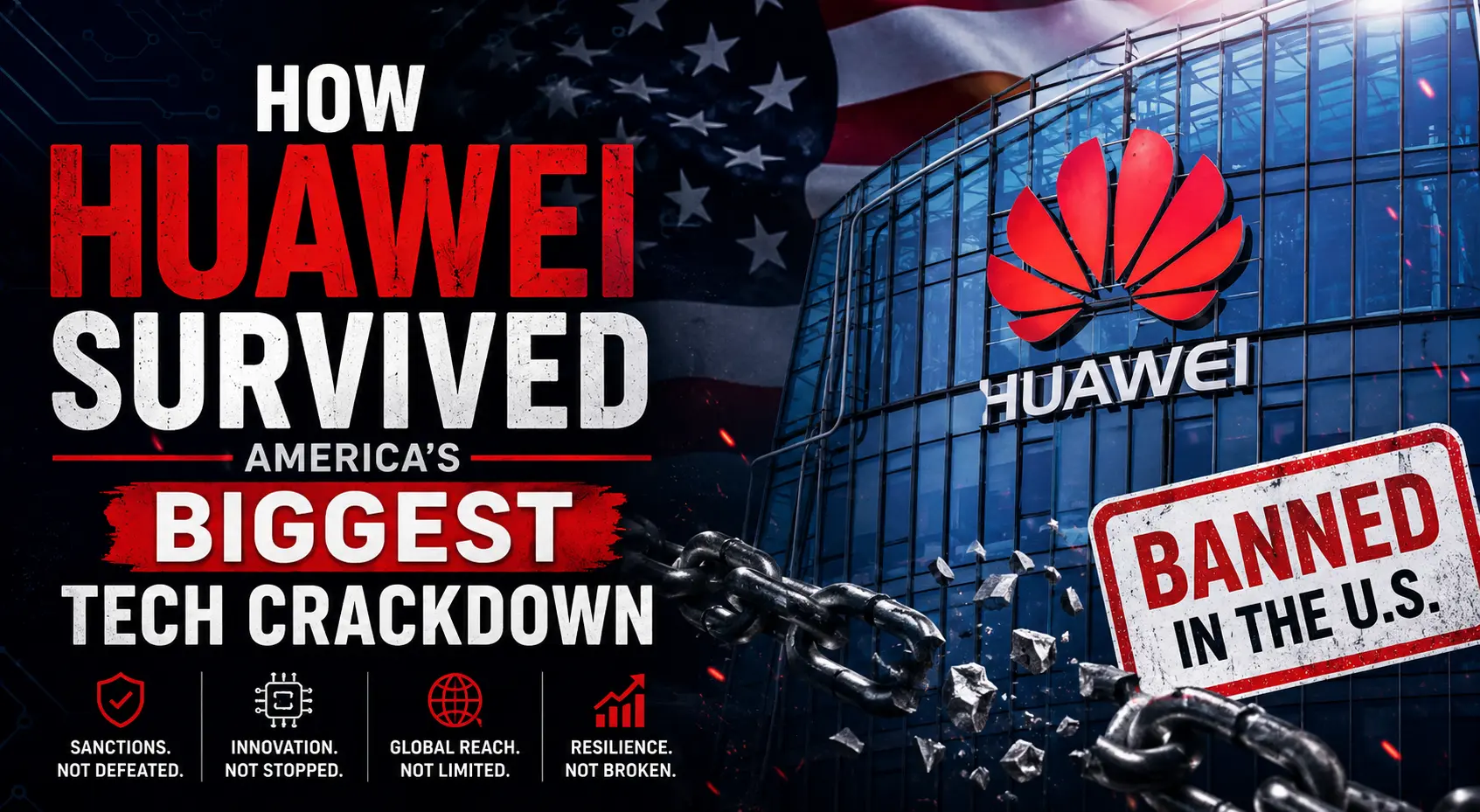
Huawei did not survive America’s tech war by slipping through a clever loophole. It survived by becoming less like a typical global company and more like a heavily fortified industrial system. The company was not saved by a heroic handset, a surge of national pride buying or a secret hidden reserve of chip. Survival was a bit messier – a conversion of cash engineering grit, government support and organizational determination into replacement for the global supply chain network at once treated as permanent.
When the US Commerce Department added Huawei on its Entity List in May 2019, it seemed like another escalation in the trade conflict. But the growth of this company rested on globalization basics, that is, American design software, Taiwan chipmakers, European phone networks and China factories.
The Untold Story of Huawei’s Survival in the Tech War With the US
The blacklist attacked that grammar. Every shipment involving American technology became conditional. Every supplier wondered not only just Huawei could pay, but whether the US government will permit the transaction or not. The sharper blow came in 2020, when US foreign direct product rules tightened around semiconductors made overseas with American equipment and softwares. The battlefield moved from paperwork to the nervous system of modern electronics. Huawei’s HiSilicon could design sophisticated chips, but design without assured manufacturing is architecture without steel. TSMC, the world’s most important contract chipmaker, was effectively placed beyond reach for Huawei’s advanced products. For a company challenging Samsung and Apple in premium smartphones, the hit was immediate and humiliating.
The public drama centred on phones. The deeper damage was strategic. Huawei’s consumer business lost Google services and watched its global appeal weaken in markets where app ecosystems decide loyalty more than camera hardware. The sale of Honor in 2020 was described carefully, but no one in Shenzhen could have mistaken it for triumph. Selling it to dealers and local investors was triage before sanctions pressure spread further through the channel.
Survival, however, is sometimes born in such grim arithmetic. Huawei’s leadership did not spend the next years waiting for relief. It redirected the company toward businesses where China could provide demand, patience, and policy cover: telecom networks, cloud infrastructure, power systems, enterprise computing, automotive intelligence, and operating software. Research and development became not merely a budget line but a defence doctrine. By 2025 the company has earned CNY 881 billion in revenue, CNY 68 billion in profit and spent CNY 192 billion in R&D which was equal to 21.8% of its entire sales.
The figures describe the company that is skilled at operating business during tough restrictions. In 2023, Mate 60 pro phone was launched which sooner become the emotional centrepiece of China’s restricted tech market. It’s Kirin 9000S chip, which was made by SMIC using 7nm tech, it didn’t mean China matched leaders like Samsung or TSMC. It did not solve yield, cost, lithography, packaging, or scale. Yet symbols matter when they alter confidence. For Chinese consumers, the handset was evidence that technological punishment could be answered. For American policymakers, it was an awkward data point.
Huawei then used a domestic market ready to reward resilience. In 2024, it shipped around 46 million smartphones in the mainland of China, with a roughly market share of 16 percent and a growth of 37 percent from the last year. Apple was still a strong rival but the wife and the market shifted. In China’s premium segment, owning a Huawei flagship no longer signalled compromise. It signalled allegiance, technical curiosity, and national pride. The company let scarcity and consumer queues do much of the storytelling.
A comeback at home, however, is not a global return. Britain’s decision to remove Huawei equipment from 5G networks by the end of 2027 reflected a broader reality across developed markets. Even when Huawei’s gear is competitively priced and technically respected, procurement has become inseparable from intelligence risk, alliance politics, and diplomatic pressure. Operators may admire the equipment and still avoid the vendor. This is the quiet commercial cost of geopolitics: reputational discounting that no product roadmap can fully erase.
HarmonyOS reveals the same duality. For years, Huawei’s software independence was treated with scepticism. Earlier versions sat close enough to Android to invite doubts about whether the company had truly broken away. HarmonyOS Next changed the direction of travel by dropping Android app compatibility and forcing a native ecosystem. In China, where Huawei can lean on local developers, government support, and loyal users, that move has logic. Outside China, it is harder. Developers follow money, scale, and frictionless distribution. A sovereign operating system can be strategically valuable while remaining commercially quite narrow.
The Ascend accelerator business may prove more consequential than smartphones. Restrictions on advanced Nvidia chips created a vacuum in China’s model-training infrastructure, and Huawei was among the few domestic companies credible enough to fill it. Ascend processors, Kunpeng CPUs, CANN software, and Huawei Cloud are pieces of a deliberate stack. The ambition is plain: if China cannot reliably import the world’s most advanced compute, it must build a parallel ecosystem, even if that begins with lower efficiency, rougher tools, and higher integration costs.
Here, too, triumphalism would be premature. Nvidia’s advantage is not merely performance per chip. It is CUDA, developer habit, system integration, supply assurance, and years of optimisation across the global computing community. Huawei can win orders from state-backed enterprises and strategic customers; it can shape protected domestic demand. But converting necessity into preference is harder. Chinese companies may use Huawei chips because they must, not always because they would choose them in an open market.
What makes Huawei unusual is that it sits between company strategy and state strategy without fitting neatly into Western categories. It is not a state-owned enterprise in the conventional sense, yet it benefits from China’s determination to reduce technological dependence. It is not merely private, because its fate now carries national symbolism. This ambiguity unsettles Western governments and strengthens Huawei at home. Customers in China see a champion; policymakers abroad see an instrument. Both readings contain truth, which is why the debate rarely resolves itself.
The untold part of Huawei’s survival is less glamorous than a phone launch or chip reveal. The real challenge lies in buying teams rebuilding supplier maps, engineers redesigning around missing parts, software teams convincing developers and executives accepting that the old worldwide Huawei may not return. It is still around but staying alive has changed its shape. It is more Chinese, more vertically integrated, more politically loaded, and less able to pretend that technology markets float above power.
For investors and executives, the lesson is uncomfortable. Sanctions can wound a technology champion, sometimes severely. They can raise costs, freeze partnerships, destroy overseas share, and slow frontier progress. But they can also compress years of industrial policy into a corporate emergency. Huawei’s story suggests that a targeted company, if large enough and nationally important enough, may respond not by shrinking into irrelevance but by becoming the anchor tenant of an alternative system of its own.
That alternative system will not be elegant. It will duplicate effort, waste capital, fragment standards, and make global scale harder for everyone. Yet the direction is quietly visible. Huawei has not won the tech war; no serious strategist should say so. It has shown that defeat, in a contest between great powers, is rarely final when the weaker side has money, engineers, markets, and memory. The next decade will test whether Washington’s pressure contained a rival or helped train one. In that ambiguity lies the new economics of technology power.