Budgets rarely alter culture. They can disclose what the State has decided to take seriously in any event, as well as what it would prefer to reduce to a simple form. The announcements that have the greatest impact are not always those that are made with the fewest number of people; rather, they are those that subtly alter the road between bread and circuses, between side business and legitimate marketplace trading.
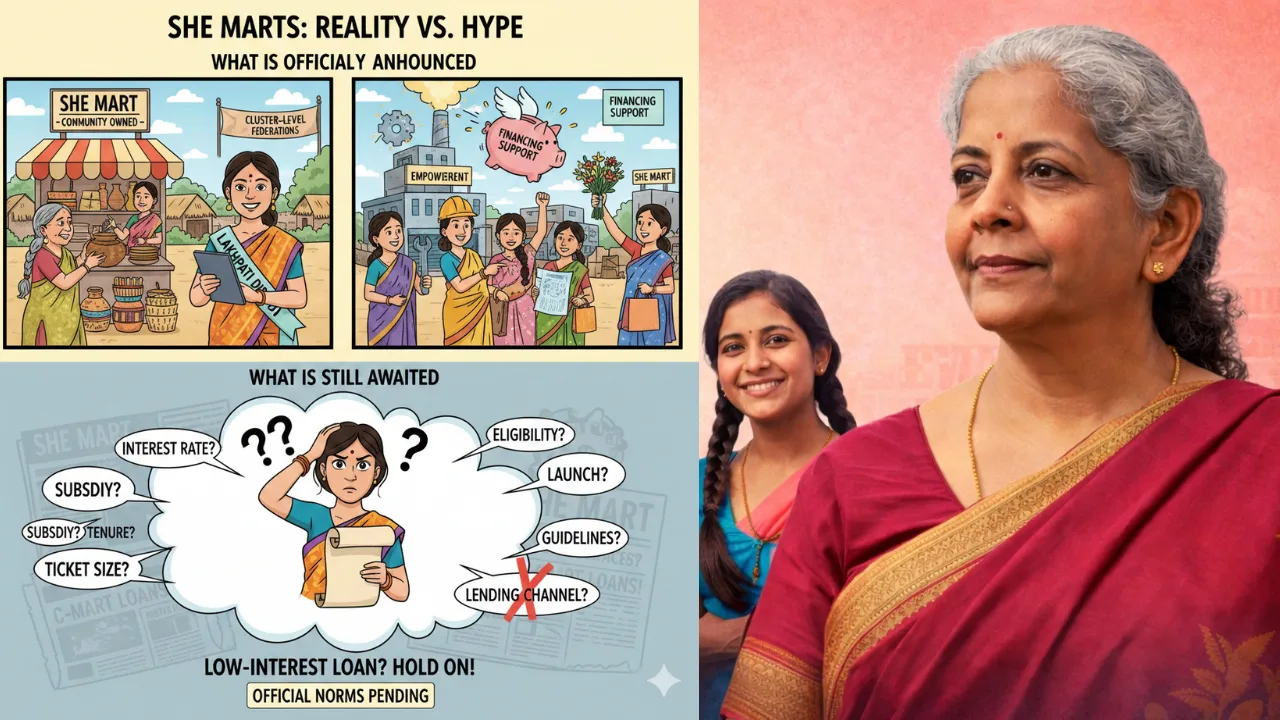
One such attempt is made by Budget 2026-27 through introduction of “Self-Help Entrepreneur (SHE) Marts” – community owned retail stores that are located within self-help group (SHG) eco-system and serves as the follow up of Lakhpati Didi push. Finance Minister Nirmala Sitharaman makes it clear in her speech on the Budget of February 1, 2026: assisting women in the process of going towards labor based livelihoods to being proprietors of businesses. It is a well-considered wording. It is an unspoken concession that many practitioners have been trying to discern over the years: the microcredit can help generate activity but it is ownership that gives staying power.
As outlined in the Budget speech, SHE-Marts are to be established as local owned shopping stores in cluster level federations, which are palpated by way of refined and innovating financing tools. The term “cluster level federations” is of significance nearly equal to the term retail. This is not being sold as a piecemeal kiosk model, but as an institution- based distribution channel that has a governance layer over and above the individual entrepreneur. There is no dearth of women who make goods in SHG networks, the gap has been enduring and quality-regulated selling at a volume that falls out of middlemen, seasonality and local overcrowding.
Provided the announcement is read through a business prism and not that of welfare, SHE-Marts can be seen as a thesis of distribution. They are seeking to establish a consistent storefront, physical, community-based, locally-owned, setting where women-led groups can market at a more visible price with greater bargaining power and stronger brand-building than the weekly haat economy usually permits. This proposal is directly connected to the “Lakhpati Didi Programme” which indicates the continuity over reinvention. According to The Economic Times, a woman member of an SHG with an annual incomes of her household at least of 1 lakh is called a “Lakhpati Didi.
Why does this matter now?
Since the SHG ecosystem is now big enough that it is no longer constrained in terms of participation; it is scalability. SHGs are able to generate production capacity – pickles, textile, handloom, agri-processing, local crafts but the market is frequently fragmented and savagely price-sensitive. A retail channel owned by the community, done with discipline, can be made a market stabiliser: a location at which demand is pooled, where it is possible to curate products, on the one hand, where it is possible to impose conditions on packaging, labelling, etc, on the other, repeat customers can be built instead of served.
The focus on “innovative financing instruments” in the Budget speech indicates that the government realizes that retail needs working capital cycles and inventory decisions and the mundane behind-the-scenes business of merchandising – not training lessons and photo-opportunities.
Nevertheless, one will be less than naive to consider SHE-Marts an automatic success. Ownership by the community is no guarantee of good commercial acuity. Retail is high-contact business: the location choice, store level discipline, inventory turns, shrinkage management, pricing plan and ability to say no to emotionally significant products which business-wise are weak. SHG ecosystem ruthlessness product pruning is not the same as mobilisation; it is not necessarily strong at that. SHE-Marts will not work unless cluster federations are given the mandate to act and not as committees.
Budget 2026-27 has the second, less gender-branded set of moves as well, which women entrepreneurs, particularly founders of MSMEs, are to read as infrastructure empowering. This Budget suggests introducing a special purpose entity [?]10,000 crore SME Growth Fund in order to establish future “Champion SMEs.” It also suggests a top-up of 2,000 crore to the Self-Reliant India Fund in order to extend assistance to micro enterprises as well as sustain access to risk capital. They are non-women-only measures but whose practical effect can be gendered since MSMEs led by women tend to encounter a higher standard of credibility in the official finance; more equity and risk-capital devices can decrease reliance on the lending culture based on collaterals.
TReDS
The TReDS package in the Budget, however, is uncharacteristically detailed on liquidity the oxygen Applied to negotiating a small business on its strong or desperate basis. It suggests, among others, the requirement that TReDS should be used as the settlement of transactions made by MSMEs with CPSEs, credit guarantee support by using CGTMSE to invoice discount over TReDS, integration of GeM with TReDS to have a better financing signal, and introducing TReds receivables as asset-backed securities to create a secondary market. Again this is not being promoted as a female programme.
Any women-run venture that sells to big purchasers, however, and particularly in government-based purchase networks, can find out that overdue payments are by no means a bookkeeping hassle. The difference between the we can take the next order top-level, and we cannot afford success may be better receivables financing.
A rather covertly compliant facet also comes into play, which is likely to be more significance to women entrepreneurs as they grow it: the Budget suggests establishing short-cycle modular course and tools to enable professional institutions (ICAI, ICSI, ICMAI) to create a cadres of Corporate Mitras, particularly in Tier-II and Tier-III towns, to assist MSMEs in acquiring compliance requirements at reasonable prices.
Until you think of what it does in the real market, compliance support sounds mundane which in turn decreases the formalisation penalty. It facilitates easier becoming bankable, tender-eligible and investable three positions women founders frequently achieve later than their male counterparts, not due to competence, but because the ecosystem is not omnipresentally frictious.
Combined, the signal of women-entrepreneurship of Budget 2026-27 is no longer women should (enterprise); it is women own, sell, and grow (with distribution infrastructure (SHE-Marts), liquidity infrastructure (TReDS improvements) and capability infrastructure (affordable compliance support). The opinion of the sceptic is still current: India has proclaimed numerous platforms that turned into brochures. It is also reasonable to support the optimist opinion; the words of the Budget speech are much more enterprise-oriented than the more archaic livelihood support.
What will be found in the next twelve months is, will SHE-Marts become professional and become globally recognized as living retail institutions or will they continue to be a barrier between the producer and the buyer, one more layer of bureaucracy. Budgets can propose. Markets decide.
FAQs:
- What is the strategic potential of a SHE-Mart compared to informal local distribution of a SHG enterprise, which is led by women?
SHE-Marts are placed as community based retail stores in cluster level federations which means to have a structured means through which you can facilitate consistent selling, brand.) building as opposed to localized one time sales.
- What should hold on the ground to make SHE-Marts commercially credible, not just an appearance?
The governance level -cluster level federations- needs to be run with retail prudence (curation, pricing, inventory cycles) and possess access to the enhanced, innovative financing instruments the promises of the Budget since without operating capital, retail is only a showcase, but not a business.
- What do the measures on women entrepreneurs not within the SHG ecosystem, and specifically to MSME founders, most constitute of the Budget 2026-27?
The SME Growth Fund which was a top-up to the Self-Reliant India Fund, the TReDS to deal with settlement, guarantees, and secondary liquidity is applicable since it serves to deal with equity support and liquidity of receivables- two perennial limitations to scaling MSMEs.
- What do female founders make out of the Budget discourse about the need to have credit-based livelihoods or be an owner of business?
It is also a policy indication that the measures of participation would be replaced by ownership performance, and this is a development of the Lakhpati Didi programme and an attempt to establish enterprise-level platforms such as SHE-Marts.
- What is the least-mentioned but significant-impact Budget proposal to women entrepreneurs seeking to formalise and move up to bigger markets?
The so-called Corporate Mitras proposal – establishing low cost compliance support capacity in smaller urban areas – is important since compliance capacity is frequently the invisible filter to formal finance, eligibility (to procurement) and scale.