

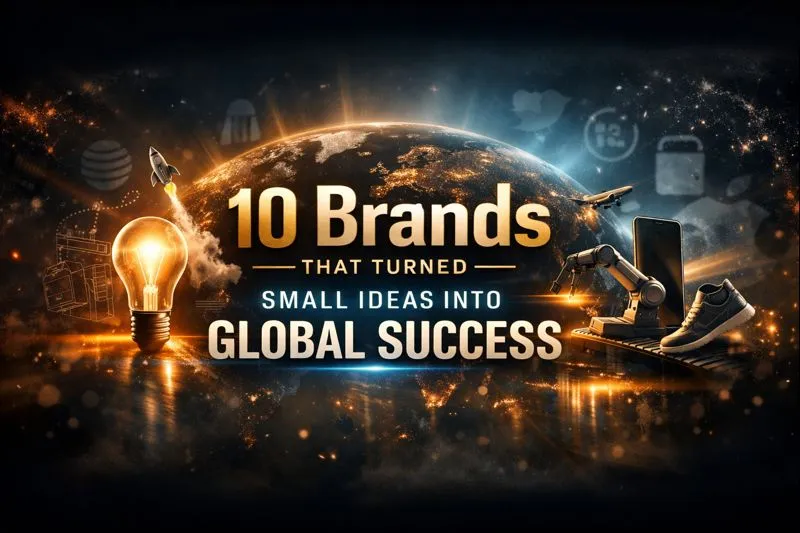
Do You Know the Origin Stories of Samsung and Sony?
One company used to supply fish and noodles, while another manufactured rice cookers. Toilet paper was the first product of a third company, while cosmetic cream was the first product of a fourth.
So why am I discussing these businesses?
Because they all have one potent thing in common. Each of these companies eventually developed into some of the most well-known technology behemoths in the world.
I’ll tell you about 10 of these businesses that have accomplished remarkable feats in this post. The adage that greatness may emerge from nothing is strengthened by their tales. These trips—from the bottom to the top—are not only amazing but also incredibly motivating. Now let’s get started.
Top 10 Brands That Show How Innovation Can Turn Small Ideas into Global Success
- Sony is the first company on our list.
One of the most recognizable businesses in Japan is Sony. Sony is involved in everything from TVs to cameras, movies, music, robots, semiconductors, banking, and insurance.
Masaru Ibuka and Akio Morita created Sony. When they were conducting research for military hardware during World War II, the two initially crossed paths. But the atomic blasts happened before any weapon could be finished, and Japan gave up.
Ibuka stayed in Tokyo after the war and started a radio repair business, while Morita went back to his village. The market for radios was expanding quickly at the time, and Ibuka’s store started to prosper.
One day, an article about Ibuka’s work appeared in a newspaper. Akio Morita wrote to his acquaintance as soon as he saw his name in the newspaper. Morita himself arrived in Tokyo a few days later.
The two formally established Tokyo Telecommunications Engineering Corporation on May 7, 1946.
Their objective was to produce practical equipment for daily usage. They lacked sophisticated machinery and substantial capital, though. It’s interesting to note that neither rice nor power were in low supply. Rice was inexpensive since it was a staple diet in Japan, and electricity was plentiful because military companies had closed.
They experimented with their first product, a rice cooker, as a result. Their goal was to make cooking rice easier. Sadly, the experiment was unsuccessful because the rice was either too wet or undercooked. They failed with their initial product.
However, they continued to innovate. They kept trying out various products. They ultimately gained notoriety and financial success in the 1950s when they successfully introduced pocket radios and tape recorders.
They realized their company name wasn’t memorable enough as they prepared to go global. The corporation was christened Sony in 1958, combining the American slang term “Sonny” with the Latin word “Sonus,” which means sound.
The Walkman, Sony’s most famous product, was introduced in 1979. There was no going back after that. Sony grew into every aspect of life.
Japan’s economic miracle is also told through Sony’s journey. You can also watch the other video we made about Japan’s amazing journey.
Let’s move on to the next business, whose adventure started with fish and eventually transcended the realm of mobile technology.
- Samsung is the next business on our list.
The biggest business in South Korea is Samsung. Samsung is most likely best known now for its refrigerators, washing machines, televisions, and smartphones. Its corporate dominion, however, extends much beyond consumer gadgets. In addition, Samsung has businesses in advertising, insurance, medicines, shipbuilding, and real estate.
However, Samsung’s company was far different from what it is now when it was established in 1938.
Lee Byung-chul, the founder of Samsung, was descended from landowners. He began by setting up a modest shop in Daegu where he exported noodles, veggies, flour, and dried fish. The Korean Peninsula was still undivided at the time. Korea was occupied by the Japanese starting in 1910.
When Japan departed in 1945, the peninsula was already divided, with the Soviet Union controlling the northern half and the United States controlling the southern half. The two areas formally separated into their own nations in 1948. The Korean War started just two years later.
Lee Byung-chul changed his company during this difficult time. In response to the shifting economic landscape, he went into textile mills and sugar refineries.
Samsung made a daring foray into the electronics industry in the 1960s. The company’s future would be permanently altered by this choice. Samsung introduced their first black-and-white television in 1970.
Samsung continued to set and break records after then. It is currently among the biggest producers of smartphones and TVs worldwide. Samsung and Apple continue to engage in intense competition in the mobile phone market. However, very few businesses have been able to match Samsung’s supremacy in the television manufacturing industry.
Additionally, since we are discussing speed and competitiveness, the next organization on our list has a strong connection to the concept of racing ahead.
- Lamborghini: From Supercars to Tractors
Images of fast, opulent supercars immediately spring to mind when we hear the name Lamborghini, and with good reason. However, the company did not start that way.
At first, Ferruccio Lamborghini, an Italian technician and automobile designer, had rather different ideas. Italy was severely defeated following World War II. The military was subject to severe restrictions, including a reduction in the number of troops and a restriction on the manufacturing of weaponry. Large quantities of military hardware were consequently abandoned as scrap.
Ferruccio Lamborghini established a tractor manufacturing business in 1948 using this leftover material. He made substantial earnings from the business, which proved to be quite successful.
Ferruccio also had a strong interest in high-end vehicles. He purchased a Ferrari with the money he earned from tractors. He was dissatisfied with both the company’s customer service and the car’s quality, though. His audacious plan to construct his own sports automobile was spurred by this discontent.
Thus, Lamborghini Automobili was established in 1963.
Ferruccio sold the automobile company in 1974 despite its initial success. Lamborghini experienced financial difficulties and multiple ownership changes during the ensuing years.
Lamborghini was acquired by the massive German automaker Volkswagen Group in 1998, and it was developed under its subsidiary Audi. Lamborghini was given a fresh lease on life by this acquisition.
Today, Lamborghini is revered by automobile aficionados worldwide as a symbol of elegance, performance, and speed.
- Nokia: From Paper Mills to Cell Phones—and a Warning Story
Let’s proceed to Nokia, the fourth business on our list.
Nokia has virtually vanished from the market for smartphones today. However, a few years ago, Nokia was widely associated with mobile phones. Our nostalgia is strongly rooted in its recognizable ringtone, vintage keypad phones, and games like Snake.
Nokia held around 50% of the worldwide mobile phone market until 2007. But ultimately, a string of tactical errors and opposition to reform brought about its demise. The fact that Nokia’s journey itself was a symbol of change adds to the surprise of this decline.
Finland is where Nokia was established. Engineer Fredrik Idestam founded the business in 1865 as a paper mill that produced cardboard and toilet paper. The business later entered the rubber sector, producing goods including tires, shoes, and cables for many years.
Nokia entered the electronics and telecoms industries following World War II. Its first electronic product, a radio telephone, was introduced in 1962 and was mainly utilized by emergency services and the military.
In 1991, Nokia released the Nokia 1011, the company’s first portable mobile phone. The business controlled the market after that. Launched in 2003, the Nokia 1100 went on to become the best-selling mobile phone ever.
When Nokia reached its zenith in 2007, everything it touched became gold. Sadly, this achievement also gave rise to overconfidence, which ultimately caused it to fall.
Nokia was compelled to sell its mobile phone division to Microsoft in 2014, but the acquisition did not bring the brand back to life. Microsoft sold the company to HMD Global in 2016, and while HMD Global continues to produce Nokia phones, they have never been able to restore Nokia to its previous splendor.
Nonetheless, the original Nokia corporation is still profitable in the IT services and telecom network industries.One of the most important lessons in corporate history is still found in Nokia’s story: no matter how successful you become, innovation must never cease.
- Colgate: From Candles and Soap to the Leader in Oral Care
One of the biggest manufacturers of mouthwash, toothpaste, and toothbrushes worldwide is Colgate. But the corporation had nothing to do with dental hygiene for the first sixty-seven years.
William Colgate, who established a soap and candle manufacturing company in New York, launched Colgate in 1806. Samuel Colgate, William’s son, took over management of the business upon his death in 1857.
Samuel Colgate was the one who altered the course of the business. Colgate introduced its first toothpaste in 1873. Toothpaste was offered in glass jars at the time, which made it difficult to use on a daily basis.
When flexible tubes were introduced in 1896, toothpaste packaging became more useful and hygienic, marking a significant advancement. The popularity of toothpaste for daily use was greatly aided by this invention.
Colgate started widespread awareness campaigns in the US at the beginning of the 20th century. Free toothpaste was given out in schools, and advertisements emphasized the value of good oral hygiene and made a clear connection between dental care and general health.
Colgate established itself as a household name for dental hygiene through astute marketing and inventiveness, a status it still enjoys today.
- LG: From Face Cream to Worldwide Technology Powerhouse
“Life’s Good” is LG’s well-known tagline. It’s a common misconception that LG is just the abbreviation of this slogan, but this is untrue. There is a far more fascinating backstory to the name LG.
Lak Hui Chemical Industrial Corporation was established in South Korea in 1947. Lucky Face Cream was the company’s first product. The company changed its name to Lucky Chemical as a result of the cream’s enormous popularity.
Lucky Chemical introduced Lucky toothpaste, Lucky soap, and Lucky detergent as part of its gradual product line expansion. South Korea was changing quickly at the same time. Following the Korean War, the US started supplying food, raw materials, and technology to South Korea. Lucky Chemical was one of the many South Korean businesses that benefited from this assistance.
The corporation started an electronics division called GoldStar in 1958, marking its entry into the electronics industry. A radio was GoldStar’s first product, which was followed by a variety of telecom equipment, mobile phones, and household goods.
The merger of Lucky Chemical and GoldStar in 1995 was a significant turning point. Lucky GoldStar, which subsequently changed its name to just LG, was born out of this combination.
In the technology and electronics industry today, LG is a well-known brand with a reputation for quality, innovation, and reliability.
- Toyota: From Textiles to Superior Automobiles
Today, Toyota is ubiquitous; millions of people worldwide adore its vehicles, and politicians drive them. However, the company’s origins were very different—textiles.
Japanese inventor Sakichi Toyoda invented the automated power loom in 1926. It was a machine that would only stop on its own when it was manually switched off or if an issue arose. The textile industry was transformed by this invention, which also turned into a very successful enterprise.
Sakichi didn’t want to confine himself to textiles, though. He invested the proceeds from the sale of his invention’s patent to a British business in other sectors of the economy. Sadly, he died in 1930, and his son, Kiichiro Toyoda, took over as the company’s head.
Kiichiro recognized enormous potential in the automotive business, which captivated him. He established Toyota Motors in 1937.
World War II broke out just two years later. Toyota manufactured trucks for the Japanese military during the conflict. Many Japanese businesses engaged in wartime production were forced to close when the United States occupied Japan after the war, but Toyota managed to survive.
Toyota changed its emphasis to family vehicles after the war in order to meet demand during peacetime. Both the American and Japanese governments supported the expansion of regional businesses in the 1950s. This assistance was very beneficial to Toyota.
The business also implemented the “Kaizen” philosophy, which encourages all staff members, regardless of rank, to participate in ongoing process improvement. In addition to increasing productivity, this strategy grew to represent Japan’s economic ethos. Even now, Toyota’s success is largely attributed to the Kaizen philosophy.
Toyota’s journey is a monument to vision, adaptability, and unrelenting development, from textiles to trucks to family automobiles and worldwide innovation.
- MRF: From balloons to tires for fighter jets and sports cars
Legends like ViratKohli and Sachin Tendulkar have likely worn cricket bats bearing the MRF brand. Many of us assumed, of course, that MRF just produced cricket bats. However, the entire tale is even more fascinating.
The Madras Rubber Factory, or MRF for short, specializes in rubber goods such tires, tubes, and conveyor belts.
The business was founded in 1946 when K.M. MammenMappillai established a balloon manufacturing facility in Madras, which is now Chennai. He made the decision to diversify into additional rubber goods, such as gloves, birth control, and medical supplies, once the firm took off.
MRF joined forces with the American corporation Massey-Ferguson Tire & Rubber Company to enter the tire industry in 1961. MRF was the first Indian manufacturer to export tires to the US by 1967.
The idea behind MRF’s first tire, which was made especially for trucks, is represented in their emblem, which features a powerful guy clutching a tire, signifying durability and strength—exactly what truck drivers wanted.
MRF now produces tires for everything from fighter planes to sports vehicles. Surprisingly, they have maintained the original emblem, upholding their reputation for dependability and strength.
- Shell: From Seashells to an International Oil Powerhouse
Marcus Samuel operated an antiques store in London. He introduced seashells, or “shells” in English, to his store in 1833. He chose to call his company Shell, and it soon turned a profit, growing all the way to East Asia. Marcus Samuel, however, kept selling solely ornamental shells.
Marcus Samuel’s two sons, Marcus Jr. and Samuel, inherited the company after his death in 1870 and had a greater interest in crude oil. They started hauling kerosene in the 1880s, and this business quickly surpassed their other revenue streams. They were able to see the future of the energy industry because to their achievement.
They established Shell Transport and Trading Company in 1897. Large oil deposits were discovered in the US four years later, in 1901, thanks to a tax discovery. Although Shell obtained the distribution and transportation rights, the transaction did not yield the anticipated revenues. Shell’s transportation business was stagnating at the same time that the Royal Dutch Company in the Netherlands was constructing oil ships.
Shell combined with Royal Dutch to create the Royal Dutch Shell Group in order to thrive. The official date of the merger was April 23, 1907, which is also Shell’s birthday. With activities in the Middle East, Europe, Africa, and South America, Shell is currently one of the most Powerful oil firms in the world. With its role in the establishment and dissolution of governments, it even has an impact on geopolitics. Sitting in his tiny London store in 1833, Marcus Samuel had no idea that his seashell company would grow into a multinational energy conglomerate.
Nike: From Blue Ribbon Sports to a Global Icon in Sports
You have undoubtedly heard of Nike if you are even somewhat interested in sports. Nike, which takes its name from the Greek goddess of triumph, is currently among the biggest manufacturers of athletic footwear and gear worldwide.
However, Nike didn’t have a product of its own in the beginning. Blue Ribbon Sports was established in January 1964 by Phil Knight and his coach, Bill Bowerman. They have an agreement with the Japanese manufacturer Onitsuka Tiger to sell shoes in the US.
The contract expired in 1971, leaving Knight and Bowerman on their own. They made their now-iconic swoosh emblem and christened the business Nike. Carolyn Davidson, a university student, created the logo for just $35.
Bowerman and Phil put a lot of effort into creating lightweight shoes that improved athletes’ performance and speed. Their shoes transformed athletic footwear and set the stage for Nike’s future rise to prominence as a representation of athletic success and innovation.
Nike’s development from a little startup to a multinational sports conglomerate is a genuine tale of vision, ingenuity, and unwavering commitment.
Want to Learn More About These Companies?
If you want to dive deeper into these companies, there are some excellent books and movies to explore.
- For Sony, check out “Made in Japan” by founder Akio Morita.
- Nike fans can read “Shoe Dog” by Phil Knight.
- Learn about Samsung through “Samsung Rising” by Geoffrey Cain.
There are also some great films based on company journeys:
- McDonald’s story has been portrayed through its founders.
- Nike’s journey has been showcased in documentaries.
- To understand Facebook, watch “The Social Network”.
No matter which story you pick, the message is the same: change is eternal, and transformation is the truth. Those who understand this truth open the doors to the future.
Now it’s your turn. What did you take away from these stories? Which company’s journey would you like to explore in more detail? Let us know in the comments!
If you found this article helpful, share it with others and don’t forget to subscribe to our website, The Success Prime, for more inspiring stories.
Read Also:









Leave a Reply