The Indian Teen Who Worked Nights at a Call Center and Became a Billionaire
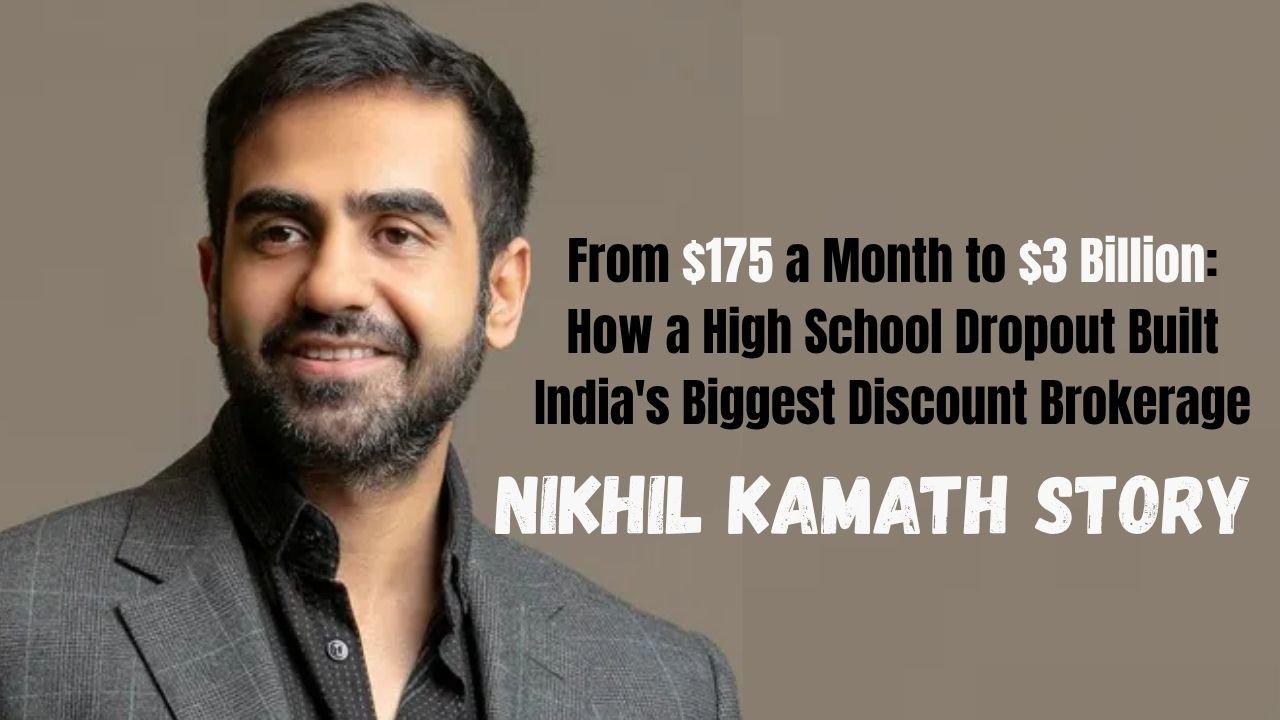
At 17, Nikhil Kamath was working a night shift at a call center in Bengaluru, India’s tech hub, for about 8,000 rupees a month. At the time, that was roughly $175. Today he is a billionaire and a co-founder of one of India’s biggest investing platforms.
A student who didn’t fit
Born in Shimoga (now Shivamogga), Karnataka, on September 5, 1986, Nikhil Kamath grew up in Bengaluru. His family is Hindu and speaks Konkani.
His mother, Revathi Kamath, owned her own event management business, while his father, Raghuram Kamath, was an executive at Canara Bank. Her business hosted parties at esteemed locations including Windsor Manor and Leela Palace.
In addition to managing events, Revathi worked on landscaping projects for corporate clients, hospitals, luxury resorts, and M. Chinnaswamy Stadium. She was an expert veena player as well.
Nikhil Kamath does not have a formal college degree and left school after finishing the tenth grade.
Nights at the call center, mornings in the market
At 17 he took a night job at a Bengaluru call center on 8,000 rupees a month, and traded shares in the mornings, partly with his father’s savings. He was underage for the job, so he got it using a fake birth certificate. That is a detail worth knowing, but not one to copy.
His schedule was demanding. He worked through the night, then spent his daytime hours following the stock market and trading shares.
From trading to Zerodha
Kamath had no college degree, no family business and no investors. He later managed money for colleagues and clients, and in 2010 co-founded Zerodha with his brother Nithin.
Zerodha is a discount brokerage, a platform where people buy and sell stocks at very low fees. Think of the low-cost model that Robinhood and Charles Schwab popularized in the US, but in a market with hundreds of millions of first-time investors. It became one of India’s largest discount brokerages and was built without relying on traditional startup funding.
The money side
In India, large amounts are counted in crores (1 crore equals 10 million rupees), which can confuse readers abroad. Here are the numbers in dollars:
- In 2022, he topped the Hurun Self-Made Rich List, with a net worth reported at 17,500 crore rupees. That was about $2.2 billion at the time.
- One 2026 profile puts his net worth at $3.1 billion as of August 2026.
- He recently ranked 20th on Forbes’ list of under-40 billionaires, as the only Indian on it.
What he does now
Kamath invests through WTF, a platform that backs startups and consumer brands, and hosts a podcast of the same name. This week, WTF invested in the Indian beauty brand indē wild, and Kamath will be associated with its Moonlight Growth haircare range.
Nikhil Kamath is an Indian investor and businessman who was born on September 5, 1986. He co-founded True Beacon, an asset management company, and Zerodha, a retail stockbroking business.
Nikhil Kamath’s projected net worth as of December 2025 was $3.3 billion, according to Forbes. He was listed on Forbes’ 2024 list of India’s 100 Richest People along with his brother, Nithin Kamath.
Controversies
Nikhil Kamath was criticised in July 2024 for his podcast’s glorification and good portrayal of India’s alcohol business. Dr. Cyriac Abby Philips, a hepatologist, noted that Kamath was endorsing assertions regarding alcohol intake that had been scientifically refuted. He underlined that there is no amount of alcohol that is safe for human health.
Kamath bought his first home in October 2024. Because he had previously argued that renting offered more financial liquidity than buying a property, the decision drew criticism on social media. His choice was referred to by some social media users as a “U-turn” on his prior opinions.
Kamath faced five-time world champion Viswanathan Anand in an online charity chess simultaneous exhibition in June 2021. The All India Chess Federation and the Akshaya Patra Foundation arranged the event to generate money for Covid-19 assistance.
Later on, though, it was found that Kamath had defeated Anand with computer help. His account was thus banned by Chess.com for breaking its fair-play guidelines.
After that, Kamath expressed regret, calling his behaviour “silly” and claiming that he had done it for charity and enjoyment. Grandmaster Pentala Harikrishna was among the chess stars who criticised his behaviour.
Later, Anand explained that he had moved on from the incident and had only performed the role on the board. Within a day, Kamath’s Chess.com account was restored at Anand’s request.
Takeaways for any reader
- Grades aren’t destiny. He found his strengths outside the classroom.
- Start early. Selling phones at 14 and trading at 17 gave him real-world practice.
- Learn by doing. He studied the market with actual money at stake.
- Build for the long term. Zerodha grew by offering low costs and winning trust.
- Know the limits. Not everyone should drop out of school, and his path was unusual.
This article is for information and inspiration only. It is not investment advice.