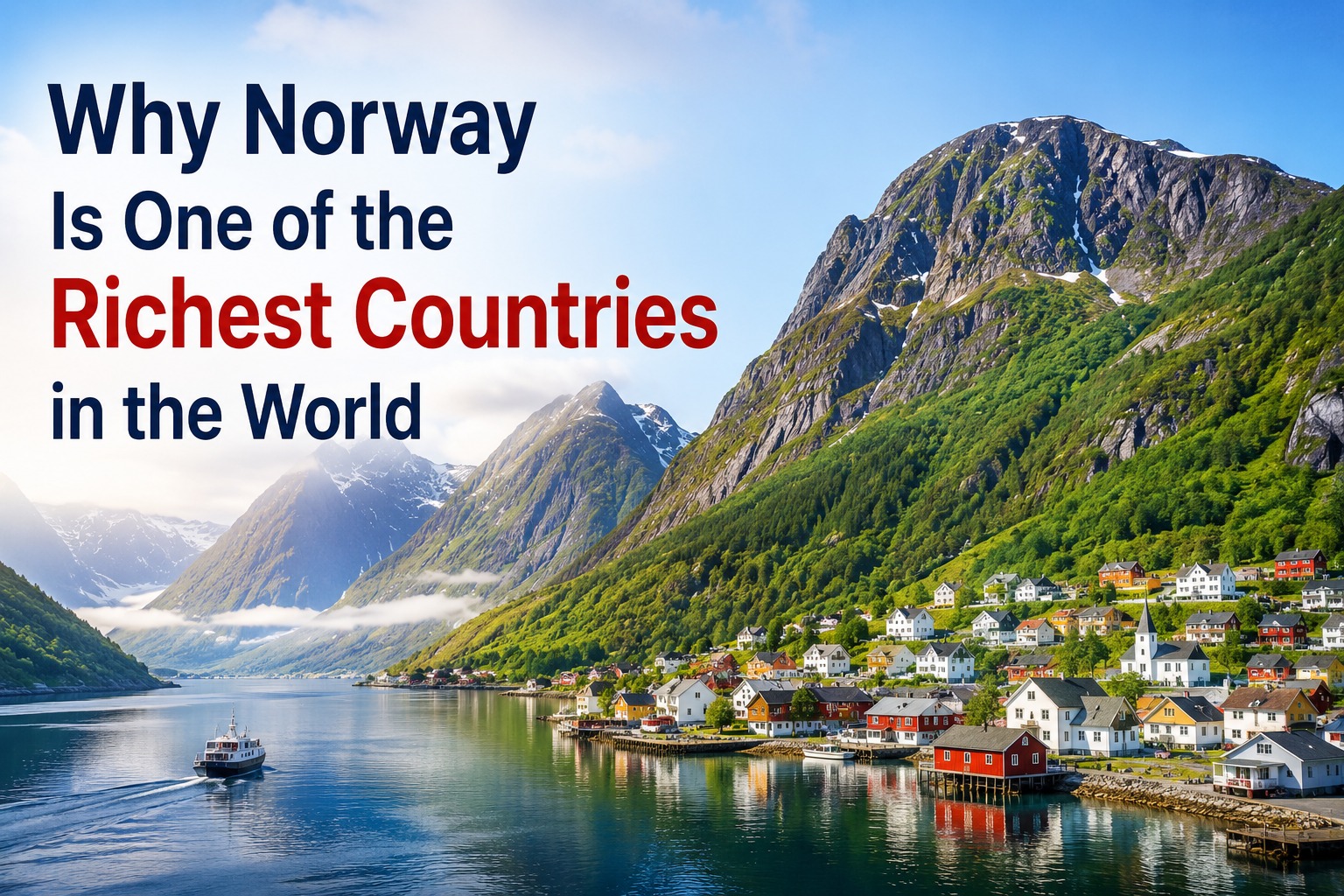
Why Norway Is One of the Richest Countries in the World
There is a website called nbim.no. On its homepage, you’ll find a live tracker that shows, in real time, how much money is sitting in Norway’s national savings account.
This money belongs to Norway’s Government Pension Fund Global, often called the “Oil Fund.” Today, the fund is worth more than $2.2 trillion, making it the largest sovereign wealth fund in the world.
What’s even more impressive is that the fund keeps generating profits. In 2025 alone, it earned approximately $47 billion in profit. If that profit were distributed among Norway’s 5.6 million citizens, each person would receive around $8,400—and that’s just from one year’s profit.
Norwegians don’t have to work for this money directly. The fund invests globally and continues to grow, giving the country a massive financial cushion. This alone gives you an idea of how wealthy Norway has become.
Norway consistently ranks among the world’s best countries to live in. It is near the top of the Human Development Index, ranks among the leaders in press freedom, provides high-quality healthcare at low personal cost, and offers free education for all citizens. Crime rates are low, and life expectancy is around 84 years.
But Norway wasn’t always rich.
For much of its history, the country struggled with poverty, unemployment, and emigration. It was once considered one of the less-developed nations in Europe. Everything changed after large oil reserves were discovered in the North Sea.
What’s remarkable is that Norway avoided the problems that often plague oil-rich nations. Around the world, countries dependent on oil revenues frequently face dictatorship, political instability, corruption, civil conflict, or foreign interference.
Norway took a different path.
Instead of spending all of its oil income, it invested the wealth for future generations. The result is a country that transformed natural resources into long-term prosperity and became a global model for economic management.
So what exactly did Norway do differently? How did it become one of the world’s richest and most stable countries? And what lessons can countries like India learn from Norway’s success story?
Let’s find out.
Norway is located in Northern Europe. It shares land borders with Sweden, Finland, and Russia, while the North Sea, Norwegian Sea, and Barents Sea surround the rest of the country.
The country has a population of about 5.6 million people and covers roughly 385,000 square kilometers of land. Its capital city is Oslo, and its currency is the Norwegian Krone (NOK).
Oslo is also the city where the Nobel Peace Prize ceremony takes place every year.
The Nobel Prizes were established in memory of Swedish chemist, engineer, and inventor Alfred Nobel. He is best known for inventing dynamite, although he held more than 350 patents during his lifetime and accumulated a substantial fortune from his inventions.
Before his death, Nobel wrote in his will that most of his wealth should be placed in a fund. The returns generated from that fund would be used to reward individuals who make outstanding contributions to humanity.
Originally, Alfred Nobel created five prize categories: Physics, Chemistry, Medicine, Literature, and Peace. In 1968, a prize in Economics was added, although it was not part of Nobel’s original will.
When Nobel drafted his will, Norway and Sweden were united under a single political union. He assigned Swedish institutions the responsibility of selecting winners in most categories. However, he entrusted the Peace Prize to the Norwegian Parliament because he viewed Norway’s political system as more liberal and democratic.
In 1905, Norway and Sweden dissolved their union, and Norway became an independent nation. Despite the separation, the Nobel Peace Prize has continued to be awarded by a Norwegian committee to this day.
Norway operates under a constitutional monarchy and parliamentary democracy, similar to the United Kingdom. The country has a king, but the monarch’s powers are largely ceremonial. The real authority lies with Parliament and the elected government.
Norway’s parliament is called the Storting and consists of 169 members elected every four years. The party or coalition that holds a majority forms the government, and its leader becomes the Prime Minister. Today, that position is held by Jonas GahrStøre.
Now let’s move to the story that transformed Norway forever: oil.
South of Norway lies the North Sea. For centuries, it was known for rough storms and rich fishing grounds. Norway’s economy relied heavily on fishing and shipping, making the North Sea the country’s economic lifeline.
Few people imagined that beneath those waters lay one of the greatest sources of wealth in modern history.
The story began to change in 1959 when a massive natural gas field was discovered in the Netherlands. Since the Dutch coastline also borders the North Sea, many experts believed the region could contain significant oil reserves as well.
Soon, international oil companies rushed to secure exploration licenses.
There was one challenge: the North Sea was not owned by a single country. Its waters bordered several nations. To resolve ownership disputes, neighboring countries negotiated maritime boundaries based on median lines and divided the seabed accordingly.
One of the most important agreements was signed between Norway and the United Kingdom in 1965. Both countries agreed that any resources discovered within their designated sectors would belong exclusively to them.
Throughout the 1960s, oil companies invested hundreds of millions of dollars in exploration. Yet results were disappointing. A few wells were found, but none contained enough oil to justify large-scale commercial production.
Patience was running out.
In Norway’s sector of the North Sea, the American company Phillips Petroleum had drilled more than 30 unsuccessful wells. By 1969, executives were ready to abandon the project altogether.
They decided to make one final attempt.
In December 1969, that last drilling operation changed history.
The company struck an enormous oil reservoir containing an estimated 3 billion barrels of crude oil. Located about 320 kilometers (200 miles) off Norway’s coast, the field became known as Ekofisk.
The discovery of Ekofisk marked the beginning of Norway’s transformation from a relatively modest economy into one of the wealthiest and most prosperous nations on Earth.
Oil is still being extracted from the Ekofisk field today, and it remains a major source of income for Norway.
Over the following decades, many more oil and gas fields were discovered across the North Sea. These discoveries transformed Norway into one of the wealthiest nations in the world. Today, Norway is the world’s 12th-largest producer of crude oil and ranks among the top exporters of both oil and natural gas. It is also Europe’s largest supplier of pipeline natural gas.
Between 1969 and 2025, Norway earned more than $1.5 trillion from oil and gas revenues. For a country with a population of just 5.6 million people, that is an extraordinary amount of wealth.
For many countries, such riches can become a curse rather than a blessing.
This phenomenon is known as the “Resource Curse.”
When a country suddenly discovers massive natural resources, money starts flowing in with little effort. Since oil is always in demand, governments often become dependent on easy revenue.
As foreign money pours in, imported goods become cheaper while local products become less competitive. Manufacturing, agriculture, tourism, and other industries begin to weaken. Governments focus increasingly on resource income and neglect the development of other sectors.
Over time, oil revenues dominate the economy.
Tax collection becomes less important because the government already has plenty of money. Public spending rises rapidly, and people begin to assume the boom will last forever.
The problem appears when oil prices fall or production declines.
Without diversified sources of income, the entire economic system becomes vulnerable. Government budgets shrink, jobs disappear, and economic instability spreads throughout the country.
Corruption often follows.
Political leaders know that whoever controls the resources controls the wealth. As a result, they may manipulate institutions, weaken democratic systems, and use every possible means to stay in power. In some cases, this leads to violence, coups, civil wars, and long-term instability.
Foreign interference becomes another risk.
Throughout history, powerful nations have sought influence over resource-rich regions. Countries with weak institutions often struggle to protect their interests, making them vulnerable to outside pressure and intervention.
In such situations, ordinary citizens usually suffer the most. A small elite benefits from resource wealth while the broader population bears the costs of economic and political instability.
Examples often cited include Iraq, Libya, Venezuela, the Democratic Republic of Congo, and Equatorial Guinea.
Norway was aware of these dangers from the beginning.
In 1971, the Norwegian Parliament introduced a set of principles for managing petroleum resources. These became known as the “Ten Oil Commandments.”
The principles stated that Norway’s natural resources belonged to its people, that the government would maintain control over the petroleum sector, and that foreign companies would not be allowed to dominate the industry.
The government also established a state-owned oil company, later known as Equinor (formerly Statoil), with a mission to develop local expertise and train Norwegians to manage the industry themselves.
Perhaps most importantly, political parties across the spectrum agreed that oil policy would remain a long-term national project rather than a partisan political issue.
Even with these precautions, Norway made mistakes.
During the early years of the oil boom, the government spent aggressively on infrastructure, reduced taxes, and increased public spending. Rising incomes encouraged people to borrow heavily, while many young workers focused almost exclusively on jobs in the oil sector.
For a while, everything seemed to be working.
But underneath the surface, warning signs were emerging. Traditional industries such as fishing weakened, local factories struggled, and parts of the economy became overly dependent on petroleum revenues.
Then came a major shock.
In 1986, global oil prices collapsed by roughly 50%.
The impact on Norway was immediate. Government revenues fell sharply, the Norwegian currency weakened, unemployment increased, and the banking sector came under severe pressure. Banks had issued large amounts of credit during the boom years and suddenly faced significant losses.
The government was forced to intervene and rescue parts of the financial system.
That crisis changed Norway’s thinking forever.
Policymakers realized that oil and gas reserves were finite. The revenue generated from them would not last forever either. If the country failed to preserve this wealth, future generations would eventually pay the price.
As a result, Norway passed the Government Petroleum Fund Act in 1990.
This decision permanently changed the country’s future.
Under the new law, Norway created a national savings fund called the Government Pension Fund Global (GPFG), commonly known as the Oil Fund.
The idea was simple but revolutionary:
All net government income from oil and gas would be deposited into the fund. Instead of spending the money immediately, Norway would invest it across global financial markets.
The fund was never intended to belong to a single government or political party. It belonged to the Norwegian people as a whole.
In 1996, the first oil revenues were transferred into the fund, and large-scale investing began.
Today, the fund is worth more than $2.2 trillion and owns stakes in over 8,000 companies worldwide, along with investments in bonds, real estate, and renewable energy projects.
Because the fund is diversified across countries, industries, and asset classes, it is less vulnerable to the performance of any single market.
Remarkably, Norway owns roughly 1.5% of all publicly listed shares in the world through this fund.
The fund has also invested billions of dollars in India, with holdings valued at approximately $30 billion.
If Norway were to distribute the entire fund equally among its citizens today, each person would receive roughly $390,000–$400,000.
However, the government cannot simply withdraw the money whenever it wants.
Strict rules protect the fund:
Rule #1: All government oil and gas revenues must first be deposited into the Oil Fund before being spent elsewhere.
Rule #2: The government can spend only a small portion of the fund each year—generally around 3% of its value. This ensures that the principal remains intact while investment returns continue to grow over time.
For example, if the fund were worth $2 trillion, the government could use only about $60 billion annually through the national budget.
Rule #3: Complete transparency.
Every investment, return, and major decision is publicly reported. Citizens can see where the money is invested and how the fund is being managed.
This combination of discipline, transparency, and long-term thinking is what turned Norway’s oil wealth into one of the greatest financial success stories in modern history.
The Norwegian government publishes virtually every detail about the Oil Fund. Its official website displays the fund’s value in real time, and the public can see exactly which companies the fund has invested in.
There is also a continuous process for removing investments from companies accused of serious ethical violations.
Another important rule is that politicians do not make day-to-day investment decisions.
Those decisions are handled by professional fund managers operating under Norway’s central bank. The government’s role is limited to setting rules, defining objectives, and ensuring accountability.
The impact of this system on Norway has been enormous.
Today, education in Norway is free from primary school through university. Every citizen has access to the public healthcare system. In many cases, individuals pay no more than about $300 per year out of pocket, after which most healthcare costs are covered by the state.
Parents are entitled to up to 49 weeks of paid parental leave after the birth of a child.
If someone loses their job, the government provides financial support while they search for new employment. People who become unable to work because of illness or injury also receive assistance. The government spends significant resources on pensions and retirement benefits as well.
But here’s an important question:
Is all of this funded solely by the Oil Fund?
Not at all.
The Oil Fund contributes roughly 20% of Norway’s national budget, while the remaining revenue comes from taxes, fees, and other government income sources.
Taxes play a particularly important role.
Norway has some of the highest tax rates in the world. The top personal income tax rate can reach around 47.7%. Most goods and services are subject to a 25% value-added tax (VAT). Food is generally taxed at 15%, while transportation and tourism-related services are taxed at 12%.
Profits from petroleum activities face an effective tax rate of approximately 78%.
The government also imposes a wealth tax, requiring individuals with assets above certain thresholds to contribute additional taxes.
Despite these high tax rates, Norwegians remain among the highest earners globally.
The country’s GDP per capita exceeds $90,000, and even after taxes, many households maintain a high standard of living.
More importantly, people receive extensive benefits in return.
Citizens do not constantly worry about catastrophic medical bills. Parents receive paid leave when children are born. Families receive support for childcare. Education is largely free. Public transportation is subsidized. Employees receive strong workplace protections, including sick-pay benefits and generous annual leave.
In many cases, workers are entitled to at least five weeks of paid vacation every year.
Perhaps the most valuable benefit is trust.
People generally believe that if something goes wrong—whether it is unemployment, illness, disability, or old age—the system will provide support.
Of course, Norway is not perfect.
One criticism concerns climate policy.
Norway has become a global leader in clean energy and electric vehicles. More than 90% of new cars registered in recent years have been electric, and most of the country’s electricity comes from hydropower.
Yet Norway remains a major exporter of oil and natural gas.
Critics argue that while Norway promotes environmental sustainability at home, it continues to profit from fossil fuel consumption abroad. The country has also faced criticism for continuing oil exploration in Arctic regions.
A second criticism concerns ethical consistency.
Norway often presents itself as a defender of human rights and international peace. However, portions of its sovereign wealth fund have at times been invested in companies connected to defense and weapons industries, creating debate about whether those investments align with the country’s stated values.
Norway has also faced challenges related to immigration, social integration, and discrimination. Reports of hostility toward immigrants and ethnic minorities have occasionally sparked public debate.
A third criticism involves media and public accountability.
Norway consistently ranks near the top of global press freedom indexes. The country has a vibrant media environment and high levels of public trust in journalism.
However, critics argue that close relationships among political, business, and media elites can sometimes reduce scrutiny of powerful institutions. Like every democracy, Norway faces ongoing debates about transparency, bias, and accountability.
The key point is this:
Norway is not a perfect country.
It has policy failures, political disagreements, regional inequalities, and social challenges. It struggles with some of the same issues that affect many developed nations.
Yet compared with most countries, Norway has managed its natural-resource wealth remarkably well.
Instead of allowing oil revenues to become a source of corruption or instability, it built strong institutions, created long-term rules, invested for future generations, and maintained broad political consensus around responsible management.
Norway transformed a finite natural resource into a permanent national asset.
Rather than spending everything today, it saved and invested for tomorrow.
That decision turned one of the world’s largest oil discoveries into one of the greatest long-term economic success stories in modern history.