

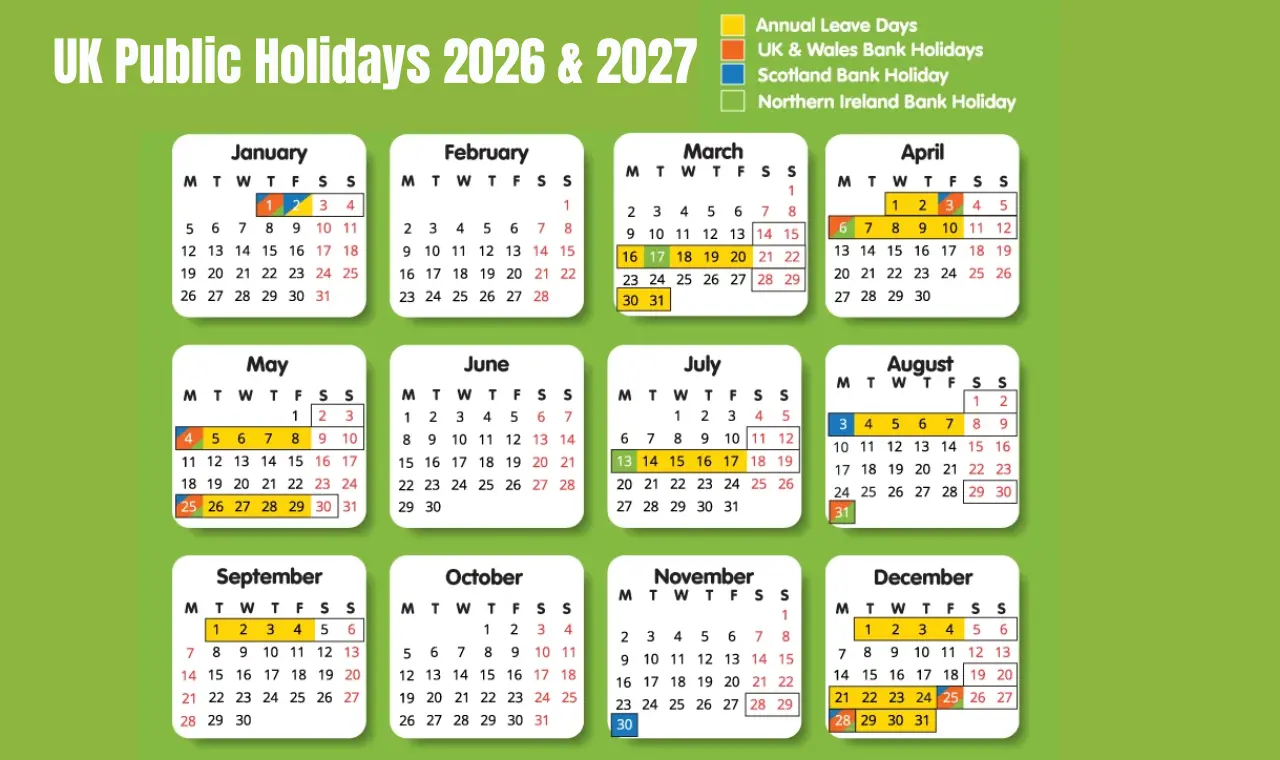
UK Public Holidays 2026 & 2027: Full List of Bank Holidays and Observances
Public holidays, sometimes known as bank holidays, are observed differently in England, Scotland, Wales, and Northern Ireland. The list of public holidays for 2026 and 2027 is as follows:
UK Public Holidays 2026–2027: Complete Table
England & Wales – Bank Holidays 2026
| Holiday | Date | Day |
| New Year’s Day | January 1, 2026 | Thursday |
| Good Friday | April 3, 2026 | Friday |
| Easter Monday | April 6, 2026 | Monday |
| Early May Bank Holiday | May 4, 2026 | Monday |
| Spring Bank Holiday | May 25, 2026 | Monday |
| Summer Bank Holiday | August 31, 2026 | Monday |
| Christmas Day | December 25, 2026 | Friday |
| Boxing Day (Substitute) | December 28, 2026 | Monday |
England & Wales – Bank Holidays 2027
| Holiday | Date | Day |
| New Year’s Day | January 1, 2027 | Friday |
| Good Friday | March 26, 2027 | Friday |
| Easter Monday | March 29, 2027 | Monday |
| Early May Bank Holiday | May 3, 2027 | Monday |
| Spring Bank Holiday | May 31, 2027 | Monday |
| Summer Bank Holiday | August 30, 2027 | Monday |
| Christmas Day (Substitute) | December 27, 2027 | Monday |
| Boxing Day (Substitute) | December 28, 2027 | Tuesday |
Scotland – Public Holidays 2026
| Holiday | Date | Day |
| New Year’s Day | January 1, 2026 | Thursday |
| 2 January Holiday | January 2, 2026 | Friday |
| Good Friday | April 3, 2026 | Friday |
| Early May Bank Holiday | May 4, 2026 | Monday |
| Spring Bank Holiday | May 25, 2026 | Monday |
| Summer Bank Holiday | August 3, 2026 | Monday |
| St Andrew’s Day | November 30, 2026 | Monday |
| Christmas Day | December 25, 2026 | Friday |
| Boxing Day (Substitute) | December 28, 2026 | Monday |
Scotland – Public Holidays 2027
| Holiday | Date | Day |
| New Year’s Day | January 1, 2027 | Friday |
| 2 January (Substitute) | January 4, 2027 | Monday |
| Good Friday | March 26, 2027 | Friday |
| Early May Bank Holiday | May 3, 2027 | Monday |
| Spring Bank Holiday | May 31, 2027 | Monday |
| Summer Bank Holiday | August 2, 2027 | Monday |
| St Andrew’s Day | November 30, 2027 | Tuesday |
| Christmas Day (Substitute) | December 27, 2027 | Monday |
| Boxing Day (Substitute) | December 28, 2027 | Tuesday |
Northern Ireland – Public Holidays 2026
| Holiday | Date | Day |
| New Year’s Day | January 1, 2026 | Thursday |
| St Patrick’s Day | March 17, 2026 | Tuesday |
| Good Friday | April 3, 2026 | Friday |
| Easter Monday | April 6, 2026 | Monday |
| Early May Bank Holiday | May 4, 2026 | Monday |
| Spring Bank Holiday | May 25, 2026 | Monday |
| Battle of the Boyne (Substitute) | July 13, 2026 | Monday |
| Summer Bank Holiday | August 31, 2026 | Monday |
| Christmas Day | December 25, 2026 | Friday |
| Boxing Day (Substitute) | December 28, 2026 | Monday |
Northern Ireland – Public Holidays 2027
| Holiday | Date | Day |
| New Year’s Day | January 1, 2027 | Friday |
| St Patrick’s Day | March 17, 2027 | Wednesday |
| Good Friday | March 26, 2027 | Friday |
| Easter Monday | March 29, 2027 | Monday |
| Early May Bank Holiday | May 3, 2027 | Monday |
| Spring Bank Holiday | May 31, 2027 | Monday |
| Battle of the Boyne | July 12, 2027 | Monday |
| Summer Bank Holiday | August 30, 2027 | Monday |
| Christmas Day (Substitute) | December 27, 2027 | Monday |
| Boxing Day (Substitute) | December 28, 2027 | Tuesday |
Employment Laws Around Public Holidays in the UK
Are Employees Entitled to Time Off on Public Holidays?
Under UK employment law, employees are not automatically entitled to take public holidays off. Whether a worker receives a public holiday as a day off depends entirely on the terms set out in their employment contract.
In many cases, employers choose to include public holidays within an employee’s annual leave allowance or grant them as additional paid days off. However, this is a contractual benefit rather than a statutory right.
The main legislation governing holiday entitlements in the UK includes:
- The Working Time Regulations 1998, which provide a statutory minimum of 5.6 weeks of paid annual leave per year (equivalent to 28 days for full-time employees). This total may include public and bank holidays if specified by the employer.
Can Employers Ask Employees to Work on Public Holidays?
Yes. Employers can require employees to work on public holidays, provided this requirement is clearly stated in the employment contract. Employers must ensure that expectations around public holiday work are communicated transparently and agreed upon at the time of hiring.
When employees are required to work on a public holiday, many organisations offer compensation, such as:
- Enhanced pay rates, including time-and-a-half or double pay
- Time off in lieu (TOIL), allowing employees to take paid leave at a later date
While these compensatory measures are not legally mandatory, they are widely regarded as good employment practice.
Best Practices for Compensating Employees Working on Public Holidays1. Monetary Compensation
When employees work on public holidays, many firms decide to pay them more. Increased compensation can boost employee morale and retention even though it is not mandated by law.
Example: Paying double wages for employees working on Christmas Day.
Offering Time Off in Lieu (TOIL)
Employees who work on public holidays can take equivalent paid vacation on a different day thanks to time off in lieu. TOIL agreements must to be prearranged and precisely recorded in business contracts or rules.
Example: An employee who works on Boxing Day may be granted a full paid day off at a later date.
Transparency and Clear Communication
Employers are urged to include explicit information about their public holiday policy in employee handbooks and employment contracts. Employers and workers can avoid misunderstandings and establish mutual understanding by talking about these phrases during onboarding.
Are employees legally entitled to public holidays off in the UK?
No. Under UK employment law, employees do not have an automatic legal right to take public or bank holidays off work. Whether an employee gets these days off depends on the terms of their employment contract.
Do public holidays count as part of annual leave entitlement?
Yes, they can. The Working Time Regulations 1998 provide a statutory minimum of 5.6 weeks (28 days) of paid annual leave for full-time employees. Employers may choose to include public holidays within this allowance, provided this is clearly stated in the contract.
Can an employer require employees to work on public holidays?
Yes. Employers are allowed to ask employees to work on public holidays if the employment contract permits it. Any such requirement should be clearly communicated in writing at the time of hiring or in company policies.
Is extra pay mandatory for working on a public holiday?
No. UK law does not require employers to offer extra or premium pay for working on public holidays. However, many employers voluntarily provide enhanced rates—such as time-and-a-half or double pay—as a goodwill gesture.
What is Time Off in Lieu (TOIL)?
Time Off in Lieu (TOIL) allows employees who work on public holidays to take equivalent paid leave at a later date. TOIL is not a statutory requirement but must be agreed upon in advance and clearly documented.
Can employers choose between TOIL and extra pay?
Yes. Employers can decide whether to offer TOIL, enhanced pay, or no additional compensation, as long as their approach complies with the employment contract and minimum legal leave entitlements.
Do part-time workers have the same public holiday rights?
Part-time workers are entitled to the same minimum annual leave on a pro-rata basis as full-time employees. They do not have an automatic right to public holidays off unless stated in their contract.
What happens if public holidays fall on a weekend?
If a public holiday falls on a weekend, a substitute day is often observed on a weekday. Whether employees receive this day off depends on contractual terms, not statutory law.
Can employers change public holiday policies?
Yes, but changes must follow contractual and consultation requirements. Employers cannot unilaterally reduce statutory leave entitlements and must provide adequate notice if policies are amended.
What is the minimum holiday entitlement under UK law?
Under the Working Time Regulations 1998, employees are entitled to:
- 5.6 weeks of paid annual leave per year
- Equivalent to 28 days for full-time employees
- Public holidays may or may not be included
Are employers required to explain public holiday rules to employees?
While not a strict legal requirement, best practice dictates that employers should clearly explain public holiday arrangements during onboarding and document them in employment contracts or employee handbooks.
What should employees do if public holiday terms are unclear?
Employees should review their employment contract and speak with HR or management. If disputes arise, guidance can be sought from ACAS or an employment law professional.
Can an employer deduct pay if an employee refuses to work on a public holiday?
Yes, if working on public holidays is a contractual requirement and the employee refuses without valid reason, the employer may treat it as unpaid leave or a disciplinary matter. However, deductions must comply with employment law and contractual terms.
Are zero-hours workers entitled to public holiday pay?
Zero-hours workers are entitled to paid annual leave under UK law, calculated based on hours worked. Public holidays are not automatically paid unless included in their contract or reflected in their accrued holiday pay.
Do agency workers get public holidays off?
Agency workers are not automatically entitled to public holidays off. However, under the Agency Workers Regulations 2010, eligible workers may gain equal treatment regarding pay and leave after 12 weeks in the same role.
Is holiday pay different when working on public holidays?
Holiday pay must reflect an employee’s normal rate of pay, including regular overtime and commission. However, there is no legal requirement to pay extra simply because the holiday falls on a public holiday.
Can employers force employees to use annual leave on public holidays?
Yes. Employers can require employees to take annual leave on specific days, including public holidays, provided they give sufficient notice—at least twice the length of the leave being enforced.
Are employees entitled to public holidays during maternity or sick leave?
Yes. Employees continue to accrue statutory annual leave while on maternity, paternity, adoption, or sick leave, including leave that covers public holidays.
What happens to public holidays during notice periods?
Employees continue to accrue holiday entitlement during their notice period. Any unused statutory leave, including days covering public holidays, must be paid in lieu if not taken.
Are employers required to close businesses on public holidays?
No. There is no legal obligation for businesses to close on public or bank holidays. Many sectors—retail, healthcare, hospitality, and transport—operate as normal.
Do religious holidays count as public holidays?
No. Religious festivals are not classed as UK public holidays. However, employers must avoid discrimination under the Equality Act 2010 and may allow annual leave or flexible working for religious observance.
Can public holiday benefits differ between employees?
Yes, as long as differences are lawful, non-discriminatory, and based on contract type, seniority, or role. Employers must ensure equal treatment under employment and equality laws.
What legal protection do employees have over holiday disputes?
Employees can seek guidance from ACAS, raise a formal grievance, or pursue an employment tribunal claim if statutory holiday rights are breached.
Does Brexit affect public holiday rights in the UK?
No. UK public holiday and annual leave entitlements remain governed by domestic law, including the Working Time Regulations 1998, which continue to apply post-Brexit.
Are bank holidays mandatory for employers to recognise?
No. Employers are not legally required to recognise bank holidays unless specified in employment contracts.
How should employers document public holiday policies?
Best practice is to clearly outline policies in:
- Employment contracts
- Staff handbooks
- HR policy documents
Clear documentation helps prevent disputes and ensures legal compliance.
Click Here:













Leave a Reply