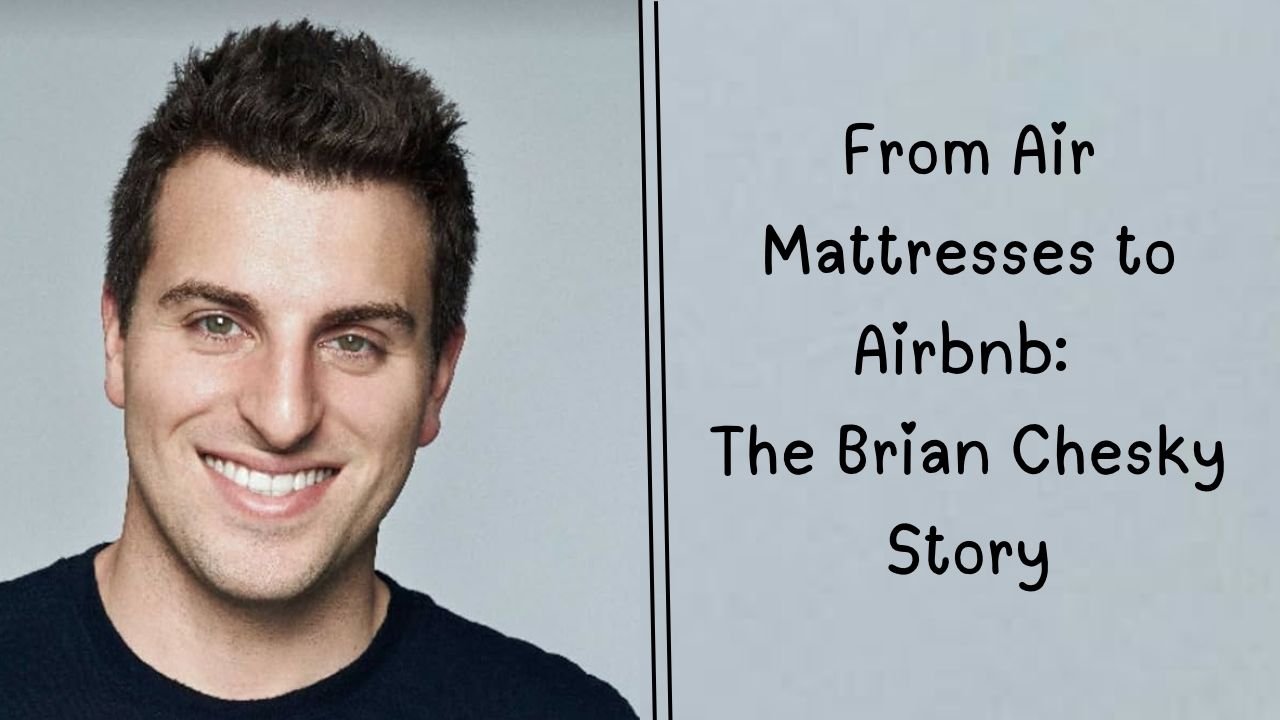
Who Is Brian Chesky? The Designer Behind Airbnb
Brian Chesky is the co-founder and CEO of Airbnb. Here is how a designer with an empty bank account built a global travel platform, what makes his leadership different, and where Airbnb stands in late 2026.
Every startup has an origin story, but few are as oddly specific as Airbnb’s: two roommates, a sold-out city, and three air mattresses on a living-room floor. That story is true, and Brian Chesky has told it many times. What gets less airtime is everything that came after, including the rejections, the cereal boxes, a pandemic that nearly wiped out the business, and a comeback that is still unfolding.
Who is Brian Chesky?
Brian Chesky is the co-founder and CEO of Airbnb, the global travel platform that turned spare rooms and whole homes into a new kind of hospitality. He was born on 29 August 1981 in Niskayuna, New York, and studied industrial design at the Rhode Island School of Design (RISD). That training matters. Chesky didn’t come up through finance or software engineering. He learned to think about how people actually use things, and that habit shaped how Airbnb looks, feels and works.
After design school he worked as an industrial designer, then moved to San Francisco, where rent was far higher than his income. The problem pushed him toward an idea.
Key facts at a glance
- Born: 29 August 1981, Niskayuna, New York, USA
- Education: Rhode Island School of Design (industrial design)
- Company: Airbnb
- Role: Co-founder and CEO
- Industry: Travel, hospitality and technology
- Known for: Building Airbnb into a global travel marketplace
How did Brian Chesky build Airbnb from a simple idea?
In 2007, a design conference filled San Francisco’s hotels. Chesky and his roommate Joe Gebbia, short on rent, put air mattresses on their apartment floor and offered guests a bed and breakfast. A few people paid, and the pair realised they had stumbled onto something bigger than a one-weekend fix.
Nathan Blecharczyk joined as the third co-founder to handle the technology, and the trio built a website. Getting people to use it was the hard part.
Trust was the real product. Investors doubted that strangers would sleep in each other’s homes. So the founders obsessed over the things that make strangers comfortable: good photos, honest reviews, clear listings and a simple booking flow. They even travelled to New York to take professional photos of hosts’ homes themselves, because listings with better pictures booked more.
Cereal boxes kept the company alive. During the 2008 US presidential campaign, the founders designed and sold limited-edition cereal boxes themed around the candidates. The boxes earned press coverage and real cash at a time when funding was nearly impossible to find. It was a scrappy, very human move for a company that would later be worth billions.
Y Combinator changed the trajectory. Airbnb joined the Y Combinator accelerator in 2009, gaining funding, mentorship and a push to focus on growth.
Airbnb’s timeline in brief
- 2007: The air-mattress experiment begins in San Francisco.
- 2008: Airbnb launches formally.
- 2009: The company joins Y Combinator.
- 2010s: International expansion and a fast-growing host community.
- 2020: The COVID-19 pandemic hits travel hard, and Airbnb cuts costs and refocuses.
- December 2020: Airbnb becomes a publicly traded company.
- 2020s: The platform widens from home rentals into hotels, experiences and services.
What makes Brian Chesky’s leadership approach different?
Chesky treats design as a way of running a company, not a coat of paint added at the end. His approach shows up in a few consistent habits.
| Principle | What it looks like at Airbnb |
|---|---|
| Design thinking | Products start from a real guest or host problem |
| Customer focus | Host and guest experiences drive product decisions |
| Simplicity | Complicated travel steps are packed into simple screens |
| Brand building | Airbnb sells belonging, not just beds |
| Long-term thinking | Product bets tie into where travel is heading |
| Founder involvement | Chesky stays close to major product calls |
A good example is how Airbnb handles uncertainty. Photos, reviews, detailed listings and clear pricing aren’t marketing extras; they are the product, built to reduce the fear of booking a stranger’s home. The business lesson is simple: trust isn’t a slogan. You can design it into the product.
His public stance has also been candid about mistakes. A year ago, at Skift Global Forum, Chesky said he was “not happy” with Airbnb’s growth, and revenue growth was 9.7% that quarter. That kind of frankness is rarer in CEOs than it should be.
Why did Airbnb become a major global travel platform?
Airbnb’s growth rests on a model that is easy to describe and hard to copy: a two-sided marketplace that connects unused residential space with travellers who want something other than a standard hotel room.
- Two-sided marketplace: More hosts mean more choice for guests, and more guests mean more earnings for hosts.
- Global supply: Hosts can list anywhere, from big cities to small towns.
- Digital discovery: Travellers compare prices, reviews and locations in one place.
- Network effects: A bigger marketplace attracts even more hosts and guests.
- Brand: Airbnb became shorthand for a different style of travel.
The pandemic test. COVID-19 sent travel into a freefall. Airbnb cut costs, restructured and leaned into longer stays and nearby trips, then went public in December 2020, a remarkable move for a company that had been fighting for survival earlier that year.
Airbnb in late 2026: what’s new
Here is where most older articles stop, and where the story gets interesting.
The strongest growth in three years. Airbnb reported third-quarter 2026 revenue of $4.87 billion, up 19% year over year, its fastest growth in more than three years. Net income rose 43% to $1.89 billion, and gross booking value climbed 21% to $27.7 billion. The company also lifted its full-year outlook to growth in the high teens.
Beating rivals. Expedia’s revenue grew 12% in the same quarter, while Booking’s fell 1%, although each company measures growth a little differently.
India is a bright spot. Nights booked in India grew 60% year over year, and every operating region posted double-digit growth, with Gen Z the fastest-growing group of first-time bookers.
AI is doing real work. About 40% of customer support issues were resolved without a human agent, and support cost per booking fell more than 17%. Chesky also said a dedicated, travel-specific AI trip-planning agent is slated for a consumer rollout in the first half of 2027.
Hotels are no longer taboo. Chesky said hotel bookings accelerated in the third quarter and are growing markedly faster than the core business, though from a small base, and he expects hotels to generate multiple billions in revenue in coming years.
Payment flexibility is boosting bookings. The Reserve Now, Pay Later option added a net 3% lift to third-quarter nights, although that boost is expected to shrink as cancellations come through. Hosts should also note that Airbnb has launched its own pricing tool and called pricing its next big growth lever.
These are company-reported figures from the third-quarter results announced on 5 November 2026, so check Airbnb’s investor page for the latest numbers.
What is Brian Chesky’s net worth and business impact?
Chesky’s wealth is mostly tied to his Airbnb shares, so his net worth moves with the stock price. That’s why published estimates differ so widely from site to site, and why I’d treat any single figure with caution unless it comes from a dated, reliable source.
His wider impact is easier to see in the industry around him. Airbnb helped normalise peer-to-peer lodging and pushed traditional hotels to compete on flexibility, digital experience and personality. And Chesky’s career shows how design, technology and marketplace economics can combine into a global company.
Five lessons founders can take from Brian Chesky
- Solve a problem you actually have. Airbnb began with a rent problem, not a market report.
- Design for trust. If customers must trust strangers, build trust into photos, reviews and clear information.
- Do things that don’t scale at first. Visiting hosts to photograph their homes isn’t scalable, but it taught the team what mattered.
- Stay creative when money is tight. Selling cereal boxes kept the lights on and made headlines.
- Keep reinventing. Hotels, experiences, AI support and flexible payments show a company that keeps changing its own model.
Frequently asked questions
What is Brian Chesky best known for?
He is best known as the co-founder and CEO of Airbnb, which grew from a short-term apartment-rental experiment into a global travel marketplace.
Where did Brian Chesky study?
He studied industrial design at the Rhode Island School of Design, which shaped his design-led approach to products and customer experience.
How did Airbnb start?
In 2007, Chesky and Joe Gebbia hosted travellers in their San Francisco apartment during a sold-out conference. That experiment grew into an online marketplace for short-term stays.
Who are Airbnb’s co-founders?
Brian Chesky, Joe Gebbia and Nathan Blecharczyk.
Is Brian Chesky still the CEO of Airbnb?
Yes. He remains co-founder and chief executive, closely involved in product strategy and long-term direction.
When did Airbnb go public?
In December 2020, during the pandemic.
How is Airbnb doing now?
Its third-quarter 2026 results showed its fastest revenue growth in more than three years, with strong demand across regions, including India.
Conclusion
Brian Chesky’s story is more than a tale of air mattresses. It’s a case study in turning a small, practical idea into a global business through design, trust and persistence. From an industrial-design background to leading Airbnb through rapid growth, a global crisis, a public listing and now an AI-driven reinvention, his career shows what happens when a founder keeps solving real problems with a distinctive product philosophy.