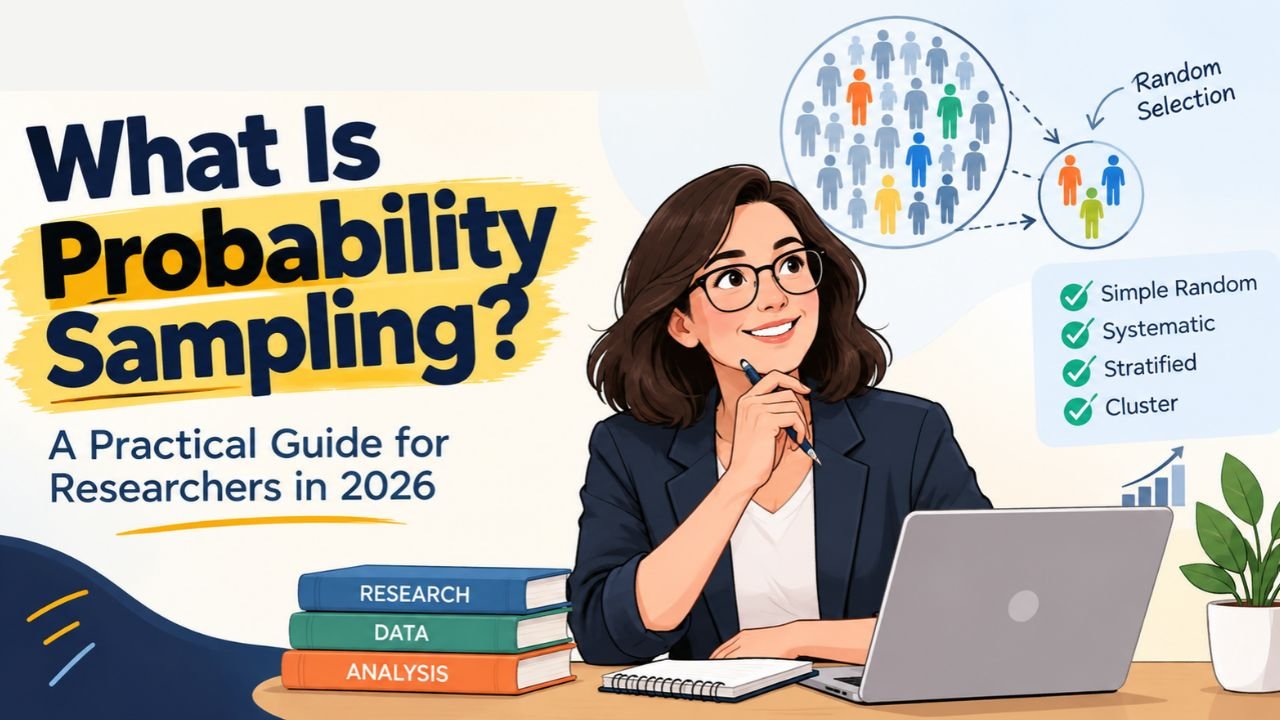
Imagine you want to know what 10 million people in a country think about a new product. You can’t ask all of them. So you ask a few thousand and hope they speak for everyone.
That hope only holds up if the few thousand were chosen the right way. Probability sampling is that way.
What Is Probability Sampling?
Probability sampling is a method where every person in the population has a known, non-zero chance of being picked, and the pick is made by a random process, not by the researcher’s judgement. The chances don’t have to be equal for everyone. They just have to be known, so you can account for them when you analyse the results.
Because chance does the choosing, the researcher’s own bias can’t creep in. That’s why the results can be generalised to the whole population, and why you can attach a margin of error to them.
Types of Probability Sampling
Simple Random Sampling
Everyone has the same chance of selection, like drawing names from a hat, except done with software. It’s the easiest to understand. The catch is that you need a complete list of the population to draw from.
Systematic Sampling
Pick a random starting point, then take every kth person on the list. If you have 10,000 customers and need 500, you’d take every 20th one. It’s quick, but it can go wrong if the list has a hidden pattern that matches your interval.
Stratified Sampling
Split the population into groups (strata) that share a trait, such as age band, region or income. Then draw a random sample from each group. This makes sure smaller groups aren’t missed, which is why it’s popular in market research.
Cluster Sampling
Divide the population into natural clusters, such as neighbourhoods, schools or branches. Randomly pick some clusters and survey everyone inside them. It saves travel time and cost when people are spread over a wide area, though it’s usually a bit less precise.
Multistage Sampling
A mix of the above. For a national survey, you might first pick states, then districts, then households, using a different random method at each step. Large government and public opinion surveys often work this way.
Examples of Probability Sampling
A health researcher wants to know how common a condition is in a city. She splits residents by age group and area, then draws a random sample from each. Every segment is represented in proportion.
A political scientist wants to gauge opinion on a new policy. He randomly selects neighbourhoods across the city and surveys households within them. That’s cluster sampling, and it keeps fieldwork manageable.
A retail brand wants feedback from its loyalty members. It splits them by spending level and randomly invites customers from each tier. That’s stratified sampling, and it stops big spenders from drowning out everyone else.
Probability vs Non-Probability Sampling
| Probability Sampling | Non-Probability Sampling | |
|---|---|---|
| How people are chosen | Random, with known chances | Convenience, judgement or volunteers |
| Bias risk | Low | Higher |
| Can results be generalised? | Yes | Usually not |
| Cost and time | Higher | Lower |
| Best for | Surveys, forecasts, studies that need statistical proof | Early exploration, pilot studies, qualitative work |
How to Conduct Probability Sampling
- Define the population. Be specific. “Adults aged 25 to 45 living in metro cities” is much better than “consumers.”
- Build or get a sampling frame. This is the actual list you’ll draw from, such as a customer database or an electoral roll. If the list misses part of the population, your sample will miss it too.
- Pick the method. Match it to your goals, your budget and how your population is spread out.
- Decide the sample size. A common formula is n = z² × p(1−p) ÷ e². At 95% confidence, a ±5% margin of error and p = 0.5, that works out to about 385 respondents for a large population.
- Draw the sample. Use random number generators or survey software, not hand-picking.
- Collect data and chase non-responders. Follow up with people who don’t reply, because the ones who ignore surveys often differ from the ones who answer.
- Weight if needed. If some groups responded less than expected, adjust the data so the final results still reflect the population.
Advantages and Disadvantages
Advantages
- The sample reflects the population closely, so results can be generalised.
- Random selection reduces selection bias.
- You can use inferential statistics, calculate confidence intervals and test hypotheses.
Disadvantages
- It costs more and takes longer, especially for scattered populations.
- You need a good sampling frame, and those aren’t always available.
- Methods like stratified and multistage sampling need careful planning.
- Falling response rates can erode the “random” part, which is why weighting matters.
What’s Changed in 2026
Probability sampling hasn’t changed in principle, but the way it’s done has.
Online panels and mobile surveys have replaced much of the door-to-door and phone work. Many studies now blend methods, mixing a probability-based panel with online responses and then weighting the results. Researchers are also using AI tools to clean data, spot fake or duplicate responses and automate weighting, though the core step still has to be genuine randomisation.
One warning is worth repeating. A big online sample isn’t the same as a good one. Ten thousand self-selected respondents can mislead you more than a well-drawn sample of one thousand.
When Should You Use Probability Sampling?
Use it when you need to make claims about a whole population and defend them. That includes national surveys, health and epidemiology studies, brand tracking, pricing research and any market sizing where the numbers will drive a big decision.
If you’re only exploring ideas, testing a questionnaire or running a small qualitative study, a non-probability approach is often enough and much cheaper.
How The Success Prime Can Help
With over two decades in market research, The Success Prime designs samples that fit the question being asked, not the other way around. Our team handles sampling frames, method selection, sample size, fieldwork and weighting, so your findings stand up to scrutiny. We work across market research, healthcare and social research projects.
Explore our services page or reach out to talk through your next study.