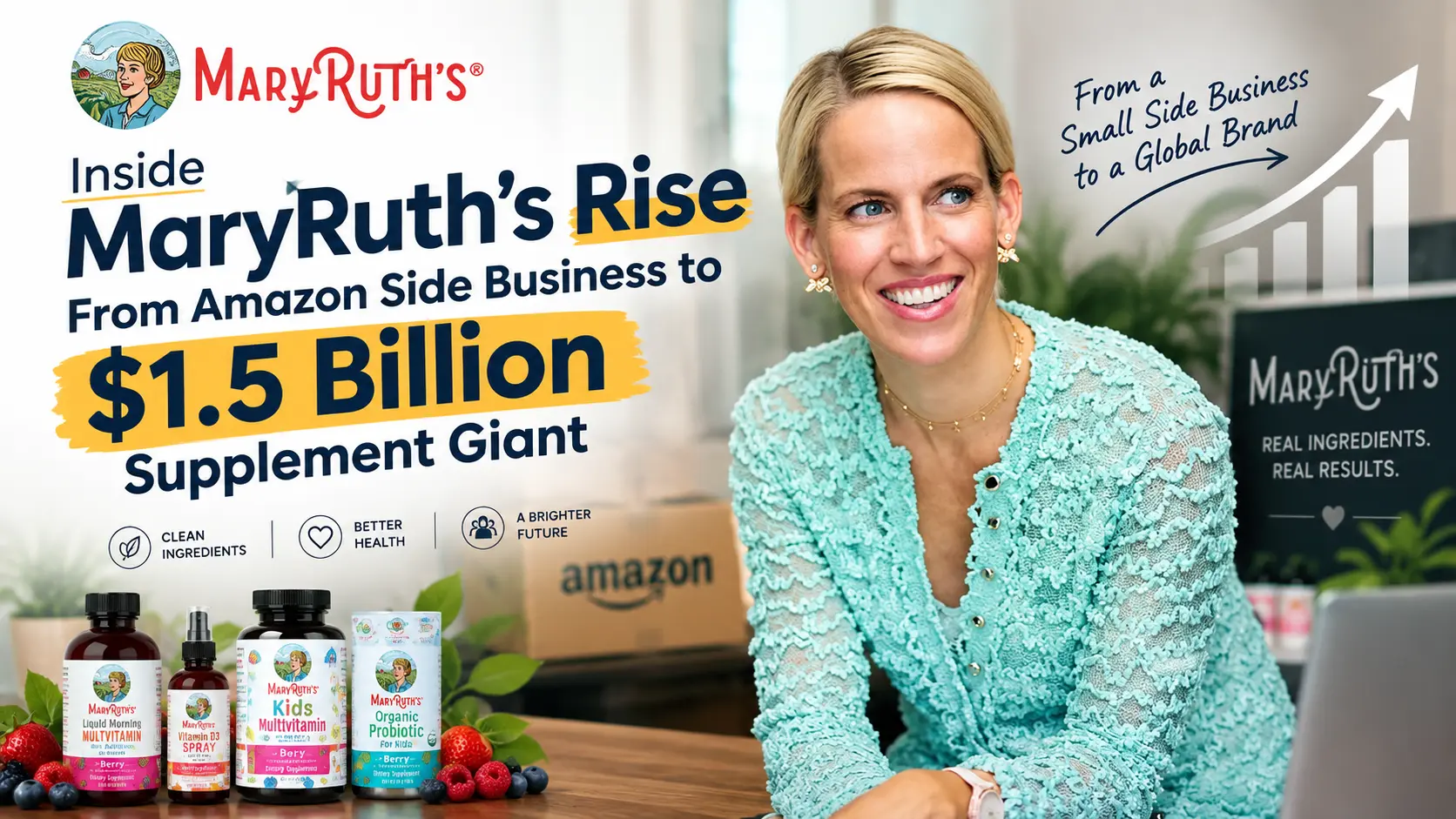
MaryRuth Ghiyam started MaryRuth’s in 2014 as a liquid multivitamin sold on Amazon. In 2026, the company generates roughly $600 million in trailing annual revenue, carries a Forbes-estimated valuation of at least $1.5 billion, and Ghiyam and her family still control close to 97% of it — a rare outcome in an industry where founders typically sell equity away long before reaching that scale.
Most founders who build a billion-dollar consumer brand end up owning a small slice of it by the time they get there. MaryRuth Ghiyam did the opposite. She built one of the fastest-growing names in the wellness industry while holding onto nearly all of it — and the story behind that decision says as much about modern brand-building as it does about her products.
From a Kitchen Multivitamin to a $1.5 Billion Brand: The MaryRuth Ghiyam Story
From Real Estate to Liquid Vitamins
Ghiyam wasn’t trained in the supplement industry. She spent her early career in real estate before a series of personal losses — the deaths of her father and teenage brother, followed by her mother’s diagnosis with two brain tumors — pushed her toward health and wellness work instead. As a certified nutrition consultant, she kept hearing the same complaint from clients: traditional vitamin capsules were hard to take, especially on an empty stomach.
Unable to find a liquid alternative she liked, she built her own. In 2014, working alongside her mother Colleen, Ghiyam launched a raspberry-flavored liquid morning multivitamin on Amazon. That single product became the foundation for what MaryRuth’s is today: a catalog spanning more than 300 product formats, including liquid vitamins, gummies, and other supplement lines aimed at women, men, and kids.
Bootstrapped to $100 Million, Then Beyond
MaryRuth’s didn’t take outside funding for its first seven years. The company scaled past $100 million in revenue entirely bootstrapped before taking its first institutional check — a private equity investment from Los Angeles-based Butterfly Equity in 2021. That deal, along with a later $420 million debt package, gave the company room to expand its product lines and retail footprint without forcing Ghiyam to give up meaningful ownership.
The growth since has been steep. MaryRuth’s is now estimated to generate around $600 million in trailing twelve-month revenue and roughly $125 million in EBITDA, putting its valuation at $1.5 billion or higher by Forbes’ estimate.
The $400 Million Deal That Kept Her in Control
The clearest sign of how differently Ghiyam has approached growth came in August 2025, when a team of ten Capital One bankers approached her directly with an offer to raise more than $400 million in debt — financing structured specifically to help her retain control of outside investment in the business rather than dilute her stake. It’s an unusual move for a bank to pitch a founder rather than the other way around, and it reflects how much leverage MaryRuth’s had built by that point in the wellness market.
Ghiyam, now 41 and co-CEO of the company alongside Jonathan Klein, has said the experience reinforced how she wanted to keep building the business. Of her public image, she has noted that she’s often mistaken for a cartoon avatar rather than a real person — “the brand is never about me,” she says of that dynamic.
What Founders Can Learn From MaryRuth’s Growth Story
A few patterns stand out for anyone building a consumer brand from the ground up:
- Solve your own problem first. MaryRuth’s original product came directly from Ghiyam’s own difficulty finding a liquid vitamin — not from market research.
- Bootstrap as long as you can. Reaching $100 million before taking outside capital gave Ghiyam far more negotiating leverage in every deal that followed.
- Debt isn’t always dilution’s only alternative — but it can be a tool to avoid it. The Capital One financing let MaryRuth’s raise significant growth capital while keeping ownership concentrated in the founder’s hands.
- A recognizable founder face can be a brand asset. Ghiyam’s image is on every bottle, turning the founder herself into part of the product’s trust signal.
Conclusion
MaryRuth Ghiyam’s path from a personal health struggle to a $1.5 billion supplements company is unusual less for its size than for how much of it she still owns. In an industry where founders routinely sell down their stake with every funding round, MaryRuth’s growth shows there’s still a path to scale that doesn’t require giving up control — even if it means turning to increasingly creative financing to get there.
Frequently Asked Questions
How much is MaryRuth’s worth in 2026?
Forbes estimates the company’s valuation at $1.5 billion or higher, based on roughly $600 million in trailing twelve-month revenue and about $125 million in EBITDA.
Does MaryRuth Ghiyam still own her company?
Yes. Despite a private equity investment and a large debt financing package, Ghiyam and her family retain close to 97% ownership of MaryRuth’s.
How did MaryRuth’s start?
Founder MaryRuth Ghiyam launched the company in 2014 with her mother, Colleen, starting with a single liquid multivitamin sold on Amazon after she couldn’t find an easy-to-take vitamin option for her nutrition clients.
Did MaryRuth’s take outside investment?
The company was bootstrapped for its first seven years before taking a private equity investment from Butterfly Equity in 2021, followed by a $420 million debt package and a further $400 million-plus debt financing arranged with Capital One in 2025.
Who runs MaryRuth’s today?
MaryRuth Ghiyam remains a controlling owner and serves as co-CEO alongside Jonathan Klein, who took on the role in 2025 after previously serving as the company’s chief legal officer.
Read Also: Why Jennifer Garner Is Expanding Her Organic Food Brand for Kids?