First, it’s critical to comprehend the nature of the Jeffrey Epstein case. Serious accusations of sex trafficking and the exploitation of minors were made against Jeffrey Epstein. On his own island, he was charged with illicit operations that allegedly involved affluent and powerful people. The case swiftly gained international attention after several well-known names came to light in relation to it.
In this regard, several documents and media reports associated with Epstein also purportedly included the name of famous physicist Stephen Hawking. According to certain sites, Hawking was cited several times in case-related documents. Additionally, a few photos of Hawking attending an event with Epstein were distributed. However, a person’s name being in records or photos does not prove that they were involved in any illegal behavior.
Epstein allegedly suggested in an email to his accomplice Ghislaine Maxwell that family members or friends of Virginia Giuffre, a significant survivor in the Epstein case, might receive some kind of reward if they could assist in refuting Hawking’s accusations. According to reports, this communication was included among the records that were eventually made public.
It is important to note that no court ruling or judicial finding established any wrongdoing by Hawking in relation to these allegations. However, many were astonished when his name was brought up in the dispute. One of the main causes was his international renown; in addition to being a renowned physicist, he was also widely seen as a representation of human intelligence and scientific genius.
Because of this, Hawking’s name generated more intense emotions and social media memes than the names of politicians or corporate leaders who also featured. His reputation and the respect he enjoyed around the world were major factors in the surprise.
Who Was Stephen Hawking? Nobel Snub and Epstein Files Connection
Many people considered Stephen Hawking to be among the best scientists of the twenty-first century. Despite the fact that Hawking never won a Nobel Prize, many people think that the Nobel organization as a whole suffered more than Hawking.
The real tale of his brilliance started at the age of 21. He received a scholarship to study physics at University College, Oxford, since his teachers thought he was an outstanding student. It’s interesting to note that Hawking himself did not originally prioritize his academic job. Roger Penrose made this point in a piece that appeared in The Guardian. According to Penrose, a physicist who shared the Nobel Prize with Hawking, he was extremely bright and had a strong enthusiasm for science.
From an early age, Hawking shown remarkable curiosity and ingenuity, as do many bright and motivated researchers. However, the real test of his determination came at the age of 21, when he was diagnosed with a severe illness — ALS (Amyotrophic Lateral Sclerosis). Although he would later face physical challenges as a result of this life-altering disease, his intellectual prowess and scientific drive remained unaffected.
The neurons, or nerve cells, in Stephen Hawking’s brain and spinal cord gradually stopped working as a result of ALS. He thus gradually lost the capacity to walk, move, use his hands, and eventually even breathe normally. Even a slight cold or fever is sufficient for the majority of us to take time off from work or school. However, ALS is a degenerative illness that gradually weakens the body.
Many thought Hawking’s life and career were finished when he was stricken with paralysis in 1963. His peers were concerned that he might not even be able to finish his doctorate. According to reports, doctors informed him he only had a few years left to live. But that forecast turned out to be wildly inaccurate—he lived for an additional 55 years.
His physical capabilities were greatly hampered by the sickness, but his mental faculties remained unabated. He experienced yet another significant setback in 1985 when he contracted a potentially fatal attack of pneumonia. His capacity to talk was completely taken away by a tracheotomy, a procedure that physicians had to execute to preserve his life. Hawking’s scientific spirit, however, seemed unmoved.
He started utilizing a sophisticated device that could sense minute movements in his face muscles in order to communicate. Despite his physical inability to communicate, he was able to convey intricate scientific concepts by converting these signals into text and eventually speech.
Hawking dedicated these fifty-five years to unraveling the universe’s secrets. He changed our knowledge of black holes by introducing novel notions. For those who don’t know, black holes are places in space where gravity is so great that once something enters, nothing can leave, not even light.
Hawking continues to create amazing work despite having ALS for almost ten years. He presented groundbreaking research on black holes and the Big Bang in 1973, shocking the scientific community and changing the course of contemporary cosmology.
British cosmologist and astrophysicist Martin Rees wrote an article about Stephen Hawking that was published in the journal Nature in 2018. Rees pointed out that Hawking was elected to the Royal Society in London at the age of 32 for his pioneering research on the event horizon of black holes in 1974.
The area around a black hole is referred to as the “event horizon.” As long as it stays outside of this barrier, anything that gets close to a black hole can still escape. However, there is no turning back after it has passed the event horizon. According to Hawking’s calculations, this boundary is spherical, like a ball’s surface. You can picture putting something on a ball’s surface and taking it off with ease. However, once something enters the ball, it cannot exit. In a similar vein, stuff cannot leave a black hole once it has passed through its event horizon.
Hawking’s physical state had substantially worsened by 1974. His speech was severely impacted, and his range of motion was severely restricted. Many people thought he wouldn’t be able to carry out meaningful studies for very long. But even though his body was deteriorating, his intellect was still incredibly active.
Soon after, Hawking put up a notion that questioned one of the most basic presumptions of black holes. It was once thought that nothing, not even light, could escape from black holes. Hawking, however, shown that this might not be totally accurate. Near the event horizon, black holes may release energy due to intricate quantum phenomena caused by their rotation. According to his theory, black holes release radiation at a specific temperature rather than being entirely black. This theoretical emission became known as “Hawking radiation.”
There was a great deal of controversy in the scientific community when the idea of Hawking radiation was first proposed. Andrew Strominger, a physicist at Harvard University, even said that Hawking’s articles have kept theoretical scientists up at night.
The big question became: does information that falls into a black hole disappear forever, or can it somehow escape through this radiation? At first, Hawking thought that all data entering a black hole would be lost forever. His views on this matter, however, underwent a significant shift in 2004, reopening one of the most important discussions in theoretical physics.
Theoretical physicist John Preskill was one of Stephen Hawking’s closest intellectual competitors and collaborators when the idea of Hawking radiation was first proposed. Later, in an essay for Time magazine, Preskill recounted their arguments. Hawking’s theories were frequently contested by Preskill during their heated and thought-provoking conversations. Hawking took pleasure in these discussions and would enthusiastically reply, occasionally converting them into amicable wagers – wagers that frequently led to significant discoveries in research.
Hawking, Preskill, and Kip Thorne, a fellow theoretical physicist and the scientific consultant for Christopher Nolan’s film Interstellar, were involved in one well-known wager. The outcome of information falling into a black hole was the main topic of the wager.
Hawking made a startling remark in 2004 at a significant meeting in Sweden that was attended by more than 500 scientists and media representatives. He said, “I think I’ve solved one of the biggest problems in theoretical physics,” as he took the stage. The audience was taken aback. Information that falls into a black hole is not permanently lost, Hawking acknowledged when he revised his mind. Rather, that information may eventually come back in some way. He acknowledged in public that he had lost the wager with that comment. The most well-known scientist in the world publicly admitting that his previous stance had been wrong was astounding. Hawking’s persona was characterized by his readiness to reconsider and amend his opinions.
Hawking had a similarly unusual personality. He famously threw a party for time travelers in 2009, but the invitations weren’t sent out until the day following the event. The idea was straightforward: someone would have appeared if it were feasible to travel back in time. Nobody did. Hawking maintained that whereas sophisticated high-speed space travel would theoretically enable travel into the future, going back in time leads to logical paradoxes. How could someone have gone back in time in the first place, for instance, if they stopped their own birth? He thought that backward time travel was impossible because of these paradoxes.
Hawking also gave the future of humanity a lot of attention. He was once asked by astrophysicist Neil deGrasse Tyson on the StarTalk program if it may be less expensive to concentrate on avoiding asteroids instead of funding the hunt for extraterrestrial life. In response, Hawking said that the biggest threat to humanity was not asteroids. Instead, he issued warnings about pollution, climate change, and nuclear Armageddon. Establishing a self-sustaining human civilization on an other planet was his audacious solution. establishing a separate, self-sufficient colony that may protect humanity in the event of a worldwide calamity on Earth, rather than necessary relocating everyone to Mars.
A lot of Hawking’s concepts were innovative. Later findings in 2017 validated his research on the region of a black hole’s event horizon. However, direct evidence of Hawking radiation is still elusive. Scientists saw high-energy neutrinos in 2023, which some think could be related to strong cosmic events involving black holes. These phenomena are theoretically related to Hawking’s predictions.
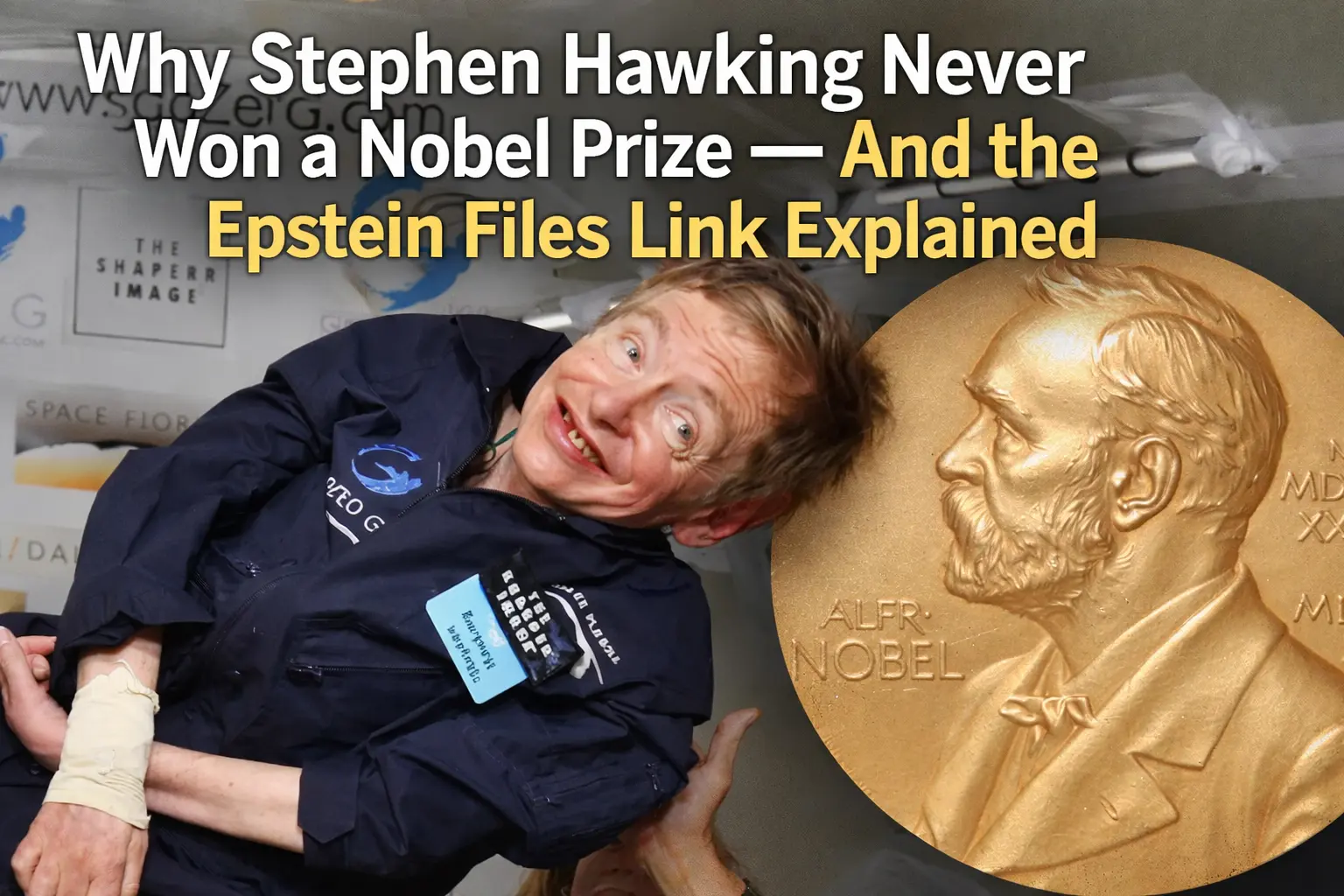
Hawking never won a Nobel Prize in spite of his revolutionary work. This was not because his theories were unimportant; rather, it was because the Nobel Prize is given for discoveries that have been validated by experiment rather than just theoretical effort. Only a few years after his passing, some of his predictions—including those pertaining to black hole physics—were verified.
Even now, his name occasionally comes up in conversations about issues unrelated to his scientific contributions. This creates a sharp contrast for many. Hawking has long been linked to humanity’s most profound inquiries concerning existence, time, and space. However, his name has also come up in discussions and scrutiny in recent years. His influence on physics and cosmology is still among the most significant in the history of contemporary science, regardless of the debate.
Read Also: