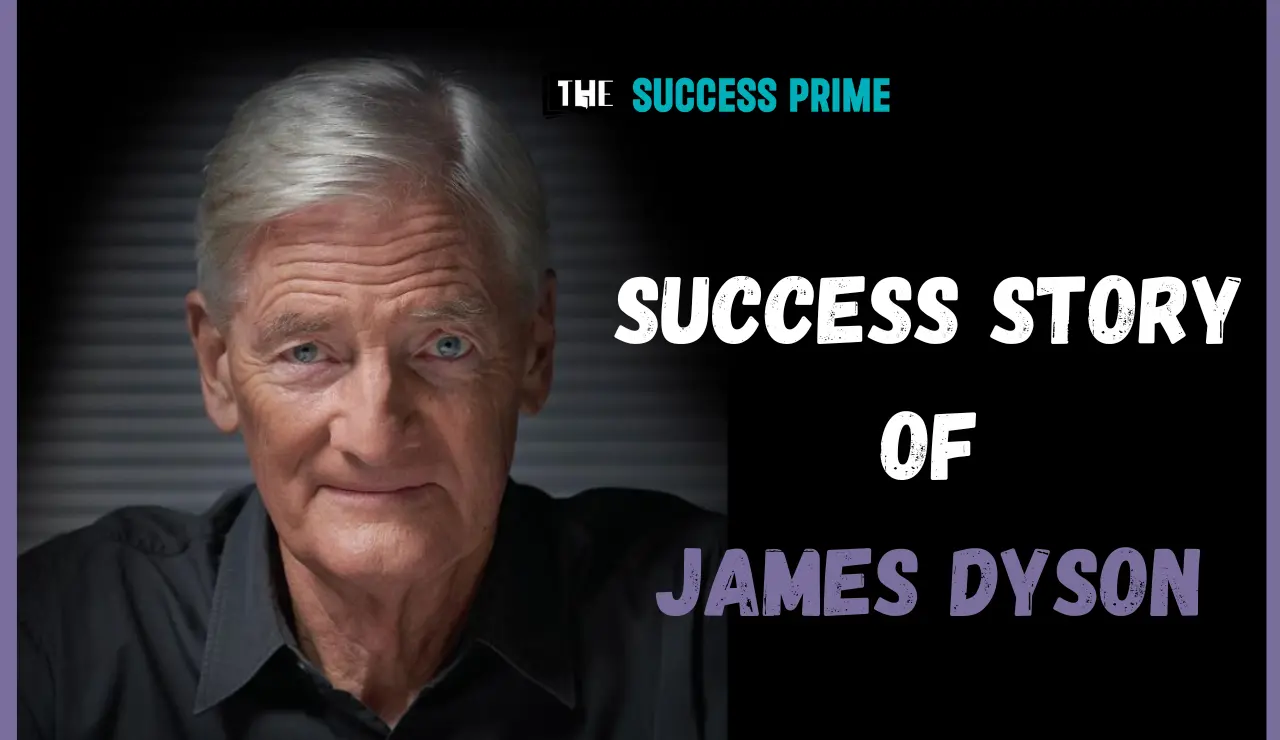
Rejected 5,000 Times! The Shocking Success Story of James Dyson
Hello friends, and welcome. Tell me—have you ever dreamed of something that everyone around you called impossible? Today, we’re sharing the story of a man who didn’t just dream big, but turned that dream into reality—after failing 5,125 times.
This is the story of James Dyson. An inventor, a fighter, and a real-life hero.
James Dyson was an ordinary man from England, but his thinking was anything but ordinary. From a young age, he was fascinated by machines and loved taking things apart to understand how they worked.
One day, he noticed a common problem—vacuum cleaners didn’t work efficiently. Over time, they lost suction power and became ineffective. Dyson asked a simple but powerful question:
Why can’t there be a vacuum cleaner that works continuously without losing power?
That question marked the beginning of his “mission impossible.”
James Dyson started working day and night on a revolutionary idea called cyclone technology—a system that separates dust from air instead of trapping it in a bag. But success didn’t come easily.
Not once.
Not twice.
5,125 times, his prototypes failed.
He ran out of money. Friends and family began to lose faith. Big brands rejected his idea. But Dyson refused to give up. He believed strongly in one thing:
“If you’re not failing, you’re not innovating.”
And then came the historic moment. On the 5,126th attempt, his machine finally worked perfectly. It was a bagless vacuum cleaner that never lost suction power. At first, people laughed. But when they saw it in action, they were stunned.
Slowly, the world began to take notice. And that’s how Dyson was born—today, a global technology brand known for innovation and excellence.
He was not meant to be successful. James Dyson was a young Norfolk kid who lost his father when he was nine years old. His only traits as a child were curiosity and grit. He had 5,126 failed prototypes, a garage, a tireless imagination, and no fancy financial backing or contacts. He is currently among the richest men in the United Kingdom. He quietly stands atop a multinational tech empire that has completely changed the way we dry our hands, clean our houses, and even style our hair. However, how could a heartbroken, impoverished youngster make billions out of vacuum cleaners? This is the man behind Dyson’s untold story.
James Dyson’s Early Background and Inspiration
James Dyson is now much more than just an innovator; he represents the pinnacle of contemporary engineering. Dyson is one of the richest people in the UK, with an estimated net worth of more than £23 billion. His brand now refers to a whole ecosystem of stylish, high-performing items, from air-purifying headphones to bladeless fans and hair straighteners, rather than just vacuum cleaners.
But what really sets Dyson apart isn’t his wealth, but rather the route he went to achieve it. Dyson was doing something far less glamorous but far more audacious: creating hardware, while Silicon Valley disruptors were coding software in dorm rooms. actual, tangible devices that people could handle, utilize, and rely on on a daily basis. He made the decision to innovate in a field that most people had dismissed as boring: household appliances.
Dyson concentrated on unnoticed annoyances, such as why vacuum cleaners lose suction, while the rest of the world chased displays and software. That one realization turned a common product into a worldwide invention tale and ignited a revolution.
James Dyson eventually unveiled the world’s first bagless vacuum cleaner using cyclone technology in 1993, following more than ten years of unrelenting trial and error. Not only did it clean better, but it also upended a whole sector that relied on single-use vacuum bags.
Dyson’s idea was straightforward but radical: make items that are better, last longer, and don’t look like anything else. This was total reinvention rather than just invention.
Dyson is still a privately held business today, with thousands of scientists and engineers working for it worldwide. The brand remains firmly anchored in Dyson’s central tenet—design-led engineering—despite its extensive global reach.
He frequently disputes the notion that engineering is dull. For Dyson, it’s the reverse: purposeful creativity. James Dyson also demonstrated a potent fact in a time when people were preoccupied with displays and software: hardware still counts, especially when you reconsider it from the inside out.
The Early Life and Formative Years That Shaped James Dyson
In the sleepy Norfolk seaside hamlet of Cromer, James Dyson was born in 1947. His early years seemed unremarkable. However, his life changed drastically when he was nine years old. After his father, Alec Dyson, a classics instructor, passed away from cancer, his family struggled to make ends meet and left an emotional gap. Dyson’s mother, Mary, became the pillar of the family since she had three kids and little money. She relied on her fortitude, self-control, and unwavering will.
James developed an early problem-solving habit as a result of his constrained upbringing. Using what was available to make things work became second nature. He never claimed to be a prodigy and was never the most intelligent student in the class. His perseverance was what made him unique. He would later say, “I was good at thinking about how to do something better.”
Dyson excelled on the running track at Gresham’s School in Holt, Norfolk, rather than in the science labs. Rather than using strength or speed to win races, he used endurance. He once remarked, “I just kept going,” a straightforward phrase that would eventually characterize his outlook on success, failure, and creation.
He took a somewhat unconventional route to engineering. With the goal of becoming a painter, Dyson first enrolled in the Byam Shaw School of Art. However, he was not content with artistic expression alone. He was more attracted by how things operated than by how they appeared. His interest brought him to London’s Royal College of Art, where he studied interior and furniture design before switching to industrial design. Here, Dyson found his true calling: using design-led engineering to solve practical issues.
Dyson was an improbable engineer, even by his own admission. He had no interest in complicated mathematics or abstract theory. The task of improvement was what fascinated him. This mentality was brilliantly encapsulated in one early episode. Instead of complaining about a wheelbarrow that kept toppling over in his backyard, Dyson reinvented it. The outcome was the Ballbarrow, an eye-catching invention that substitutes a big orange ball for a conventional wheel. It was unorthodox, reliable, and distinctly Dyson.
His mother was a silent yet important figure during these years. She never pushed him toward a normal professional path or dissuaded him from pursuing his unusual interests. Dyson frequently disassembled household gadgets in their tiny home just to see how they operated. Once, determined there had to be a better way, he disassembled a vacuum cleaner and studied its workings for hours.
This tendency of challenging commonplace items was about discovery rather than damage. Dyson had an innate ability to recognize defects that others took for granted. He became something extraordinary as a result of that unique blend of independence, adversity, and support: a designer who thought like an engineer and an engineer who never ceased thinking like a designer.
James Dyson had no aspirations of becoming rich. His dream was to improve the situation. And everything would be altered by that distinction.
James Dyson Net Worth
In addition to being one of the richest innovators in the world, James Dyson is a name that is synonymous with invention. With a projected personal fortune of approximately £23 billion as of 2025, Net worth 1,550 crores USD (2026) he is among the richest people in the UK and the world. This enormous fortune is a result of decades of unrelenting commitment to innovative discoveries, design-led engineering, and wise business choices.
Dyson’s revenue is derived from concrete, high-performing products that address practical issues, such as bagless vacuum cleaners, bladeless fans, air purifiers, and cutting-edge hair care equipment, in contrast to entrepreneurs who create software empires overnight. The Dyson brand’s premium positioning enables the business to command high prices, and ongoing R&D expenditures guarantee that it remains at the forefront of technology.
Along with his fortune, Dyson has a significant impact on engineering advancement and education. He fosters the next generation of engineers through the Dyson Institute of Engineering and Technology, demonstrating his dedication to long-term innovation rather than just short-term financial gain.
In addition to the success of his innovations, Dyson’s wealth is a monument to his innovative approach, which includes identifying issues that go unnoticed, coming up with ground-breaking solutions, and developing a worldwide brand that combines performance and superior design.
James Dyson Education
James Dyson’s education played a key role in shaping his inventive mind:
Early Schooling: Dyson grew up in Norfolk, England, and attended local schools where he showed curiosity and persistence rather than academic brilliance.
Art Foundation: He first enrolled at the Byam Shaw School of Art to study painting, but soon realized he was more interested in functional design than artistic expression.
Royal College of Art, London: He then joined the Royal College of Art, where he studied furniture and interior design before shifting focus to industrial design.
Focus on Engineering: While he wasn’t drawn to traditional theory or equations, Dyson excelled at practical problem-solving, learning by creating prototypes and experimenting with real-world designs.
His education combined art, design, and engineering, which later became the foundation for his innovative approach to household appliances and technology.
James Dyson Wife
Deirdre Dyson and James Dyson are married. She is a British textile designer who has helped him along the way as an entrepreneur and innovator. The couple had kids together, and Deirdre is frequently acknowledged for giving Dyson support and stability throughout the difficult early years of his career.
Dyson’s Early Years: Building a Global Engineering Brand
James Dyson was performing a completely routine task in the late 1970s: vacuuming his house. But that simple work was the catalyst for a remarkable shift. The suction of his Hoover vacuum cleaner has started to diminish. It wasn’t damaged. It wasn’t very old. It was only gradually losing its effectiveness, as all vacuums of that age did. After changing the bag and cleaning the filters, Dyson gave it another go. Nothing was altered.
At that point, he came to the realization that design, not maintenance, was the issue.
Dust-clogged vacuum bags prevented ventilation. Weaker suction resulted from less airflow. This defect was viewed by the industry as unavoidable. Dyson didn’t. At about the same time, things changed when a nearby sawmill was visited. He observed a huge cyclone system there that separated sawdust from air using centrifugal force. Without filters or bags, it operated without a hitch.
A question formed instantly: What if this principle could be used in a household vacuum cleaner?
Dyson went inside his workshop and started doing experiments. One prototype gave rise to another, and so on. He produced an incredible 5,127 prototypes over the course of the following five years. Tiny adjustments were made to angles, airflow pathways, chamber sizes, and filter placement in each iteration. He wasn’t just making improvements to a vacuum cleaner. He was creating a whole new class of technology.
Innovation, however, was just half the fight.
Dyson was consistently turned down for licensing his design by well-known vacuum manufacturers. The explanation was straightforward and brutal: vacuum bags were incredibly profitable. Their entire business strategy was at risk due to a bagless vacuum. He was told categorically by executives that the plan would not be successful.
Dyson thus made a choice that would shape his legacy.
He placed a wager on himself. He depleted his assets, took out a mortgage on his house, and started his own business. His friends believed he was insane. Even Deirdre, his wife, was naturally nervous despite being encouraging. Their house was suddenly collateral for a commodity that no one had consented to sell, and they had kids to raise.
Then, in 1993, Dyson unveiled the DC01, his first dual-cyclone, bagless vacuum cleaner, following years of rejection, sacrifice, and unrelenting iteration.
It was not ostentatious. However, it was more effective than anything else available on the market.
British consumers weren’t initially wary, but retailers were. Word got out fast. There was no loss of suction. Emptying the dustbin was simple. Additionally, the futuristic appearance contrasted sharply with the heavy, unimaginative machines that people were accustomed to.
The DC01 quickly rose to the top of the UK’s vacuum cleaner sales charts. best-selling vacuum cleaner in the UK. James Dyson transformed from a garage inventor to an industry disruptor by solving an issue that everyone else had come to ignore, rather than by following trends. His early career involved more than just engineering. It has to do with belief. conviction that innovative concepts may overcome established systems. conviction that engineering and design go hand in hand. and the conviction that making 5,127 mistakes wasn’t a sign of failure but rather advancement.
It was more than just a firm that was built on that concept. It completely changed an industry.
The Growth of Dyson as a Global Brand
James Dyson began looking beyond the UK once the DC01 established a household name there. It’s interesting to note that Japan, not his own market, was the first to welcome his success. In the late 1980s, Dyson signed a licensing agreement with the Japanese company Apex even before the DC01 was formally introduced in the UK. The G-Force vacuum cleaner, a high-end, bagless device with a striking, futuristic look, is the end product. At more than $2,000, it became a prestige symbol for the wealthy of Tokyo. Dyson gained confidence that his technology could succeed anyplace after breaking into Japan, one of the most demanding and design-conscious markets in the world.
He learned another important lesson from his success: control was important. Dyson terminated license agreements and started his own business in 1993. In Malmesbury, Wiltshire, he established his first manufacturing facility, setting the stage for a worldwide expansion. The reaction to Dyson vacuums’ entry into the US market was enormous. American consumers were lured to the glass bins, vibrant colors, and—most importantly—consistent suction because they were fed up with machines that promised power but soon lost it. By the early 2000s, Dyson had overtaken long-standing industry titans to gain a sizable portion of the US vacuum cleaner market.
However, Dyson never desired to be referred to as “just the vacuum guy.” Design-led engineering, which prioritizes innovation above short-term profit and utility over gimmicks, was the foundation upon which the company was created. Engineers were urged to take on common issues that others overlooked and to reconsider things from the inside out. The outcomes were self-evident. With its high-speed air sheets, the Airblade hand dryer revolutionized public restrooms. The bladeless fan delighted design enthusiasts and perplexed doubters by reimagining cooling. Subsequent developments in hair care included the Supersonic hair drier and Airwrap, which were designed with precise airflow to lessen heat damage.
By this point, Dyson was establishing the standard rather than just competing. Performance, high-end design, and astute problem-solving became synonymous with the brand. The company’s culture was shaped by the same way of thinking. Dyson built a state-of-the-art headquarters in Malmesbury with research labs, prototype workshops, and campus-style areas meant to inspire innovation. Packaging was considered an engineering difficulty as well. Dyson once turned down marketing proposals for slick, hype-filled cartons. He demanded that the packaging show the inner workings, including the clear dust container, the cyclone system, and the mechanisms underlying the magic. His philosophy was straightforward: let engineering gain the confidence of the client.
That kind of thinking worked. Dyson was marketing confidence in innovation rather than merely appliances. “People buy a product not just because it works, but because they believe in the thinking behind it,” as James Dyson memorably stated. Dyson went from a single prototype constructed in a garden shed to a worldwide brand with a loyal fan base by defying the rules because it was too busy rewriting them.
Dyson Today: A Global Engineering Powerhouse
Dyson is now a worldwide force and much more than a British success story. With operations in more than 80 countries and a product line that includes fans, vacuums, air purifiers, hair care products, and more, the company is a representation of accuracy, style, and unrelenting innovation. At the core of it all is Sir James Dyson, one of the richest innovators in history and one of the wealthiest people in the UK, with an estimated personal fortune of over £23 billion as of 2025.
However, Dyson takes pleasure in his inventions rather than his wealth. Dyson made £7.1 billion in revenue in 2023, demonstrating the continued demand for its high-end, high-performance products. Dyson makes significant investments in R&D, in contrast to tech businesses that profit off hype. 6,000 of the company’s 14,000 workers worldwide are engineers and scientists; this astounding percentage demonstrates the company’s engineering-first culture.
Education is a part of this dedication to innovation. Dyson introduced the Dyson Institute of Engineering and Technology in 2017. This ground-breaking concept allows students to work while they learn, contributing to actual Dyson projects while earning a degree—all without having to pay tuition. Dyson’s long-term goal is to develop problem solvers, not just workers.
Not every action has been devoid of controversy. In order to improve access to Asian markets, Dyson announced in 2019 that its worldwide headquarters would be moving to Singapore. Given James Dyson’s history of British manufacturing and his vocal support for Brexit, the choice drew criticism. According to Dyson, it was a calculated business decision. While Malmesbury, UK, continues to be the hub of Dyson’s research and education, Singapore now manages the company’s Asian operations.
Dyson is now more than just a business, having grown from a dusty garage prototype to a multibillion-pound tech empire. James Dyson continues to be its silent, unyielding architect. It’s a lesson in creativity, perseverance, and problem-solving.
James Dyson Products List
| Category | Product Name / Series | Description / Features |
|---|---|---|
| Vacuum Cleaners | Dyson Cyclone / DC Series | Bagless, cyclone technology, powerful suction, innovative design |
| V11, V12, V15 Detect | Cordless, smart suction, laser dust detection | |
| Ball™ Series | Ball steering, bagless design, easy maneuverability | |
| Air Treatment | Pure Cool / Pure Hot+Cool | Air purifiers with HEPA filters, fan and heater functions |
| Dyson Airwrap™ | Multi-styling hair tool using controlled airflow | |
| Supersonic™ Hair Dryer | Fast drying, intelligent heat control, minimal hair damage | |
| Fans & Heaters | AM Series (Desk, Tower) | Bladeless fans, air multiplier technology, safe and quiet |
| Hot + Cool™ | Heating and cooling in one device | |
| Hand Dryers | Airblade™ | High-speed, hygienic hand dryers using sheets of air |
| Lighting | Lightcycle / CSYS | Intelligent task lighting, adaptive to daylight |
| Other Innovations | Dyson Corrale™ | Cordless hair straightener, heat-controlled plates |
| Dyson Humidifier / Purifier Combo | Humidifies and purifies simultaneously | |
| Dyson 360 Eye™ Robot Vacuum | AI-powered smart cleaning robot | |
| Concept / Past Products | Dyson EV (Electric Vehicle – discontinued) | Prototype electric car project, advanced battery & motor tech |
| Dyson Airblade Tap™ | Integrated tap and hand dryer system |
The Future of Dyson 2030: Shaping the Future of Engineering
Even while Dyson is now well-known throughout the world, its future is far from set in stone. The company is currently actively investigating robotics, artificial intelligence, and sustainable technology because it believes that intelligent machines and environmentally friendly solutions will drive the next wave of innovation.
Dyson announced an ambitious intention to invest £2.75 billion over five years in cutting-edge technology back in 2020. Bold exploration, some hazardous, some innovative, is still fueled by such investment. Consider Dyson’s electric car project. Due to unmanageable expenses, the corporation abandoned the project in 2019 after years of development and hundreds of millions of dollars. It wasn’t a waste of effort, though. Dyson gained unparalleled expertise in batteries, motors, and design integration as a result of the experience; these talents are already being used across other product lines.
These days, Dyson is branching out into wearables, sophisticated air purification systems, and smart home technologies, such as AI-powered domestic robots that can recognize and adjust to human needs. One thing hasn’t changed despite all of these developments: James Dyson’s fundamental beliefs. He believes that design should solve actual issues rather than just look good.
Dyson continues to wager on significant ingenuity in a market full of gimmicks. It’s a wager that will continue to pay off if history is any guide.
Have you personally witnessed Dyson’s innovation? Did it have an impact on your day-to-day activities? Leave a comment below with your opinions.
Read Also: